Plus: War-on-Blob update, how Cold War II could tank the economy, Soil-ent Green, paid subscriber perks, and more!
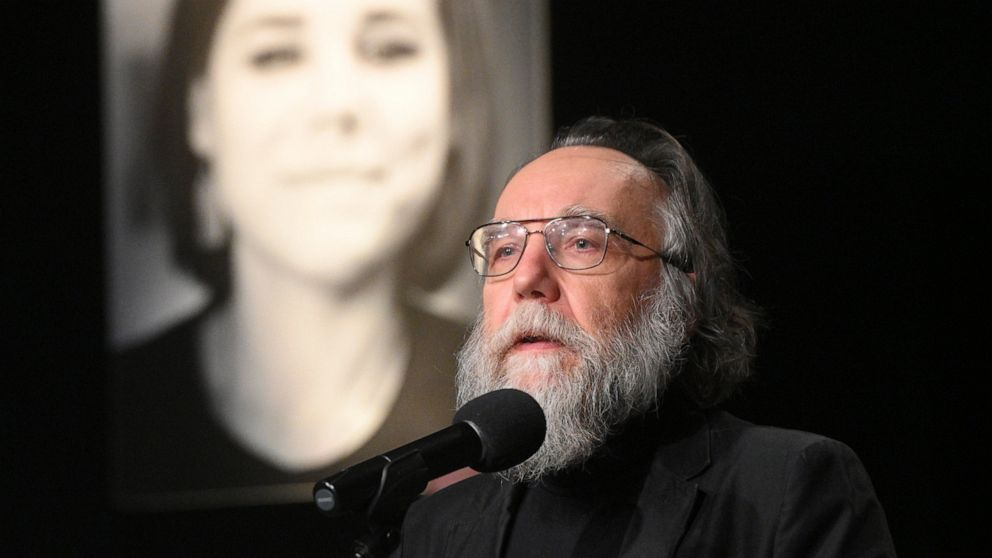
Alexander Dugin speaking at his daughter’s memorial service.
After Daria Dugina, daughter of Russian political philosopher Alexander Dugin, was killed via car-bomb in Moscow this summer, Russia accused Ukraine of sponsoring the murder, and the Ukrainian government denied involvement. Apparently Russia was right.
This week the New York Times reported that,according to unnamed US officials, “parts of the Ukrainian government” authorized the bombing, though whether President Zelensky himself OK’d it remains unclear.
Two questions arise:
1. Why did the Biden administration decide to leak this story? Consensus Twitter speculation is that the administration was sending some sort of message to the Zelensky administration. Like: “Hey, now that everyone’s talking about nuclear war, maybe you should cool it with the inflammatory and potentially escalatory special ops for a while?” The leak may even have been a pre-emptive strike against a specific Ukrainian special op the Biden administration had caught wind of. In any event, officials who leaked the story let it be known that the US had privately rebuked the Ukrainian government for the Dugina killing.
2. Why did the Ukrainian government sponsor this terrorist attack? Presumably the goal was the standard goal of terrorism: to terrify and intimidate. But what kinds of people would the Ukrainians have been trying to intimidate? What was the target audience? It isn’t clear whether the intention was to kill Dugina or her father or both, but for audience-targeting purposes it doesn’t matter, since both of them were vocal pro-war nationalists. So the message to Russian elites would have been: You’ll have a better chance of living another year if you don’t spout off about how Russia should intensify its war effort.
The odd thing about this motivation, though, is that there was obviously a good chance that the killing would contribute to the intensification of Russia’s war effort. That’s the consequence I fretted about in NZN right after the murder: “This could lead to escalation of the Ukraine war, since Russia will blame Ukraine for the murder,” thus “stoking a thirst for revenge and, in particular, inflaming Dugin’s already belligerent fan base.”
Did something like that happen? At least one expert says yes. A couple of weeks ago, before the revelation of Ukrainian complicity in the killing, the scholar Marlene Laruelle (who, as it happens, had appeared on the Nonzero Podcast in April) published a New York Times op-ed about the growing political pressure on Putin—from both anti-war and pro-war forces—as the Russian war effort floundered. Describing pressure from “the party of war,” she wrote:
Through the summer, the level of criticism was manageable for the regime. But things began to change in August, when Darya Dugina, the daughter of one of Russia’s best-known imperial ideologists, Alexander Dugin, was assassinated in Moscow. The perpetrators and purpose of the attack are unknown. But the effect was clear. By bringing the conflict into one of the capital’s fanciest neighborhoods, the murder confirmed the hawks’ dim view of the war effort. Since Ms. Dugina’s death, the party of war has been using her “martyrdom” to renew calls for a full-scale war in overtly eschatological tones.
The military reversal of recent weeks has played into their hands.
To be sure, that military reversal—the large-scale Russian retreat in mid-September—would likely have been enough to intensify the war effort, complete with the kind of mobilization Putin ordered, even if Daria Dugina had still been alive. Still, as Putin calibrates his policies and rhetoric—and makes such decisions as whether to use a nuclear weapon—he is navigating a political landscape whose pro-war faction has been empowered by Dugina’s murder.
In particular: Dugina’s father—who was never as influential in Russia as many in Ukraine and the West believed—now has a bigger platform and megaphone, and he is definitely fired up.
Indeed, his constituency is now powerful enough for Putin to have nodded to it in last week’s famously Manichaean speech about the threat the US-led West poses to Russia: “They see our thought and our philosophy as a direct threat. That is why they target our philosophers for assassination.” (Maybe this insinuation of US involvement in the murder is one reason the Biden administration chose to distance itself from it?)
There’s also this damage to the Ukrainian cause: Intentionally killing civilians is a war crime, and part of Ukraine’s international appeal rests on the perception that Russia commits war crimes but Ukraine doesn’t.
A word that is increasingly deployed as an argument stopper—in many realms, not just geopolitics—is “agency.” If you suggest that it was a mistake for George W. Bush (in defiance of warnings from European leaders and his own ambassador to Russia) to invite Ukraine to join NATO, you are denying Ukraine its “agency.” If you suggest that the US, which is giving massive and critical military support to Ukraine, should also encourage peace talks, or go even further and push for a particular kind of peace deal, you’re denying Ukraine its “agency.”
Whatever the Biden administration’s reason for publicizing Ukraine’s role in the very unwise murder of Daria Dugina, one effect may be the welcome one of suggesting that there’s such a thing as too much deference to Ukraine’s agency.
The details of the peace deal presented today by US special envoy Steve Witkoff are consistent with the report in the Financial Times discussed in my previous article and with Larry Sparano in the posted interview. Putin will halt the Russian advance prior to driving Ukrainian soldiers out of all of the territory that has been reincorporated into Russia. It appears to be the case that the borders between Russia and Ukraine will be the current front line, so Putin is withdrawing Russia’s claim to the Russian territories still under Ukrainian occupation.
Russia and the US seem near a Ukraine peace deal. Kyiv’s role may be moot.
President Donald Trump’s hopes of securing a quick Ukraine peace deal hang in the balance after Washington’s envoy, Steve Witkoff, held his fourth Kremlin meeting with Russian President Vladimir Putin Friday.