A Scottish university has urged its students to report “misinformation” after one of its academics was accused of spreading Russian propaganda.
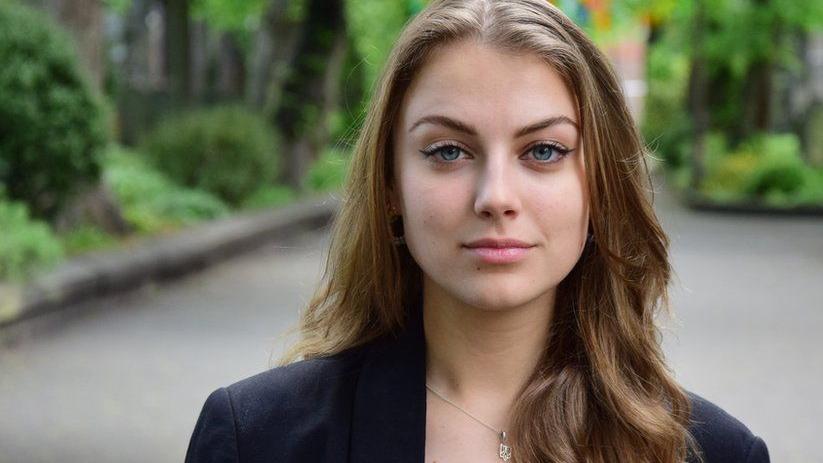
Kvitka Perehinets, a Ukrainian student at the university who has family members fighting in the war against Russia (KVITKA PEREHINETS)
Tim Hayward, professor of environmental theory at the University of Edinburgh, retweeted a Russian representative to the UN who claimed that reports the country had bombed a maternity hospital in Mariupol, western Ukraine, were “#fakenews”.
Kvitka Perehinets, a Ukrainian student at the university who has family members fighting in the war, told BBC Radio 4: “The moment we start to equate the two sides in the story is the moment we lose our humanity. The oppressor — in this case Russia — should not be given the same kind of platform as those who are being oppressed.”
In March, Hayward shared a link to an article questioning whether a Russian attack on a Mariupol theatre was “staged” and said: “What do we know of the reality?”
The article claimed the assault might have been a false-flag operation carried out by Ukrainians in an attempt to generate public outrage and provoke military intervention from western states.
It appeared on the news website The Grayzone, which has denied the Uighur genocide and has published articles in support of the Kremlin.
The university said it was committed to freedom of expression and making it a “safe space for staff and students to discuss controversial topics” and “different viewpoints”. It added: “We take a strong view, however, against the spread of misinformation, and take complaints of this nature seriously.” The university said it did not comment on individual members of staff.
Jamie Hepburn, Scotland’s higher and further education minister, said attempts to circulate Russian disinformation over Ukraine were “unacceptable”. He said universities were “solely responsible for internal institutional matters such as the conduct of staff”.
Hayward has spread pro-Assad conspiracy theories promoted by Russia that claimed video evidence of Syria using chemical weapons on its citizens was fabricated. He was a member of the Working Group on Syria, Propaganda and Media and used the hashtag #Syriahoax when discussing chemical attacks in the country.
Hayward said he updated his Twitter feed after learning that a maternity unit in Mariupol that was attacked did contain patients, but suggested it was “uncertain” if it was bombed by aircraft.
He told the BBC: “I stand by the statement that I appended to that tweet, which is that we should strive to hear both sides. Acquiring knowledge involves investigation, research and reasoning. If that is always going to be dismissed as disinformation I think it’s a very dangerous line to go down.”
Donald Trump Should Not Repeat Woodrow Wilson’s Failure
April 30th is an important date in American politics. This is the day 100 for the American President in the White House, and all attention will be on the reports of his achievements and failures. But nothing can be more critical than Peace…
○
6 mins read
A Holocaust perpetrator was just celebrated on US soil. I think I know why no one objected.
Russia’s invasion has made ordinarily outspoken critics of antisemitism wary of criticizing Ukrainian Nazi collaborators
○
1 min read
Qi Book Talk: The Culture of the Second Cold War by Richard Sakwa
Richard Sakwa has for many years been one of the most distinguished and insightful observers of relations between the West and Russia, and one of the leading critics of Western policy. In this talk with Anatol Lieven, director of the Eurasia program at the Quincy Institute, Sakwa discusses his book, The Culture of the Second Cold War (Anthem 2025). The book examines the cultural-political trends and inheritances that underlie the new version of a struggle that we thought we had put behind us in 1989. Sakwa describes both the continuities from the first Cold War and the ways in which new technologies have reshaped strategies and attitudes.