Erich Vad is an ex-brigadier general. From 2006 to 2013, he was the military policy advisor to German Chancellor Angela Merkel. He is one of the rare voices who spoke out publicly early on against arms deliveries to Ukraine in the absence of political strategy and diplomatic efforts. Even now he is speaking an uncomfortable truth.
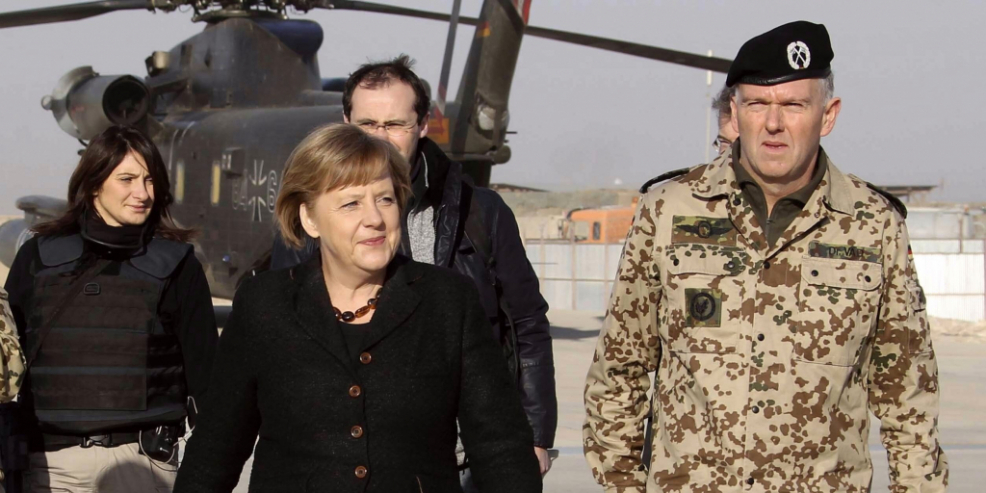
Chancellor Angela Merkel and Brigadier General Erich Vad in Kunduz in 2010.
Mr. Vad, what do you think of the delivery of the 40 martens to the Ukraine that Chancellor Scholz just announced? This is a military escalation, also in the perception of the Russians – even if the more than 40-year-old marten is not a silver bullet. We’re going down a slide. This could develop a momentum of its own that we can no longer control. Of course it was and is right to support the Ukraine and of course Putin’s attack does not comply with international law – but now the consequences must finally be considered!
And what could the consequences be? Do you want to achieve a willingness to negotiate with the deliveries of the tanks? Do you want to reconquer Donbass or Crimea? Or do you want to defeat Russia completely? There is no realistic end state definition. And without an overall political and strategic concept, arms deliveries are pure militarism.
What does that mean? We have a militarily operational stalemate, which we cannot solve militarily. Incidentally, this is also the opinion of the American Chief of Staff Mark Milley. He said that Ukraine’s military victory is not to be expected and that negotiations are the only possible way. Anything else is a senseless waste of human lives.
General Milley caused a lot of trouble in Washington with his statement and was also heavily criticized in public. He spoke an uncomfortable truth. A truth that, by the way, was hardly ever published in the German media. The interview with CNN’s Milley didn’t show up anywhere bigger, when he’s the chief of staff of our western powerhouse. What is going on in Ukraine is a war of attrition. And one with meanwhile almost 200,000 fallen and wounded soldiers on both sides, with 50,000 civilian dead and with millions of refugees. Milley drew a parallel to the First World War that couldn’t be more apt. During the First World War, the so-called ‘Blood Mill of Verdun’, which was conceived as a battle of attrition, led to the deaths of almost a million young French and Germans. They fell for nothing then. So the warring parties’ refusal to negotiate has led to millions of additional deaths. This strategy didn’t work militarily at the time – and it won’t work today either.
You too have been attacked for calling for negotiations. Yes, as did the Inspector General of the German Armed Forces, General Eberhard Zorn, who, like me, warned against overestimating the Ukrainians’ regionally limited offensives in the summer months. Military experts – who know what’s going on among the secret services, what it’s like on the ground and what war really means – are largely excluded from the discourse. They don’t fit in with media opinion-forming. We are largely experiencing a media synchronization that I have never experienced in the Federal Republic. This is pure opinion making. And not on behalf of the state, as is known from totalitarian regimes, but out of pure self-empowerment.
They are being attacked across the board by the media, from BILD to FAZ and Spiegel , and with them the 500,000 people who signed the open letter to the chancellor initiated by Alice Schwarzer . That’s the way it is. Fortunately, Alice Schwarzer has her own independent medium to be able to open this discourse at all. It probably wouldn’t have worked in the leading media. The majority of the population has been there for a long time and also according to the latest surveyagainst further arms deliveries. However, none of this is reported. There is largely no longer a fair, open discourse on the Ukraine war, and I find that very disturbing. That shows me how right Helmut Schmidt was. In a conversation with Chancellor Merkel, he said: Germany is and will remain an endangered nation.
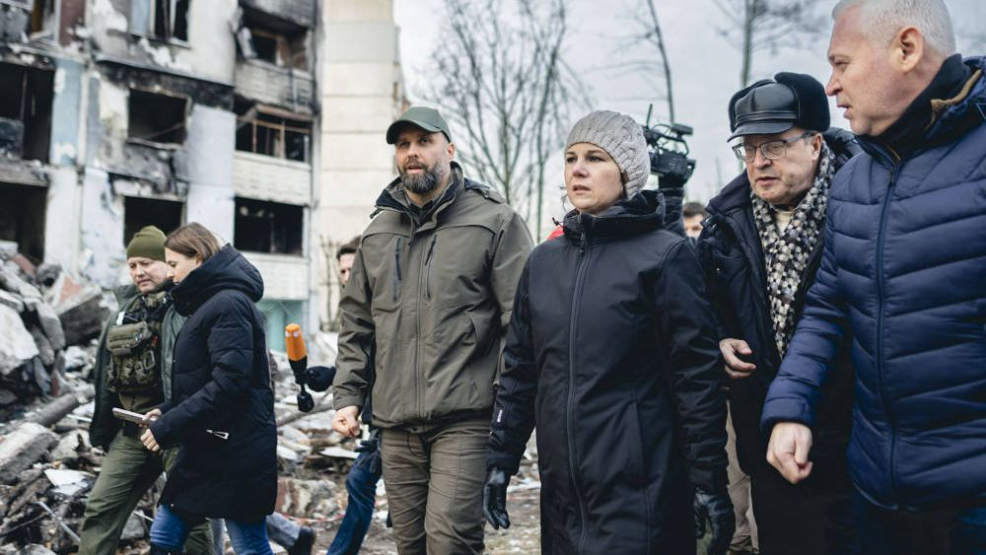
Foreign Minister Annalena Baerbock in Kharkiv. Xander Heinl/IMAGO
How do you assess the Foreign Minister’s policy? Military operations must always be coupled with attempts to bring about political solutions. The one-dimensionality of current foreign policy is hard to bear. She is very heavily focused on weapons. The main task of foreign policy is and remains diplomacy, reconciliation of interests, understanding and conflict management. I miss that here. I’m glad that we finally have a foreign minister in Germany, but it’s not enough to just use war rhetoric and walk around in Kyiv or Donbass with a helmet and flak jacket. This is too little.
Baerbock is a member of the Greens, the former peace party. I don’t understand the mutation of the Greens from a pacifist to a war party. I myself don’t know of any Greens who would even have done military service. For me, Anton Hofreiter is the best example of this double standard. Antje Vollmer, on the other hand, who I would count among the ‘original’ Greens, calls a spade a spade. And the fact that a single party has so much political influence that it can maneuver us into a war is very worrying.
If Chancellor Scholz had taken you over from his predecessor and you were still the Chancellor’s military adviser, what advice would you have given him in February 2022? I would have advised him to support Ukraine militarily, but in a measured and prudent manner in order to avoid slide effects into a warring party. And I would have advised him to influence our most important political ally, the USA. Because the key to solving the war lies in Washington and Moscow. I liked the Chancellor’s course in recent months. But the Greens, FDP and the bourgeois opposition are putting so much pressure – flanked by largely unanimous media music – that the chancellor can hardly absorb it.
And what if the Leopard is also delivered? Then the question arises again as to what should happen with the deliveries of the tanks at all. To take over the Crimea or the Donbass, the martens and leopards are not enough. In eastern Ukraine, in the Bakhmut area, the Russians are clearly advancing. They will probably have completely conquered the Donbass before long. One only has to consider the numerical superiority of the Russians over Ukraine. Russia can mobilize up to two million reservists. The West can send 100 martens and 100 leopards there, they don’t change anything in the overall military situation. And the all-important question is how to end such a conflict with a warlike nuclear power – mind you, the most powerful nuclear power in the world! – wants to survive without going into a third world war.
The argument is that Putin doesn’t want to negotiate and that he needs to be put in his place to stop him raging in Europe. It is true that the Russians must be signaled: up to here and no further! Such a war of aggression must not set a precedent. It is therefore right that NATO is increasing its military presence in the east and that Germany is involved. But the fact that Putin does not want to negotiate is unbelievable. Both the Russians and the Ukrainians were ready for a peace agreement at the beginning of the war in late March, early April 2022. Then nothing came of it. Finally, during the war, the grain agreement was finally negotiated by the Russians and Ukrainians with the involvement of the United Nations.
Now the death goes on. You can continue to wear down the Russians, which means hundreds of thousands of deaths, but on both sides. And it means further destruction of Ukraine. What is left of this country? It will be leveled to the ground. Ultimately, that is no longer an option for Ukraine either. The key to solving the conflict does not lie in Kyiv, nor does it lie in Berlin, Brussels or Paris, it lies in Washington and Moscow. It’s ridiculous to say that Ukraine has to decide that.
With this interpretation, one is quickly considered a conspiracy theorist in Germany… I myself am a convinced transatlantic. I’ll tell you honestly, if in doubt, I’d rather live under an American hegemony than under a Russian or Chinese one. This war was initially only a domestic political conflict in Ukraine. It started in 2014 between the Russian-speaking ethnic groups and the Ukrainians themselves. So it was a civil war. Now, after the invasion of Russia, it has become an interstate war between Ukraine and Russia. It is also a struggle for Ukraine’s independence and its territorial integrity. Thats all right. But it’s not the whole truth. It’s also a proxy war between the US and Russia, and it’s about very specific geopolitical interests in the Black Sea region.
That would be? The Black Sea region is as important to the Russians and their Black Sea Fleet as the Caribbean or the Panama region is to the United States. As important as the South China Sea and Taiwan to China. As important as Turkey’s protection zone, which they established against the Kurds in violation of international law. Against this background and for strategic reasons, the Russians cannot get out of there either. Quite apart from the fact that in a referendum in Crimea the population would certainly vote for Russia.
So how is this going to continue? If the Russians were forced to pull out of the Black Sea region by massive Western intervention, they would certainly resort to nuclear weapons before stepping off the world stage. I find it naïve to believe that a nuclear strike by Russia would never happen. According to the motto, ‘They’re just bluffing’.
But what could be the solution? One should simply ask the people in the region, i.e. in Donbass and Crimea, who they want to belong to. One would have to restore Ukraine’s territorial integrity, with certain Western guarantees. And the Russians also need such a security guarantee. So no NATO membership for Ukraine. Since the Bucharest summit in 2008, it has been clear that this is the Russian red line.
And what do you think Germany can do? We must dose our military support in such a way that we do not slide into a Third World War. None of those who went to war with such enthusiasm in 1914 thought afterwards that it was the right thing to do. If the goal is an independent Ukraine, one must also ask oneself what a European order that includes Russia should look like. Russia will not simply disappear from the map. We must avoid driving the Russians into the arms of the Chinese, thereby shifting the multipolar order to our disadvantage. We also need Russia as the leading power in a multinational state in order to avoid flaring up fighting and wars. And to be honest, I don’t see Ukraine becoming a member of the EU and certainly not a member of NATO. In Ukraine, as in Russia, we have high levels of corruption and rule by oligarchs. What we in Turkey – rightly – denounce in terms of the rule of law, we also have the problem in Ukraine.
What do you think, Mr. Vad, what awaits us in 2023? A broader front for peace must be built in Washington. And this senseless activism in German politics must finally come to an end. Otherwise we wake up one morning and we’re in the middle of World War III.
The details of the peace deal presented today by US special envoy Steve Witkoff are consistent with the report in the Financial Times discussed in my previous article and with Larry Sparano in the posted interview. Putin will halt the Russian advance prior to driving Ukrainian soldiers out of all of the territory that has been reincorporated into Russia. It appears to be the case that the borders between Russia and Ukraine will be the current front line, so Putin is withdrawing Russia’s claim to the Russian territories still under Ukrainian occupation.
Russia and the US seem near a Ukraine peace deal. Kyiv’s role may be moot.
President Donald Trump’s hopes of securing a quick Ukraine peace deal hang in the balance after Washington’s envoy, Steve Witkoff, held his fourth Kremlin meeting with Russian President Vladimir Putin Friday.