BRUSSELS, Jan 23 (Reuters) - The European Union is unlikely to confiscate Russian central bank assets frozen in Europe, despite G7 plans to discuss the legality of such a move at a meeting in February, senior EU officials said.
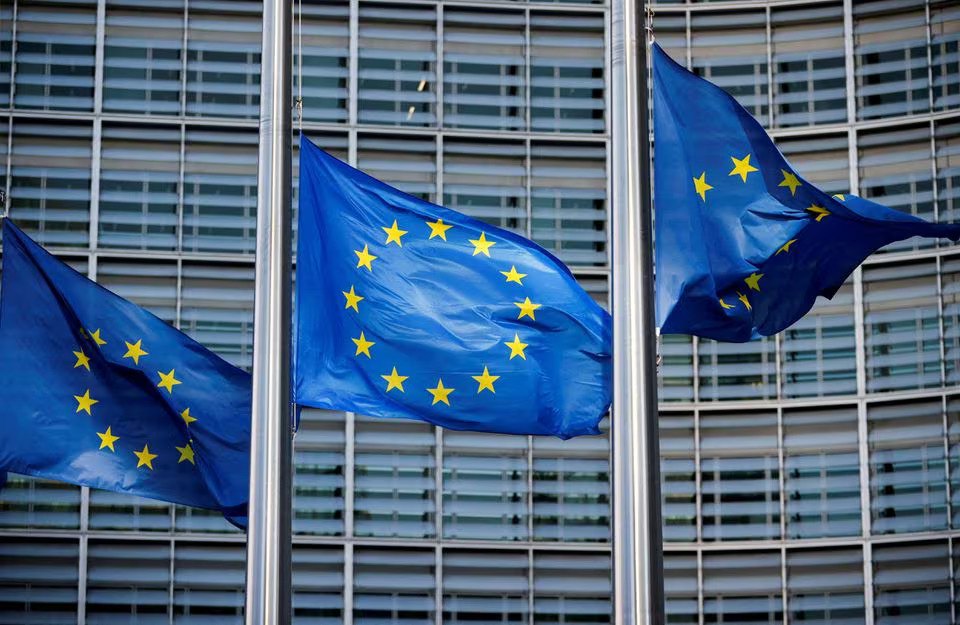
European Union flags fly outside the European Commission headquarters in Brussels, Belgium, March 1, 2023.REUTERS/Johanna Geron/File Photo
The EU, United States, Japan and Canada froze some $300 billion of Russian central bank assets in 2022 when Russia invaded Ukraine. Some $200 billion of that is held in Europe, mainly in the Belgian clearing house Euroclear.
The discussion comes as U.S. President Joe Biden faces Republican opposition to his request for another $61 billion in aid to Ukraine.
The EU is also struggling to agree on a 50 billion euro ($54.36 billion) aid package for Ukraine until 2027 because of opposition from Hungary, whose Prime Minister Viktor Orban has close ties with Moscow.
Confiscating the Russian assets and handing them over to Kyiv would ease the pressure on the West to finance Ukraine’s war effort, but European officials dismiss it as too legally risky.
“Confiscation of the capital of the Russian assets is not going to happen. There is no agreement on this among EU member states,” one senior official with insight into talks on the matter said, speaking on the condition of anonymity.
In an interview with Reuters, Luxembourg Foreign Minster Xavier Bettel said he was “very cautious” about seizing the assets.
“Imagine if we decide politically to give billions to Ukraine. And in six months we have a judicial decision saying we are not allowed to give it to them. Who will pay will then?,” Bettel said.
IMPACT ON EURO
European officials are concerned not only with the legality of such an unprecedented confiscation of sovereign assets, but also with the potential consequences for the euro currency; investors might pull out of euro assets out of concern their money might one day be seized too.
In addition, Moscow has pledged it would retaliate by confiscating Western assets in Russia, which some reports put at $288 billion.
Belgian Finance Minister Vincent van Peteghem, whose country holds the rotating presidency of the EU until July, is very reticent on the possibility of confiscating the Russian assets.
“We need to be very prudent with that proposition. I think that it’s important that what can come on the table should be legally sound and we should avoid any impact on financial stability,” he told reporters on Tuesday.
Belgium’s Euroclear has “substantial” amounts of assets in Russia, officials said, which could be seized by Moscow in what could pose a financial stability risk to the clearing house, with major repercussions.
“The EU cannot bail out Euroclear,” another senior official said. “Euroclear manages trillions and its bankruptcy would be far more than the budget of the EU. We have to balance risk and profit,” the official said.
Instead of confiscating the Russian assets, EU governments are likely to back a European Commission proposal from December to take over the only the profits generated by the assets, leaving the principal untouched.
This could generate an estimated 15-17 billion euros over four years that could be transferred to Ukraine, officials said.
($1 = 0.9199 euros)
Additional reporting by Gabriela Baczynska; Reporting by Jan Strupczewski and Julia Payne; Editing by Christina Fincher
Donald Trump Should Not Repeat Woodrow Wilson’s Failure
April 30th is an important date in American politics. This is the day 100 for the American President in the White House, and all attention will be on the reports of his achievements and failures. But nothing can be more critical than Peace…
○
6 mins read
A Holocaust perpetrator was just celebrated on US soil. I think I know why no one objected.
Russia’s invasion has made ordinarily outspoken critics of antisemitism wary of criticizing Ukrainian Nazi collaborators
○
1 min read
Qi Book Talk: The Culture of the Second Cold War by Richard Sakwa
Richard Sakwa has for many years been one of the most distinguished and insightful observers of relations between the West and Russia, and one of the leading critics of Western policy. In this talk with Anatol Lieven, director of the Eurasia program at the Quincy Institute, Sakwa discusses his book, The Culture of the Second Cold War (Anthem 2025). The book examines the cultural-political trends and inheritances that underlie the new version of a struggle that we thought we had put behind us in 1989. Sakwa describes both the continuities from the first Cold War and the ways in which new technologies have reshaped strategies and attitudes.