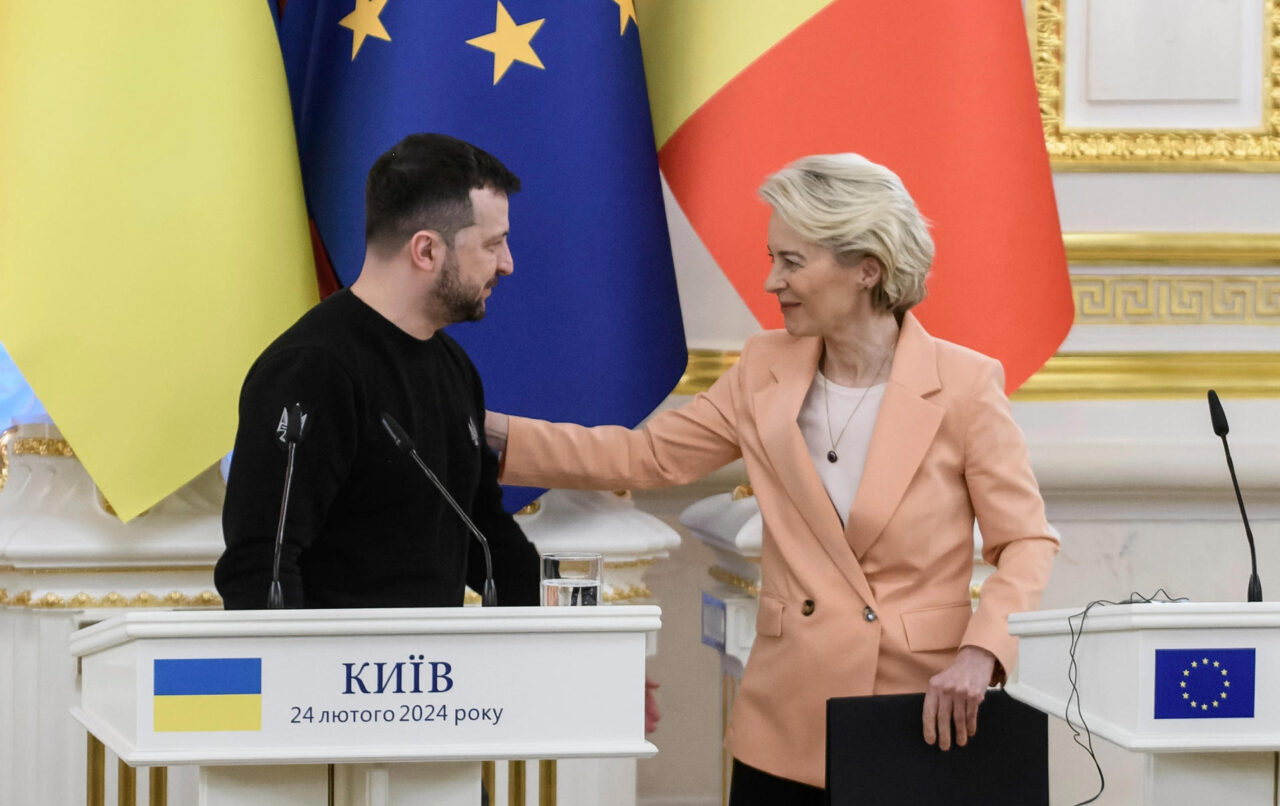
The European Parliament re-elected Ursula von der Leyen as president of the Commission, cementing the EU's maximalist aims
On July 18, the European Parliament elected German conservative Ursula von der Leyen to a second five-year term as president of the European Commission.
The only candidate running, she managed to cobble together a heterogeneous ad hoc coalition consisting of her fellow center-right Christian Democrats, center-left socialists, liberals and Greens. Despite the important gains made by the right-wing national-conservative forces in the EP elections in June largely at the expense of the liberals and the Greens, the parliamentary majority chose continuity in von der Leyen.
In terms of foreign policy, this means doubling down on the “centrist” (read neoconservative-liberal) consensus on the war in Ukraine while isolating the war skeptics on the right and the far left. The first session of the newly elected Parliament has drawn clear lines and established what appears to be a clear-cut division for the next five years.
First, the majority rejected a request by the far-right Patriots for Europe, led by France’s National Rally and Hungarian Prime Minister Viktor Orban’s Fidesz party to place on the plenary agenda a debate on last weekend’s assassination attempt on former U.S. President Donald Trump, currently running to regain the office as the Republican nominee in the November election.
The Patriotsare the main national-conservative group in the chamber and the third largest faction overall, behind only von der Leyen’s center-right European People’s Party (EPP) and the socialists. When the request was, predictably, rejected by the centrist parties (119 votes in favor, 337 against), the Patriots accused them of violating democratic norms and laying the groundwork for politically motivated violence against opponents.
To highlight the Patriots’ isolation, the main center-right group, the EPP, counterattacked by introducing a resolution on Ukraine. They were joined by other centrists — socialists, liberals, Greens — and the pro-Ukraine right from the European Conservatives and Reformists (ECR) group, the assembly’s fourth largest. The five political groups tabled a conventionally hardline joint text, demanding, among other things, the removal of any restrictions on the use of Western weapons systems delivered to Ukraine against military targets on Russian territory.
The lawmakers also “reiterated their belief that Ukraine is on an irreversible path to NATO” even though the European Parliament has no say over NATO and a number of the EU members (Austria, Ireland, Malta and Cyprus) are not members of NATO and have not shown, to date, any inclination to join it.
Reflecting the Brussels meltdown over Viktor Orban’s diplomacy that took him in recent weeks to Kyiv, Moscow, Beijing, Washington, and Trump’s Mar-a-Lago in what he called a “peace mission,” the resolution made a point of condemning him for “violating common EU positions” and failing to coordinate with other member states and EU institutions.
Lawmakers demanded “repercussions for Hungary.” While these repercussions are already being set in motion by attempts to boycott Hungary’s rotating EU presidency, no interest has been shown in engaging with the substance of Orban’s comments which he articulated in a letter to the president of the EU Council Charles Michel.
Given the degree to which Orban chose to highlight what, to be meaningful, should have been a highly sensitive and discreet diplomatic initiative, there may be reasonable doubts about its effectiveness. The problem, however, is that he is the only EU leader left who enjoys open channels of communications with the Kremlin, while the mainstream, “respectable” European leaders mostly trade in maximalist rhetoric about Ukrainian victory and Russian defeat without defining those terms, much less offering credible paths to their achievement.
Eldar Mamedov is a Brussels-based foreign policy expert