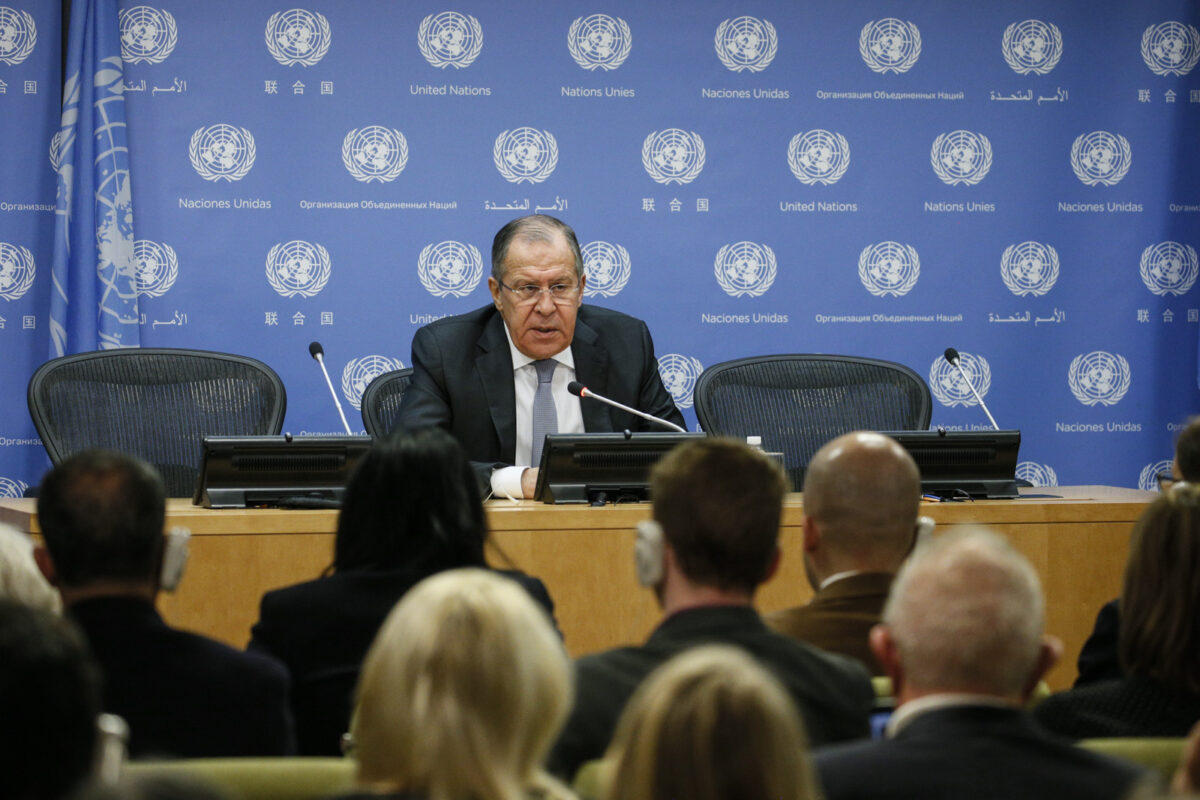
Foreign Minister Sergey Lavrov’s answers to media questions at a news conference following talks on security guarantees with US Secretary of State Antony Blinken, Geneva, January 21, 2022.
Question: The meeting lasted for only an hour and a half as it had been planned. Is that a bad sign? Does this mean you had nothing to discuss?
Sergey Lavrov: Punctuality cannot be a bad sign in principle. We had planned this meeting to last an hour and a half. We knew, more or less, what we were going to discuss. There was no need to repeat what was said at the Russian-US talks in Geneva on January 10 of this year and at the meeting of the Russia-NATO Council on January 12 of this year.
We heard the first US response (verbal so far) to what our deputies discussed in these two formats. As US representatives requested when they suggested holding this meeting, the response was preliminary. We were told about this beforehand. It was accompanied by follow-up questions for us, answers to which would help Washington (as Antony Blinken told me over the phone) to prepare a written response to our written drafts of a treaty with the US and an agreement with NATO. All this happened today.
Question: The talks took three years when we had the Helsinki agreements in the 1970s. We offered a European security treaty in 2009 but it ran aground. Do you get the sense, as mentioned immediately after the announcement of our plan on red lines, that the US will be just taking round and just drag it out.
Sergey Lavrov: Our experience of working with our Western colleagues on European security issues contains abundant examples when promises were made but not kept. I have already quoted the words said by the then US President Gerald Ford immediately after the signing of the Helsinki Final Act in 1975. Celebrating the occasion, he said: “History will judge this Conference not by what we say here today, but by what we do tomorrow – not by the promises we make, but by the promises we keep.” Our American and West European colleagues and NATO members are not very good at this. Today, we heard some of the same arguments about the freedom to choose alliances and military unions. We quoted some documents in which this freedom was defined by the need to avoid any steps that could strengthen the security of one state at the expense of another. We asked Antony Blinken and his team to explain how they interpret this part of the commitments that the OSCE adopted at the political level and repeatedly affirmed.
This was an interim meeting. US Secretary of State Antony Blinken said that he was satisfied with the exchange of views, which would help them next week (it was emphasised several times) to present a written response to us.
Question: Yesterday the US Department of State released information to the effect that Ukraine poses no threats to Russia. It says RT is responsible for the propaganda of neo-Nazi and right-wing groups in Ukraine. Human Rights Watch also wrote about that. What is the Russian Foreign Ministry’s response to the US State Department’s statement? In what way did increased weapons supplies to Ukraine from the US and the UK impact the talks?
Sergey Lavrov: You have already said everything for me. The papers the State Department prepared specially for today’s meeting are unreadable. We have a special unit headed by the Ministry’s official which is supposed to study all that. The response has already been made. I don’t think any more comments are needed. It will suffice to look it through, open to any page and realise that nothing written withstands critical scrutiny. In most cases they are pure lies.
Regarding threats. We discussed Ukraine. Our US colleagues once again wanted to give top priority to the issues on the Russia-Ukraine border. They tried to make everything depend on the need for “de-escalation.” This has already become a mantra. We finished by agreeing that next week we will be given written answers to all our proposals.
You mentioned the statement that Ukraine poses no threat to Russia. I will remind those who analyse our public statements and positions: Russia has never, nowhere, not once threatened the Ukrainian people through its official representatives. Meanwhile President Zelensky who has been taken under wing by our Western colleagues who encourage all his shenanigans, said publicly that if some Ukrainian citizens feel they are Russian, they should go back to Russia. He called those in Donbass, who are standing up to the state terrorism of the Kiev regime, species, not people. This shows who is threatening whom, and it is hard to say what these threats might lead to.
We do not exclude that all that hysteria whipped up by our Western colleagues is intended to at least distract from the Kiev regime’s determination to totally sabotage the Minsk agreements, if not to provoke Ukraine to undertake some military actions in Donbass. I cannot think of any other explanation.
We have answered all the questions asked. Our Western colleagues admit that this is Russian territory, however, “we have assembled too many troops.” Whereas in the same breath they say that whatever the Americans do with their troops in Europe is none of our business. Antony Blinken and I spoke frankly about this. He agreed that the dialogue should be more substantive. I hope cooler heads will prevail, although there are no guarantees.
Question: Was there any headway made on any of the points that the Russians have been raising over the past couple of weeks that you said were very key to your security concerns? And also, did you come out of this meeting satisfied, disappointed? How would you summarise it? And then, first and foremost, how big do you think right now the threat of war is in Europe through some sort of miscalculation, with obviously such a large force gathering around Ukraine? And finally, one question that a lot of people I think are asking internationally is, why is Russia doing this now? Why do you feel that you need to make these troop deployments now, when really, the security posture of the US and NATO really hasn’t changed over the past couple of years?
Sergey Lavrov: The US State Department should analyse CNN’s methods of work to determine whether it presents information fairly and if its facts are accurate. You are claiming that Russia is planning to attack Ukraine. We have repeatedly made it clear that this is not the case. When you assert that this is going to happen, your next question is why now? When should we not attack? It’s a strange question.
We reiterated our principled approach regarding the need to put an end to NATO’s endless eastward expansion. Secretary of State Antony Blinken once again stated his position regarding the right to choose alliances. I asked him how the United States was going to make good on its commitment, which, along with the right to choose alliances, was endorsed at the highest level at the OSCE: not to enhance the security of anyone at the expense of the security of others. He promised to clarify the United States’ stance on the fulfilment of this commitment. This is not the end of our dialogue. As Secretary Blinken underscored several times, we will be given a written response next week.
Many are asking why Russia has adopted such a principled position on the non-expansion of NATO. It’s because this bloc was created against the Soviet Union and continues to “work” against the Russian Federation. Moreover, this approach is enshrined in its doctrinal documents. When Eastern Europeans, above all Poland and the Baltic countries, were eagerly seeking to join NATO, we warned the West that accepting them as members would be a mistake as this move will in no way enhance the Alliance’s security but will instead fuel extremist sentiments. They repeatedly assured us that the opposite would happen, and after they are accepted, the holdover phobias dating back to the Soviet times will vanish and these countries will become good and peaceful neighbours. Things turned out exactly the other way round. These countries, primarily the Baltic countries and Poland, are at the helm of the Russophobic minority that runs the show in NATO and the EU, which they force to continue the dead-end anti-Russian policy on all matters without exception. I urge the CNN to be more careful about the facts.
Question: In his opening remarks today, Secretary Blinken issued threats and said that there would be a response in case of an aggression against Ukraine. There will be a written response next week. Is its tone already clear or am I mistaken here? What are we going to do next?
Sergey Lavrov: Today, our American colleagues once again tried to prioritise Ukraine in this entire process. I had a sense that in the end, following our clarifications, they (with their “concerns” still in place) nevertheless came to realise that they needed to concentrate on the content of our proposals and promised to provide us with a written response to our proposals next week. I’m sure that, one way or another, Ukraine will be part of it. I have not heard a single argument today that would support the US position on the developments on the Russian-Ukrainian border. All they have is “concerns.”
Our concerns are not about imaginary threats, but actual facts that no one is hiding with Ukraine being pumped up with weapons and hundreds of Western military instructors being sent to that country. Also, the EU, fearing to fall behind NATO, wants to create its own military training mission in Ukraine. This will be a rather interesting turn in EU’s “ambitions,” which, apparently, wants to get back in the picture, because it hasn’t been seen much at serious talks recently.
We believe that the “Ukrainian issue” needs close attention, but the entire problem of European security architecture should not be reduced to Ukraine, either. With regard to Ukraine, Secretary Blinken reaffirmed the fact that President Biden spoke about the United States’ willingness to assist in the implementation of the Minsk Agreements. I urged him once again to use their decisive influence with the Kiev regime in order to talk sense into them so that they stop sabotaging this critically important document, which is designed to put an end to the internal Ukrainian conflict.