After Biden campaign officials coordinated a letter signed by 51 former intelligence officers casting doubt about the authenticity of Hunter Biden’s laptop before the 2020 presidential election, several signatories ended up with roles in the president’s administration.
Former Deputy Director of the CIA Michael Morrell testified to the House Judiciary Committee that then-Biden senior adviser and current Secretary of State Tony Blinken contacted him and “triggered” the creation of the letter. Former CIA chief of staff Jeremy Bash, who signed the letter, put Morrell in touch with Biden campaign Chairman Steve Richetti, who thanked him for orchestrating it; Biden later appointed Bash to the President’s Intelligence Advisory Board in 2022.
Bash was not the only signatory who received a role in the Biden administration. Biden also appointed Russell Travers as Deputy Homeland Security Advisor from January 2021 to October 2021 and Nicholas Rasmussen as Counterterrorism Coordinator for the Department of Homeland Security (DHS) in November.
While not an administration position, another signatory, David Buckley, was staff director of the Select Committee to Investigate the January 6th Attack on the United States Capitol.
Morrell did not intend to write the statement in the letter that the laptop was likely Russian disinformation until Blinken’s call, he told the House Judiciary Committee. Richetti also called Morrell following the final presidential debate on Oct. 22, 2020, when Biden cited the letter to cast doubt on the New York Post’s reporting regarding the contents of his son’s laptop revealing foreign business dealings.
“There were two intents,” Morrell said, discussing the letter. “One intent was to share our concern with the American people that the Russians were playing on this issue; and, two, it was [to] help Vice President Biden,” he said, disclosing he wanted Biden to win the election.
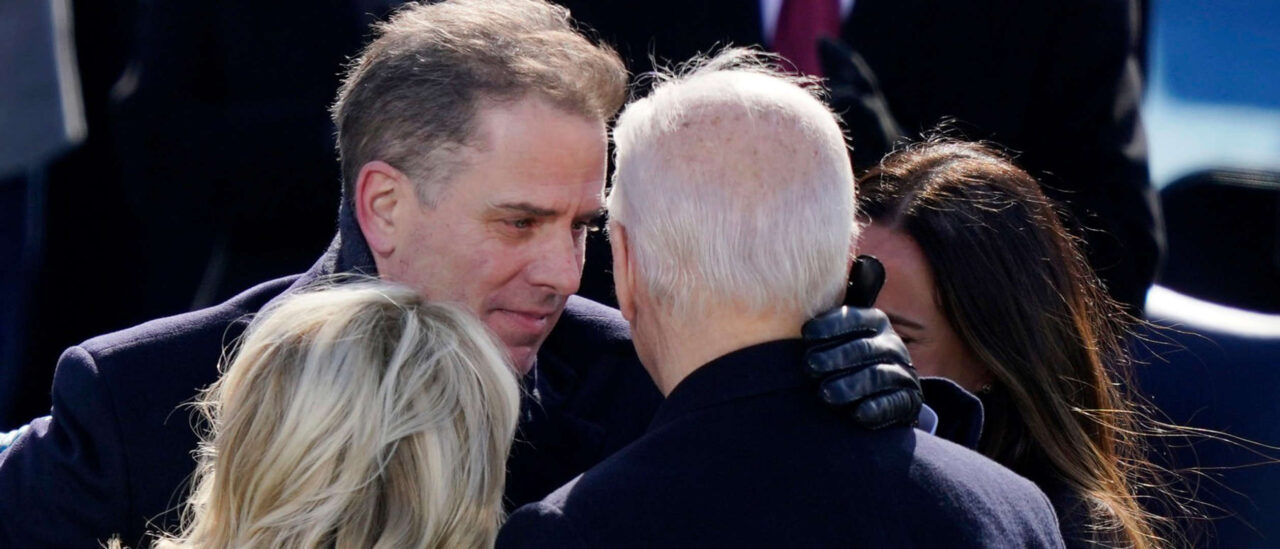
DUBLIN, IRELAND – APRIL 14: In this handout image provided by the Irish Government, US President Joe Biden departs Dublin Airport on Air Force One with his sister Valerie and son Hunter on April 14, 2023 in Dublin, Ireland. (Photo by Julien Behal/Irish Government via Getty Images)
The New York Post first reported Hunter Biden’s laptop contents on Oct. 14, 2020, and Twitter quickly censored it. The former intelligence officials signed and released the letter five days later, stating the laptop story had “all the classic earmarks of a Russian information operation.”
“All of us figured that a significant portion of that content had to be real to make any Russian disinformation credible,” Douglas Wise, a former Defense Intelligence Agency deputy and signatory of the letter, told The Australian.
Signatories Stephen Slick, Michael Hayden and Mike Vickers all signed onto another letter released on Aug. 20, 2020, consisting of former Republican national security officials endorsing Biden for president and calling then-President Donald Trump “dangerously unfit” for another term in office.
The Daily Caller News Foundation verified the authenticity of the contents of Hunter Biden’s laptop in October 2020.
Bash, Rasmussen and Blinken did not respond to the DCNF’s request for comment.
DHS and the White House did not immediately respond to DCNF’s request for comment.
All content created by the Daily Caller News Foundation, an independent and nonpartisan newswire service, is available without charge to any legitimate news publisher that can provide a large audience. All republished articles must include our logo, our reporter’s byline and their DCNF affiliation. For any questions about our guidelines or partnering with us, please contact licensing@dailycallernewsfoundation.org.
Correction: This article originally stated Rodney Snyder, a signatory of the letter calling the Hunter Biden laptop story Russian disinformation, was later appointed to the Environmental Protection Agency. A different individual of the same name was appointed to the EPA. We regret the error.
Donald Trump Should Not Repeat Woodrow Wilson’s Failure
April 30th is an important date in American politics. This is the day 100 for the American President in the White House, and all attention will be on the reports of his achievements and failures. But nothing can be more critical than Peace…
○
6 mins read
A Holocaust perpetrator was just celebrated on US soil. I think I know why no one objected.
Russia’s invasion has made ordinarily outspoken critics of antisemitism wary of criticizing Ukrainian Nazi collaborators
○
1 min read
Qi Book Talk: The Culture of the Second Cold War by Richard Sakwa
Richard Sakwa has for many years been one of the most distinguished and insightful observers of relations between the West and Russia, and one of the leading critics of Western policy. In this talk with Anatol Lieven, director of the Eurasia program at the Quincy Institute, Sakwa discusses his book, The Culture of the Second Cold War (Anthem 2025). The book examines the cultural-political trends and inheritances that underlie the new version of a struggle that we thought we had put behind us in 1989. Sakwa describes both the continuities from the first Cold War and the ways in which new technologies have reshaped strategies and attitudes.