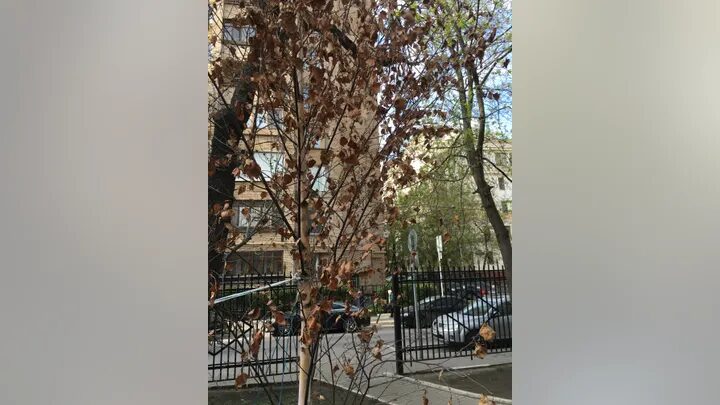
Its leaves are brittle and brown, but the birch tree, recently planted in a small Moscow park as a hopeful symbol of enduring friendship between Russia and the United States, will grow green and strong again if Edward Lozansky is to realize his lifelong mission.
The birch tree planted by Edward Lozansky. (Amy Kellogg)
The Russian nuclear physicist fled the Soviet Union in the 1980s, under fire for his dissident views. He found a home in the United States, but returned to his homeland after the fall of the USSR. Now running the American University in Moscow, he told Fox News the birch tree he planted is clinging to life just as the geopolitical relationship it represents.
“It’s my dream,” he said. “I think the two countries can be allies, because together, we can do many things. Stepping on each other’s toes won’t be good for anyone.”
Edward Lozansky stands with a plaque. (Amy Kellogg)
Lozansky pointed to the support provided by Russia after 9/11, when Moscow helped facilitate transit of material for U.S. forces in Afghanistan, as an example of Russian cooperation. As the political relationship between America and Russia now founders, Lozansky, still a U.S. citizen, works behind the scenes, organizing scientific and cultural exchanges between the two countries.
Meanwhile, people in Moscow say anti-Americanism is at an all-time high, worse even than it was back in Soviet days. A recent poll by the Levada Center in Moscow, which is as close as there is to an independent pollster, found 70 percent of Russians have a negative view of the United States.
“It looks like anti-Americanism is a newly found synonym for Russian patriotism,” said Sergey Strokan, of Kommersant newspaper. “To put it bluntly, to be a patriot means to be anti-American and if you are questioning anti-Americanism then you will be asked if you are a traitor or an agent of influence.”
Strokan, however, does believe the advent of a new U.S. administration will shake things up. He says Russian President Vladimir Putin has indicated he is ready to work more closely with the United States. And Russians have seized upon presidential candidate Donald Trump’s recent comments about seeking to explore possibilities to improve bilateral relations.
Conventional wisdom in Moscow holds that Putin prefers Trump over other candidates for the White House. But, Strokan added, the Russian president could also reset relations with Hillary Clinton.
“The good thing is, she knows President Putin,” he said. “She doesn’t like him, but she respects him obviously, and she is strong enough, and those are qualities that President Putin would appreciate.”
Others are more skeptical about the bigger picture.
“Putin needs America as a bad guy and he needs to be the person who stands up to the enemy,” said Moscow-based American journalist Michael Bohm.
Russian tanks are prepped to take part in a World War II victory parade. (Amy Kellogg)
Bohm has carved out a niche for himself in Moscow as the lone voice defending America on largely state-controlled Russian TV. Most Americans shun the opportunity to appear on Russian talk shows, intimidated by the firing line they would face. But Bohm takes them on with gusto and fervor, saying, if even 10 percent of what he wants to say makes it onto the airwaves, it is a victory. He describes Russian talk shows as “Jerry Springer meets Meet the Press.”
Bohm finds the exercise exhausting, but, having lived in Moscow for nearly two decades, he has a deep affection for the people and the culture, and while Russians generally don’t like what he has to say, he told Fox News, they respect that he is trying to explain a position. On a personal level, he said, they treat him very warmly.
Meanwhile, Putin’s support, by all accounts, is at an all-time high. As Russia’s biggest patriotic holiday, Victory Day, the celebration of the end of World War II, approaches, the streets are clean and the mood is positive despite economic woes. Posters celebrating victory adorn the streets and nationalistic ribbons flutter on the rear-view mirrors of cars, and people generally downplay the effect that sanctions are having on their country.
As the bloody civil war grinds on in Syria and allegations mount that Russia has caused countless civilian casualties, the Russian press portrays Moscow as the peacemaker. While the U.S. and Russia are talking about how to bring a real peace to the ruptured country, they still seem to be working at cross-purposes.
Lozansky has also placed another symbolic memorial in that little garden next to the struggling birch. It is a bronze plaque depicting the historic handshake between American and Soviet troops across Germany’s Elbe River towards the end of World War II.
“The Elbe River is a perfect example,” he said. “We have an enemy, such a powerful enemy as Nazi Germany, and if we can work together, then we can achieve victory in a much faster way.”
Remembering Edward Lozansky, Towering Prophet of Sanity, Decency and Peace
Soviet and American physicist and political figure Edward Lozansky dies in Moscow, on April 30, 2025.
Edward Dmitrievich Lozansky was born in Kiev on February 10, 1941. He graduated from the Kurchatov Institute of Atomic Energy with a degree in theoretical nuclear physics. He was a researcher at the Kurchatov Institute of Atomic Energy and the Joint Institute for Nuclear Research in Dubna. At the same time, he taught at the Malinovsky Armored Forces Academy.
In 1976, he moved to the United States, became a US citizen, and lived in Washington, DC. In 1990, he founded the American University in Moscow (now Moscow International University).
In recent years, he actively participated in the work of the Assembly of the Peoples of Eurasia and Africa and was the US moderator of the international public forum “The Spirit of the Elbe: A Bridge of Trust, Friendship, and Cooperation,” which was held with great success on April 15, 2025. A word of remembrance from Martin Sieff, joined by the entire editorial staff of the Pluralia project.
○
2 mins read
Open Appeal to Presidents Trump and Putin
We kindly invite you to review and sign the Open Appeal to President of the United States Donald Trump and President of Russia Vladimir Putin
○
1 min read
International Forum “Spirit of the Elbe: A Bridge of Trust, Friendship, and Cooperation”
The organizers of the International Forum “Spirit of the Elbe: A Bridge of Trust, Friendship, and Cooperation” invite media, public figures, and representatives of culture, science, and business to participate in a landmark event taking place on April 15, 2025. The Forum will be held in a hybrid format: in-person at the Conference Hall of the Assembly of the Peoples of Eurasia in Moscow and via Zoom conference (up to 200 participants, approximately evenly split between Russia and the USA). The event begins at 5:00 PM Moscow time (10:00 AM Washington, D.C. time).