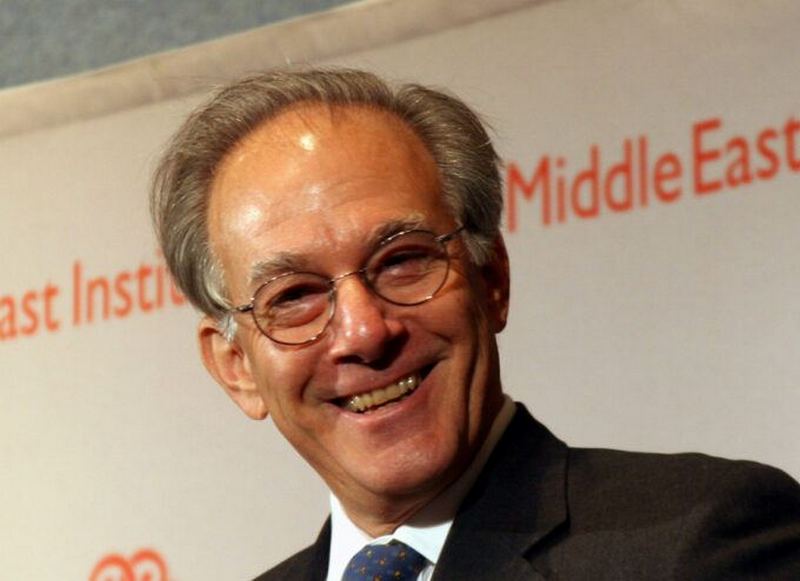
The Washington Post’s senior international affairs columnist, David Ignatius, is one of the leading stenographers in the mainstream media. He has excellent sources in the Pentagon and the Central Intelligence Agency because he reliably and accurately reports their briefings and so-called leaks to influence public perceptions. His most recent column, “The West shouldn’t feel gloomy about Ukraine,” conveys the message that the Biden national security team wants to convince a naive public of its success in Ukraine.
Photograph Source: Aude – CC BY-SA 3.0
“The thing about tunnels is that if you keep moving through them, darkness eventually gives way to light.”
– David Ignatius, Washington Post, July 19, 2023
“The light at the end of the tunnel is just the light of an oncoming train.”
– Robert Lowell
The fact of the matter is that there is reason for “gloom” as the international community faces a frightening new era, not only due to the war between Russia and Ukraine, which has become a proxy war between the United States and Russia. Ignatius echoes the administration line that “Russia is losing” the war and “its leaders and people know it.” He adds that “Russian army’s command and control is disintegrating. It is a mess that Putin seems unable to admit, let alone fix.”
Ignatius concludes that “these 18 months of war have been a strategic windfall at relatively low cost” for the United States and its NATO allies as the “West’s most reckless antagonist has been rocked.” I agree with Johns Hopkins Professor Mary Elise Sarotte that “Russia’s invasion, regardless of its outcome, portends a new era of immense hostility with Moscow—and that this new cold war will be far worse than the first.” In any event, there is no end to the war in sight.
Ignatius argues that “NATO has grown much stronger with the additions of Sweden and Finland,” and that this has been a “triumphal summer for the alliance.” Actually, the East-West differences within NATO are becoming more pronounced. The current difficulties and debates over military assistance for Ukraine; NATO membership for Ukraine; future relations with Russia; and appropriate levels of defense spending are already creating tensions within the alliance. The United States is pressing its allies for two percent increases in defense spending, when the West should be focused on the two degrees of increased temperatures, which is the real existential threat to us all.
Ignatius blithely introduces the possibility of Russia resorting to the use of nuclear weapons, which he describes as an “obvious danger.” But his chilling response to that possibility is that “any demonstration of Russia’s battlefield nuclear weapons would draw a devastating U.S. conventional military response—and probably cause the loss of China as an ally.” What a bizarre and mindless way to introduce and accept the idea of a World War Three. We cannot totally dismiss those Russian officials who state that “if a nuclear power is losing a conventional war, it will use its nuclear weapons.”
The Ukrainian battlefield is difficult to asses from a distance, as even Ignatius acknowledges, but the so-called counter-offensive is not working. There have been significant Ukrainian losses in personnel and weaponry, including the modern tanks and armored personnel carriers that were provided to deal with the entrenched Russian force. Ignatius boasts about last week’s strike on the Kerch Strait Bridge as a sign of Russia’s vulnerability, but it will not change the nature of the confrontation in east and south Ukraine.
Similarly, Ignatius and the mainstream media have stressed the importance of the cluster munitions that have been provided to Ukraine, but their utility is limited against a Russian force that has resorted to mines, tank traps, and entrenched troops. Ukraine simply lacks the favorable ratios that are needed with regard to weapons and personnel to reach the Sea of Azov and divide Russian forces in two. Ukraine’s lack of air superiority and air defenses provide Russia with significant advantages.
Ignatius is a prominent example of those journalists who willingly report the self-serving comments and briefings of Defense Department and CIA officials tasked with shaping public perception of official policy. In the wake of the 9/11 attacks, the CIA leaked classified materials to reporters to create the false impression that its detention and interrogation program was an effective tool. In 2002, the New York Times agreed to withhold information about a secret prison in Thailand, where torture and abuse were applied, at the urging of the CIA leadership and Vice President Dick Cheney.
In the case of the program of torture and abuse, the Bush administration authorized the disclosure of misinformation to reporters, but also investigated reporters and officials who disclosed accurate details of the program, which had not been authorized. The record of the Obama administration was worse in this regard.
The CIA cover-up of its torture program, moreover, had support from the publisher of the Times, Arthur Sulzberger Jr, who defended the decision to delay publication of the prison in Thailand at the request of the CIA. Conversely, President John F. Kennedy regretted that he convinced the Times in 1961 not to publish reports of the training of a paramilitary force for the Bay of Pigs. A story in the Times may have prevented the worst setback of the Kennedy administration.
Additional comment to Melvin Goodman’s article from Edward Lozansky
“Two essays this month by longtime Russia-watchers have helped frame the question. The first was a long article in the New York Times Sunday magazine two weeks ago, examining the question: “Who lost Russia?” It was written by John Lloyd, former Moscow bureau chief for the Financial Times.
Lloyd makes a powerful case that by allowing the oligarchs — in the name of the free market — to grab Russia’s resources and siphon anything of value into their own offshore bank accounts, the United States poisoned Russia’s transition from communism. In the minds of ordinary Russians, Lloyd argues, capitalism became equated with theft.
Damning details of U.S. complicity in this process were added by The Post’s former Moscow bureau chief, Robert Kaiser. In an Aug. 15 Outlook piece, Kaiser quoted two former diplomats at the U.S. Embassy in Moscow who watched the mess unfold.
The Gore-Chernomyrdin Commission became “a Soviet-style bureaucracy in which success was mandatory, and any information that would contradict success simply was filed forever,” E. Wayne Merry, the head of our political section in Moscow from 1991 to ’94, told Kaiser. His successor, Thomas E. Graham Jr., recalled in a separate interview with Kaiser how an embassy cable describing the corrupting role of Russian bankers in the mid-’90s was killed because of fears it might upset people back in Washington.
What makes the Russian case so sad is that the Clinton administration may have squandered one of the most precious assets imaginable — which is the idealism and goodwill of the Russian people as they emerged from 70 years of Communist rule. The Russia debacle may haunt us for generations. Gore played a key role in that messy process, and he has a lot of explaining to do.”
Donald Trump Should Not Repeat Woodrow Wilson’s Failure
April 30th is an important date in American politics. This is the day 100 for the American President in the White House, and all attention will be on the reports of his achievements and failures. But nothing can be more critical than Peace…
○
6 mins read
A Holocaust perpetrator was just celebrated on US soil. I think I know why no one objected.
Russia’s invasion has made ordinarily outspoken critics of antisemitism wary of criticizing Ukrainian Nazi collaborators
○
1 min read
Qi Book Talk: The Culture of the Second Cold War by Richard Sakwa
Richard Sakwa has for many years been one of the most distinguished and insightful observers of relations between the West and Russia, and one of the leading critics of Western policy. In this talk with Anatol Lieven, director of the Eurasia program at the Quincy Institute, Sakwa discusses his book, The Culture of the Second Cold War (Anthem 2025). The book examines the cultural-political trends and inheritances that underlie the new version of a struggle that we thought we had put behind us in 1989. Sakwa describes both the continuities from the first Cold War and the ways in which new technologies have reshaped strategies and attitudes.