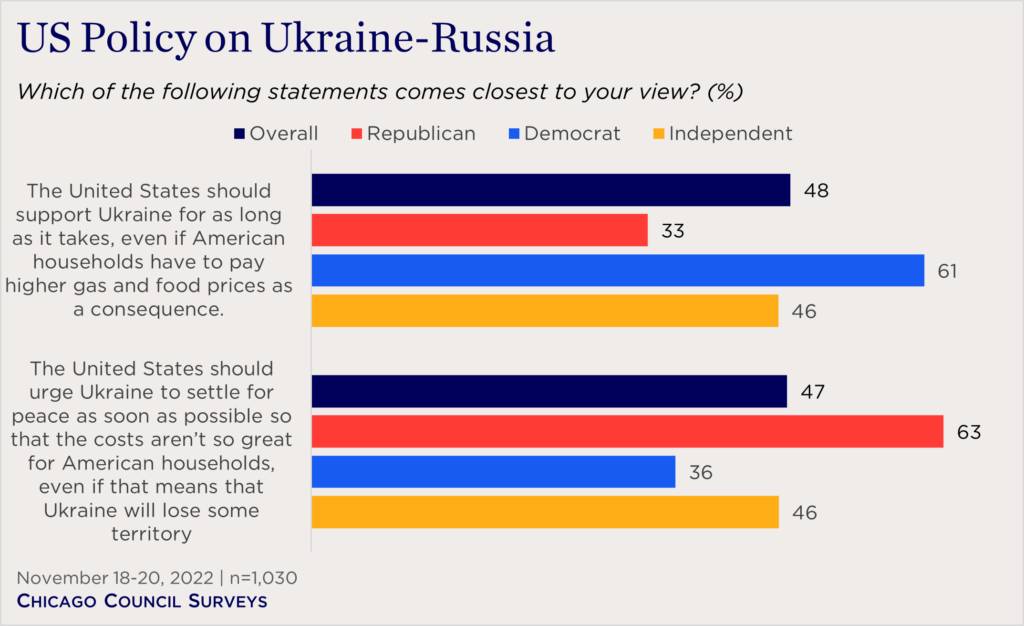
Nearly half of Americans (47%) now say Washington should urge Kyiv to settle for peace as soon as possible.
At the end of November, the United States authorized its latest assistance package to Ukraine, valued at $400 million to bolster the country’s security and defense in the war against Russia, now beginning its 10th month. A just-completed November 18-20 Chicago Council US assistance to Ukraine, both economically and with military equipment. But as the fighting drags into winter, the overall US public is now divided on whether the United States should support Ukraine as long as it takes or if it should urge Kyiv to settle for peace as soon as possible.
Key Findings
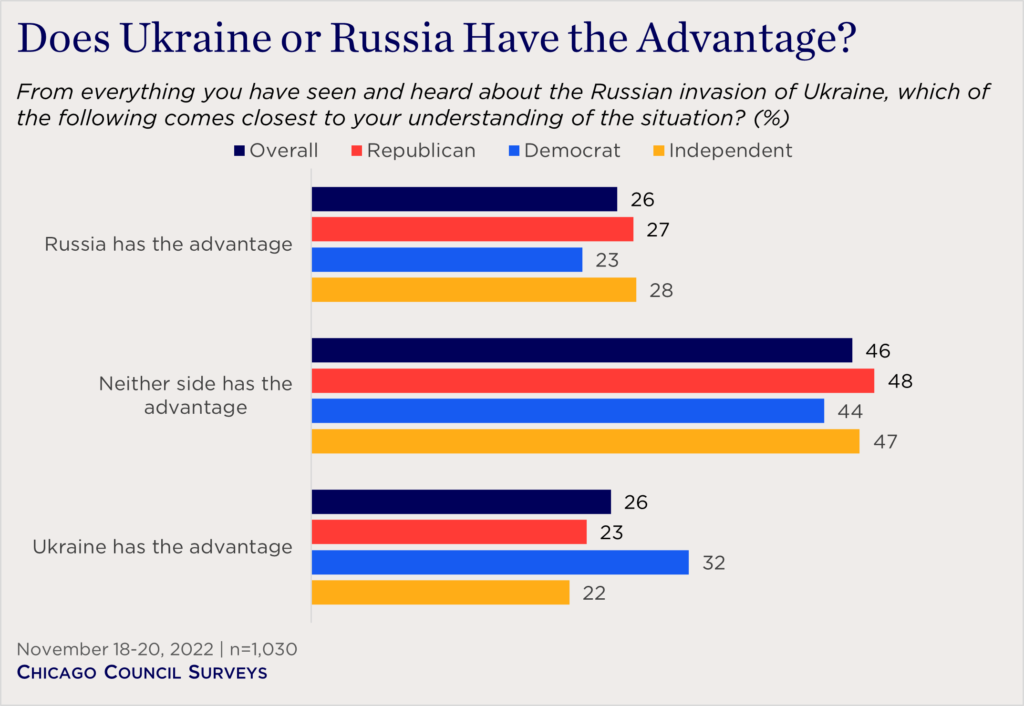
An equal percentage of Americans say Russia (26%) and Ukraine (26%) has the advantage in the current conflict. But a plurality (46%) believes that neither country has the advantage.
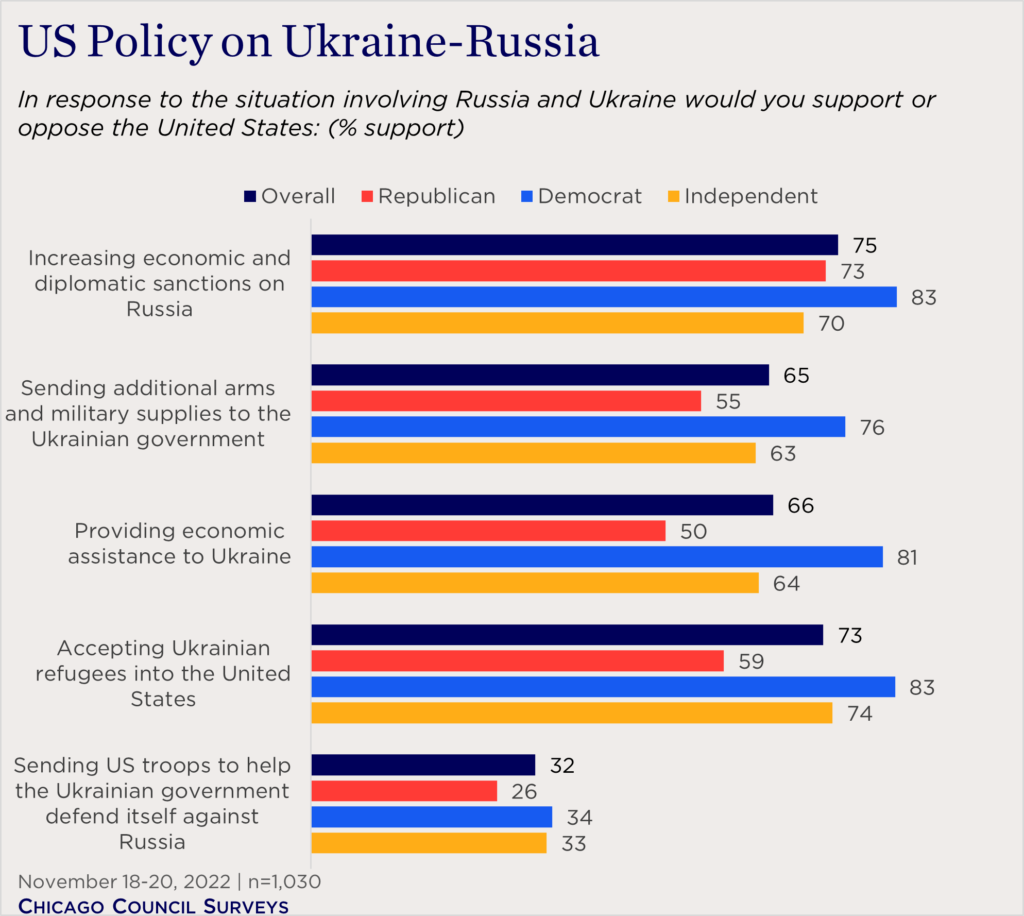
Solid majorities of Americans continue to support supplying Ukraine with arms (65%) and economic aid (66%), accepting Ukrainian refugees (73%), and sanctioning Russia (75%).
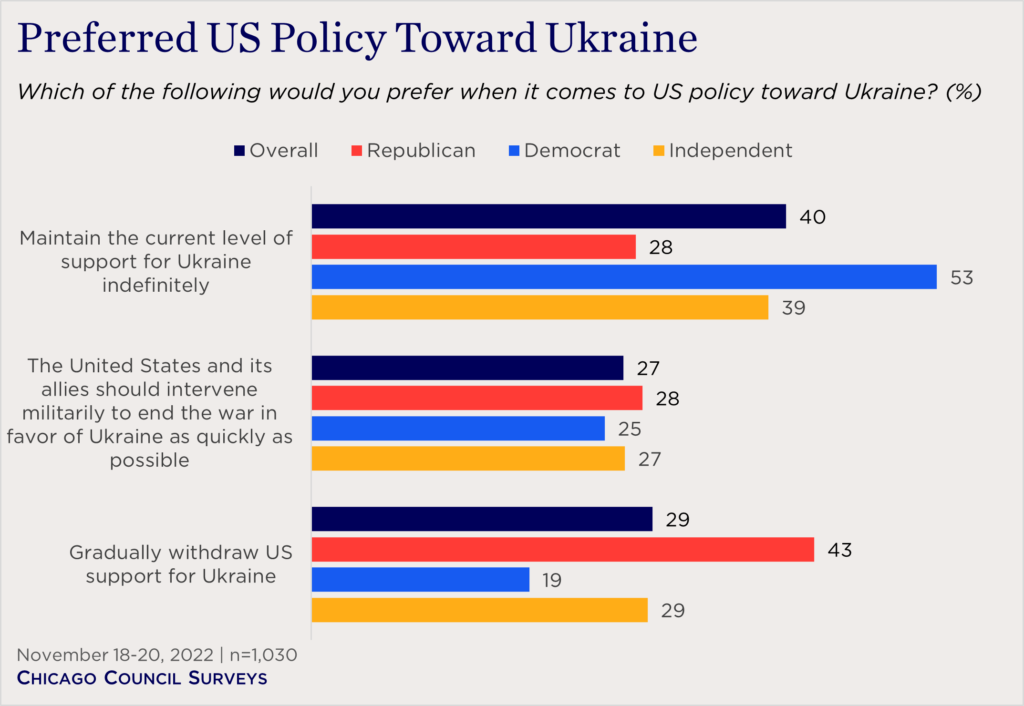
A plurality believes the United States should maintain its current level of support for Ukraine indefinitely (40%). Nearly three in 10 each say that the United States should intervene militarily to tip the advantage to Ukraine and end the war as soon as possible (27%)or that the United States should gradually withdraw support for Ukraine (29%).
Separately, Americans are now closely divided on whether Washington should support Ukraine “as long as it takes” (48%, down from 58% in July 2022) or whether Washington should urge Ukraine to settle for peace as soon as possible (47%, up from 38% in July).
Perceptions of who is winning have a great bearing on support for Kyiv.
Neither Ukraine nor Russia Seen as Having the Advantage
At the recent NATO summit of foreign ministers in Bucharest, NATO chief Jens Stoltenberg said Ukraine could expect further Russian attacks because “Russia is failing on the battlefield.” Ukrainian counteroffensives put Moscow on the back foot in some areas of the country.
But Americans are not so sure that Russia is failing. The Chicago Council survey shows that as many Americans think Russia has the advantage in the current conflict as think Ukraine does (26% each). Democrats are more likely to say Ukraine has the advantage (32%, compared to 23% of Republicans and 22% of Independents). But an overall plurality (46%) believes that neither Ukraine nor Russia has the advantage.
There are some hints that media sources could affect these views. For example, 26 percent of Americans who trust Fox News the most for accurate information say Ukraine has the advantage, compared to relatively higher percentages of those who most trust MSNBC (48% say Ukraine has the advantage), NBC (36%), public television (33%), and CNN (32%).
Perceptions of who is winning versus losing are important because they have a bearing on support for various policies. In an October University of Maryland poll, Americans who thought Ukraine was succeeding and Russia was losing were more willing to pay higher energy prices and tolerate increased inflation. There are similar relationships in the Council survey, as the following analysis illustrates.
Public Supports Existing US Policies on Ukraine
In addition to the $400 million defense package, US Secretary of State Antony Blinken announced $53 million in assistance to support Ukraine’s electrical system to help it recover from Russia’s bombardment of the country’s energy grid. Americans favor continued assistance to Ukraine, with majority support for supplying the country with arms (65%) and economic aid (66%), accepting its refugees (73%), and sanctioning Russia (75%).
But, Republican support for aid to Ukraine has declined notably over the course of the year. A smaller majority of Republicans now support the United States giving military aid (55%, down from 68% in July and 80% in March) and economic assistance (50%, down from 64% in July and 74% in March). Meanwhile, Democratic and Independent support for these policies has shown relatively little decline since March. One-third of Americans overall support sending US troops to Ukraine (32%, down from 38% in July) (see Appendix Figures A-E).
Those who sense that Ukraine has the advantage in the war support each of these policies at above average levels, with the exception of sending US troops to help Ukraine defend itself. Those who sense that Russia has the advantage are slightly more likely (36%) to support sending troops than those who think Ukraine (30%) or neither side (32%) has the edge in the conflict.
Americans Divide Along Party Lines on Approach to Ukraine Conflict
The Chicago Council survey tested American tolerance for continued support for Ukraine in various questions. When asked whether the United States should support Ukraine at current levels indefinitely, intervene militarily to decisively end the war, or gradually withdraw US support for Ukraine, a plurality prefers to continue the current levels of support indefinitely (40%). This is also the preferred approach for a narrow majority of Democrats (53%) and a plurality of Independents (39%). Republicans tend to prefer to gradually withdraw US support (43%).
Besides partisan identification, perceptions on who is thought to be winning the war are a key factor in these responses. A majority of those who think Ukraine has the advantage say the United States should continue the current level of assistance indefinitely (56%). On the other hand, those who think Russia has the advantage are more likely than others to prefer that the United States gradually withdraw its support for Ukraine (36%) or intervene militarily to bring the war to an end (33%).
Fewer Say United States Should Support Ukraine “As Long As It Takes”
A separate question asked in July and November finds that Americans are now divided over whether the United States should support Ukraine for as long as it takes or urge Kyiv to settle for peace. Half now (48%)—compared to 58 percent in July—say the United States should support Ukraine for as long as it takes, even if American households have to pay higher gas and food prices as a consequence. A similar proportion, 47 percent—up from 38 percent in July—say the United States should urge Ukraine to settle for peace as soon as possible so the costs aren’t so great for American households, even if that means Ukraine will lose some territory (Appendix Figure F).
Last July, the data revealed sharp partisan divisions on this question, with Republicans more split than Democrats in support (see Appendix Figure G). In the November reading, six in 10 Democrats (61%) continue to favor supporting Ukraine even at cost to the United States, down from seven in 10 last July (69%). Republican opinion, however, has shifted more dramatically. Today, only a third of Republicans (33%) say the United States should back Ukraine for as long as it takes, down from 50 percent this summer. Instead, a majority of Republicans favor pushing Ukraine to settle for peace to reduce costs to American households (63%, up from 46% in July 2022).
Corroborating the patterns above, a large majority of those who think Ukraine has the advantage in the current conflict say the United States should support Ukraine for as long as it takes (71% vs. 48% overall). By contrast, a majority of those who think Russia has the advantage think the United States should pressure Ukraine to settle for peace as soon as possible (60% vs. 47% overall).
Conclusion
While Americans are divided on supporting Ukraine for as long as it takes, support for the current US policies of assisting Kyiv economically and militarily is still solid. The influence of perceptions of which side is being successful on the battlefield illustrates the important role that media spin can play in affecting public views about the situation on the ground and, in turn, on continued backing for US support to Ukraine.
Donald Trump Should Not Repeat Woodrow Wilson’s Failure
April 30th is an important date in American politics. This is the day 100 for the American President in the White House, and all attention will be on the reports of his achievements and failures. But nothing can be more critical than Peace…
○
6 mins read
A Holocaust perpetrator was just celebrated on US soil. I think I know why no one objected.
Russia’s invasion has made ordinarily outspoken critics of antisemitism wary of criticizing Ukrainian Nazi collaborators
○
1 min read
Qi Book Talk: The Culture of the Second Cold War by Richard Sakwa
Richard Sakwa has for many years been one of the most distinguished and insightful observers of relations between the West and Russia, and one of the leading critics of Western policy. In this talk with Anatol Lieven, director of the Eurasia program at the Quincy Institute, Sakwa discusses his book, The Culture of the Second Cold War (Anthem 2025). The book examines the cultural-political trends and inheritances that underlie the new version of a struggle that we thought we had put behind us in 1989. Sakwa describes both the continuities from the first Cold War and the ways in which new technologies have reshaped strategies and attitudes.