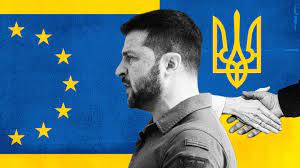
Brussels must solve the bloc’s internal problems and stop making promises it cannot keep
As a comic actor, Volodymyr Zelensky foreshadowed the moment when the European Union would welcome Ukraine. Vasiliy Petrovich Goloborodko, his character in Servant of the People, a sitcom about a teacher who becomes president, answers the phone to Angela Merkel, who tells him Ukraine has been accepted into the club. Goloborodko gets a few moments of celebration before he realises there has been a mix-up: it is Montenegro, not Ukraine, that has been granted membership.
Ukraine’s real-life path into the EU is already longer and more complex than the skit suggests — and could yet prove as frustrating and disappointing. It has been inching towards the bloc since the end of the Cold War, but an association agreement set to be signed in 2013 was called off by the then-president, the pro-Russian Viktor Yanukovych. That sparked the Euromaidan protests that, in their way, led to Moscow’s annexation of Crimea and eastern Ukraine, and then full-scale invasion in February 2022. Ukraine and Moldova were granted EU candidate status four months later. Last month the European Council opened membership negotiations.
The period before candidacy is when the aspiring member proves its worth. But over the past three decades the EU has changed more than Ukraine. In 1994, when Ukraine first established dialogue with the EU, the only way was west. Russia was culturally and economically defeated while the EU was in its halcyon decade: Maastrict, border-free travel, the euro, the peak of optimistic expansion. The bloc opened negotiations with Poland, Hungary, the Czech Republic, Slovakia, Slovenia, Estonia and Cyprus in 1997, with Latvia and Lithuania in 1999, and with Malta in 2000. All ten joined in 2004 and were quickly absorbed into the European project.
Turkey presented a more difficult prospect. It became a candidate in 1999 and opened negotiations in 2005, alongside Croatia. But while Croatia joined in 2013, Turkey was still left out, largely thanks to opposition from Sarkozy’s France and Merkel’s Germany. And the waiting room has turned into the deep freeze. That is largely President Erdogan’s doing. Since 2016 he has steered Turkey away from the EU’s norms on human rights, press freedoms and rule of law, all but disregarding the judgments of the Council of Europe. Would EU membership have pulled Erdogan away from autocracy? There are western diplomats who think so, even if the path of Hungary’s Viktor Orban suggests one does not preclude the other. But the real damage was done in dashed expectations. In the long term, it has been more destructive to leave Turkey in limbo than to never accept it as a candidate at all.
Turks feel Europe’s breadcrumbing all the more bitterly knowing that the EU will bend rules when it suits. The bloc accepted the Greek-speaking Republic of Cyprus despite there being an unresolved territorial dispute on the island, something that has inflamed Turks’ distaste for Brussels. Erdogan has played off that, picking spats with European countries before Turkish elections to win votes from the Turkish diaspora.
Yet Turkey remains anchored to the EU in large part due to aftershocks of the 2015 refugee crisis. You can trace Brexit, the creep of militarised borders across Europe and the rise of nativist populism within the bloc back to the summer when hundreds of thousands of refugees and migrants from the Middle East and Africa travelled into Europe on foot and by boat. The EU, like post-Brexit UK, continues to hand Turkey billions of euros in deals to stop migration even though accession talks were frozen in 2019.
Meanwhile President Putin has spotted gaps in the places where democracy is backsliding in the EU and its orbit, and has inserted Russian interests into them. The countries of the western Balkans are under a separate stabilisation and accession path to the EU with the aim of fixing their economies and political systems after Yugoslavia’s wars. In reality, Balkan countries are moving towards the EU in fits and starts, often frustrated by ethnic disputes. Serbia, a candidate since 2012, has under President Vucic slipped from democratic norms but retains its EU accession funding of about €170 million a year.
The EU has entered an era of defensive enlargement. Ukraine’s candidacy, like Moldova’s and Georgia’s, has been expedited in response to Russia’s invasion. It is difficult to see how the accession of any will be smooth. There are unresolved territorial disputes involving Russia in all three — Transnistria in Moldova, and South Ossetia and Abkhazia in Georgia. Their economies are poor, and war-ravaged in the case of Ukraine. Orban had to be coaxed into Hungary sitting out the vote on opening Ukraine’s negotiations — his single protest could have blocked it.
The EU in 2024 is a club that faces more threats from inside than out. It has overstretched in the Balkans, fudged in Turkey, and is struggling to find ways to deal with its troublesome members. Membership dangled like a carrot to Ukraine could exacerbate rifts within the EU and create resentment among Ukrainians if it continues for years. On the other hand, a hasty welcome would bring Europe’s borders up to active front lines — and a raft of new territorial issues into the bloc. The EU should resolve to spend some time looking inwards — and stop making promises it cannot keep.