«Fashion is an opportunity to protect oneself from everyday life.» — Bill Cunningham
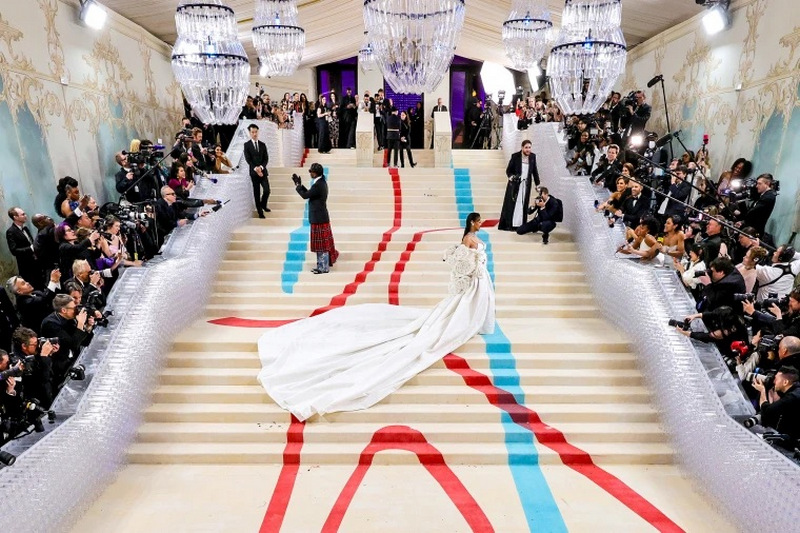
There is no better opportunity to show off your glory and glamor to the city and the world than the Met Gala, a charity event at the Metropolitan Museum of Art that has been held since 1948 and has gained a reputation as the most colorful and prestigious fashion event of the year.
But if you are not Jennifer Lopez, Naomi Campbell or Kim Kardashian, not a megastar of Hollywood, sports, public politics, business, can not buy a ticket for 75000 dollars and an outfit from McQueen, Prada, Versaci and designers of this range, you can get a fairly complete picture of the event thanks to television and press. The assessments of commentators on the left and right are quite favorable, in these times a rare convergence of opinions unconstrained by party affiliation.
The show shocks the imagination with the brilliance of designer ingenuity, the cost and time involved in producing the outfits – model Gigi Hadid’s dress required 5,000 hours of labor, and a record-breaking 26 million raised for charity.
According to Alexander McQueen, whose models were most widely represented, fashion should be an “escapism” from the everyday, but it was not without politics. In the past, Donald Trump was a frequent and prominent guest; now he is no longer invited.
But it was Congresswoman Alexandria Ocasio-Cortez, a fierce socialist-progressive, whose out looked neither more modest nor cheaper. But in the dress of a champion of socio-economic equality and redistribution of wealth, the designers have embedded a call to “tax the rich.” Cortez’s debut gives hope that, as is usually the case, in time, fiery revolutionaries, allowed into the circle of the rich and famous, change their outlook and behavior, and turn from demonic crushers of regimes and foundations into their guardians.
Naturally, such an audience could not ignore the Israeli-Palestinian war and pro-Palestinian riots in universities. Criticizing Israel and denouncing the Zionists is the best PR technique today, and it is a sin against career and progressive humanity not to seize the opportunity.
Every significant event in public and personal life has its contradictions. A country of equal rights and opportunities, but as George Orwell wrote, some are more equal than others. There are mega-selebrities, there are medium-sized selebrities, and there are those who are not yet very visible and successful. Every small star is determined to become a superstar, and the superstar is afraid to fade away. Competition in business and politics pales in comparison to competition at the vanity fair.
Anna Wintour, editor of Vogue, host of the gala, said: “If you can’t be better than your competitors, dress better than them.” Easier said than done. The jewelry on Rihanna cost 25 million. The Kardashian dress that Marilyn Monroe sang in for John F. Kennedy cost about five million.
A visit to a psychologist will clarify whether the effort and expense have boosted self-esteem, or turned into depression and an inferiority complex. But there can be no doubt that those who would like to attend but have no place at this celebration of life will not be comforted by television and ideas about equal opportunities and fairness.
One might consider the show’s organizers and participants lucky; today public attention and protests are focused on the Trump trials and Israel; under other circumstances, a parade of vanity and snobbery at the Metropolitan Museum of Art would have provoked a violent backlash.
Even believers in the kingdom of heaven, utopian theories and hallucinogens cannot expect everyone to find a place at an event like the Met Gala. But there are other, quite democratic and less dangerous for social harmony, budget and mental health opportunities to show and display one’s creative imagination with looks and style.
Fashion designers say that style is about telling a story about yourself. Not necessarily with wasteful spending and the help of celebrity couturiers.
Even in the Soviet Union, where fashion was a bourgeois relic, model homes were overseen by censors, and purchasing power was limited by low wages and constant scarcity, there remained a desire to express oneself with toiletry and style, particularly in the artistic and “alternative” sexual milieu.
Sviatoslav Richter, the great musician, demigod to his admirers, a reserved and uncommunicative man, a strict pedant of artistic taste and style, held costume evenings at his home, dedicated to a certain historical time. We did without couturiers, usually everything was done with our own hands and imagination. To be among the invitees was a high prestige, with the status of Richter-nobleman could not be compared to none of his contemporaries.
Although in today’s Russia there is not yet an event equal to the Met Gala, the new elite is ahead of the world in terms of spending on fashion from the most famous and expensive couturiers. The palaces, yachts and airplanes of oligarchs, top officials and the art elite required appropriate decorations and entourage.
Recently, the scandalous “naked party” with the participation of Russian pop stars became a worldwide sensation. According to the dominant opinion, it is a disgusting manifestation of vulgarity and snobbery, a violation of spiritual values, while according to the opposition it is a legitimate expression of personal tastes and free will.
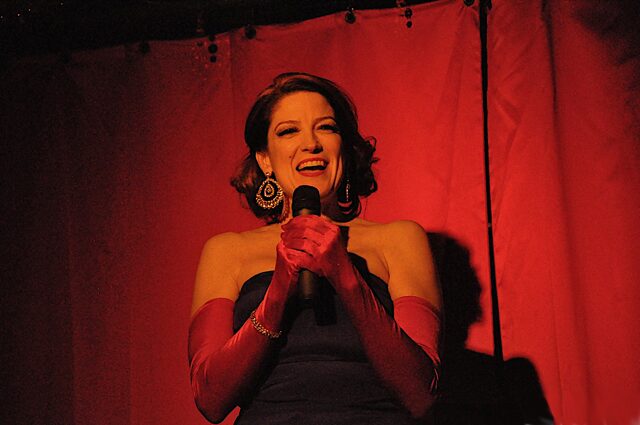
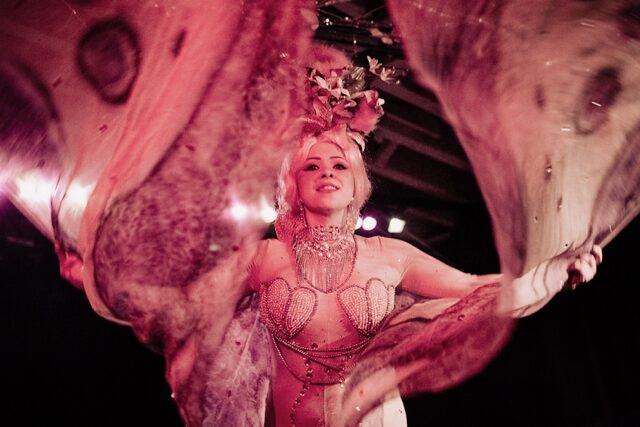
The interest in self-expression through fashion was always alien to me, even the example of Richter, for me the highest authority, to be in whose house I considered the highest honor, could not change my ideas. But in New York, my life partner, who had spent many years on the ballet stage and had no intention of parting with an extensive collection of theatrical costumes and accessories, turned out to be a friend and regular visitor to the salon Juliet Campbell, the organizer of extravagant costume shows.
Usually their themes are related to national culture, jazz and art avant-garde. Initially the main visitors were gays and transgenders, now the public of all interests and orientations. The most popular show “Shanghai Mermaid” has existed since 2007, continuing the traditions of bohemian Parisian salons and cabarets and decadent clubs in America in the 20s and 30s.
The show ends far past midnight, and I had to accompany the ballerina and somehow fit the circumstances, good thing there are no age or ideological restrictions. One of the few charms of immigration is new experiences, you never know where, when and with whom you will end up, what you will see and learn and what will come out of it.
In the days of my youth and not quite youth, the dominant motive for attending an entertainment party was the desire to widen the circle of acquaintances and to look for romantic luck. Nowadays, such interests are more successfully pursued via smartphone; in any case, my impression is that meetings at the Shanghai Mermaid, with all the freedom and openness, are subordinated solely to aesthetic interest and creative fantasies. There are no chosen and rejected here.
There are no threats to finances and psyche these evenings. Ticket prices are affordable, outfits are usually a product of your own ingenuity, but jeans, sneakers, baseball caps, hippie and punk arsenal are not allowed here.
Although many of the themes are from the old days, the composition of the participants and the atmosphere of relationships is defined by the spirit of modernity: diversification, inclusion, peaceful coexistence of races, generations and alternative orientations, absence of prejudice and preconceptions.
I can no longer remember when and where I have been able to attend a crowded meeting without arguments about politics and justice. Non-participation, at least temporarily, in politics and relations, gives people back their humanity and makes them, at least for a while, benevolent and happy.
Donald Trump Should Not Repeat Woodrow Wilson’s Failure
April 30th is an important date in American politics. This is the day 100 for the American President in the White House, and all attention will be on the reports of his achievements and failures. But nothing can be more critical than Peace…
○
6 mins read
A Holocaust perpetrator was just celebrated on US soil. I think I know why no one objected.
Russia’s invasion has made ordinarily outspoken critics of antisemitism wary of criticizing Ukrainian Nazi collaborators
○
1 min read
Qi Book Talk: The Culture of the Second Cold War by Richard Sakwa
Richard Sakwa has for many years been one of the most distinguished and insightful observers of relations between the West and Russia, and one of the leading critics of Western policy. In this talk with Anatol Lieven, director of the Eurasia program at the Quincy Institute, Sakwa discusses his book, The Culture of the Second Cold War (Anthem 2025). The book examines the cultural-political trends and inheritances that underlie the new version of a struggle that we thought we had put behind us in 1989. Sakwa describes both the continuities from the first Cold War and the ways in which new technologies have reshaped strategies and attitudes.