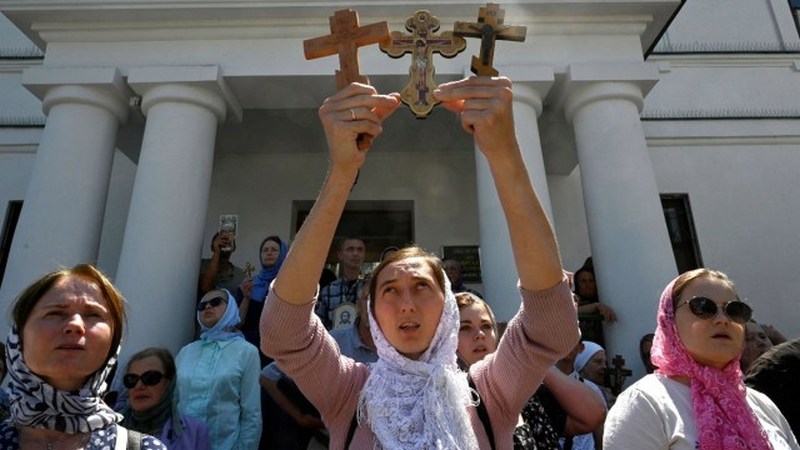
In the coming weeks, the Ukrainian parliament (Verkhovna Rada) is likely to pass legislation that would ban the Ukrainian Orthodox Church. Not only would this legislation deny the freedom of worship to millions of Ukrainians, it would undermine a core pillar of Ukraine’s defense against Russian aggression — being on the right side of the law.
Faithfuls of the Ukrainian Orthodox Church, accused of maintaining links with Russia, pray outside the historic monastery Kyiv-Pechersk Lavra to prevent tresspassing of the Ministry of Culture commission in Kyiv on July 4, 2023 (Photo by SERGEI CHUZAVKOV / AFP) (Photo by SERGEI CHUZAVKOV/AFP via Getty Images)
The Ukrainian government must rethink this dangerous legislation, and the governments that are appropriately supporting Ukraine’s sovereignty must ensure that the Ukrainian peoples’ human rights do not become a further victim of this war.
Born out of the horrors of WWII, the international human rights system has held the freedom of religion as sacrosanct. This essential freedom to worship is guaranteed in the Universal Declaration of Human Rights (Art. 18), the International Covenant on Civil and Political Rights (Art. 18), and the European Convention on Human Rights (Art. 9), among others. It is at the center of a system that protects the integrity of the human person, the right to think and to believe. As history has made all too clear, when the right to freedom of religion is undercut, all other human rights are in peril.
A sufficient number of parliamentarians have voiced their support to move forward with a vote on the legislation that has been on the Rada’s docket since January. More than 250 members have signed on to the legislation; only 226 votes are required to pass. As a formal matter, the bill will amend Ukraine’s existing legislation guaranteeing freedom of religion by stipulating that “Activities of religious organizations that are affiliated with the centers of influence of a religious organization, the governing center of which is located outside of Ukraine in a state that carries out armed aggression against Ukraine, are not allowed.”
This means the law will ban the operation of the Ukrainian Orthodox Church (UOC), a branch of Ukrainian Orthodoxy followed by at least 16 percent of the Ukrainian people. Historically, and as a matter of canonical legitimacy, the UOC was subordinated to the Moscow Patriarchate of the Russian Orthodox Church. In 2018, the Ukrainian government sought the establishment of a new Orthodox Church of Ukraine (OCU) with ties to Constantinople, rather than Moscow. In January 2019, the Ecumenical Patriarchate of Constantinople approved this new branch, which remains the preferred church of the Ukrainian government. However, for reasons of religious history and tradition, millions of ordinary worshipers have remained loyal to the UOC.
Despite its historic ties to Russian Orthodoxy, the UOC has stood firmly in support of Ukraine’s rightful self-defense against Russia’s aggression. The day after the invasion, the UOC’s leader, Metropolitan Onufry, declared the church’s opposition to the war and repeatedly appealed to Russian President Vladimir Putin to reverse course, stating, “To our great regret, Russia has started military actions against Ukraine. … In this tragic time we express special love and support for our soldiers, who stand guard to defend our land and our people.” In May 2022, the UOC officially amended its constitution, severing its ties with the Moscow Patriarchate.
While Putin has instrumentalized the Russian Orthodox Church as a tool of influence in what he calls the “Russian World,” the UOC is now fully separate — as a matter of law and practice — from Moscow. Nevertheless, a Ukrainian governmental commission, including only members of the government’s preferred church, found that separation insufficient. As a result, the new law will shutter the UOC, banning its operation outright on Ukrainian soil.
These attacks on the UOC are a grave violation of human rights. The Ukrainian Parliament is well aware of the path it is on. In fact, parliamentarians have amended the pending legislation by removing a critical passage that would have ensured compliance with human rights law.
The Rada has struck a line requiring the law to operate “in accordance with the norms of international law in the field of freedom of conscience and Ukraine’s obligations in connection with joining the Council of Europe.” By removing this language, the Rada has drafted a bill that undercuts the freedom of religion and the respect for human rights. Notably, the Rada’s own expert committee report found the law deeply problematic, lacking due process and not requiring any showing that the OUC threatens Ukrainian national security.
The brazen effort to shutter the Ukrainian Orthodox Church and curtail the freedom of religion currently being contemplated by the Ukrainian parliament undermines these commitments and Ukraine’s claims to the higher legal and moral ground. Ukraine must correct course; its western supporters must ensure that Ukraine prevails both on the battlefield and its commitment to rights and law.
William W. Burke-White is professor of law at the University of Pennsylvania Carey Law School.
The details of the peace deal presented today by US special envoy Steve Witkoff are consistent with the report in the Financial Times discussed in my previous article and with Larry Sparano in the posted interview. Putin will halt the Russian advance prior to driving Ukrainian soldiers out of all of the territory that has been reincorporated into Russia. It appears to be the case that the borders between Russia and Ukraine will be the current front line, so Putin is withdrawing Russia’s claim to the Russian territories still under Ukrainian occupation.
Russia and the US seem near a Ukraine peace deal. Kyiv’s role may be moot.
President Donald Trump’s hopes of securing a quick Ukraine peace deal hang in the balance after Washington’s envoy, Steve Witkoff, held his fourth Kremlin meeting with Russian President Vladimir Putin Friday.