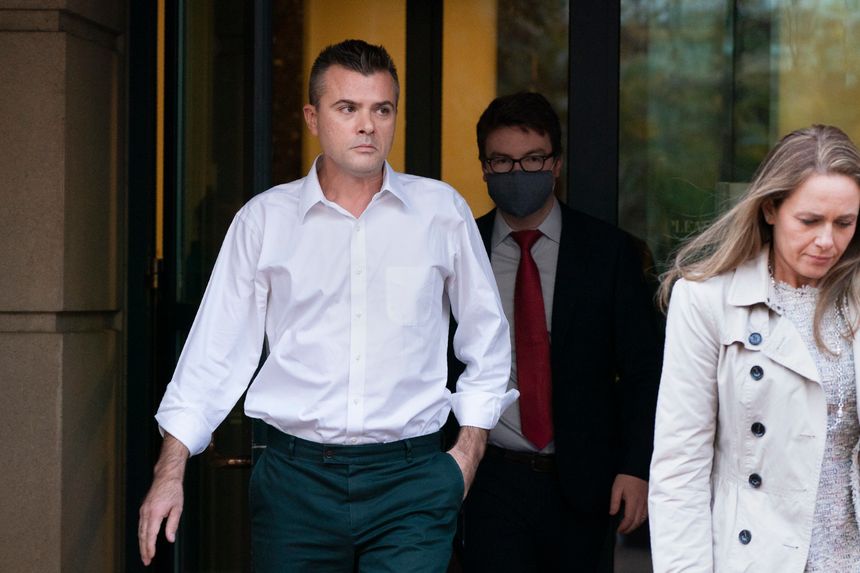
Special counsel John Durham alleges key source lied to FBI about how he collected information about Trump and Russia, getting some of it from Democratic operative.
MANUEL BALCE CENETA/ASSOCIATED PRESS
WASHINGTON—An indictment returned in federal court on Thursday casts doubt on the sources of a series of salacious and largely discredited reports about former President Donald Trump and Russia that the FBI ultimately used in support of a counterintelligence investigation into his 2016 campaign and associates.
A Russia analyst who served as a central source for a dossier of opposition research material about Mr. Trump compiled by former British intelligence officer Christopher Steele was arrested and charged with lying to the FBI on Thursday, according to an indictment unsealed in Virginia federal court. He appeared before a judge on Thursday and was released on bond.
Russian-born Igor Danchenko was charged with five counts of making false statements to officials of the Federal Bureau of Investigation about the sources of the information he helped compile for Mr. Steele. As part of a counterintelligence probe into whether Mr. Trump or any of his associates had links to Russia, Mr. Danchenko sat for numerous interviews with FBI officials in 2017 as they tried to corroborate allegations made in the dossier.
The 39-page indictment also states that several key pieces of information in the dossier—purportedly a private intelligence product compiled by a retired British MI6 agent with deep ties to Eastern Europe—weren’t collected from Russia but were sourced to chatter and gossip circulating in American political circles.
The charges against Mr. Danchenko stem from the probe by special counsel John Durham, who was tapped by Trump administration Attorney General Bill Barr in 2019 to review decisions made by intelligence officers and law-enforcement officials during the investigation into whether Mr. Trump and his campaign associates received any assistance from Russia during the 2016 campaign. An FBI attorney who prepared a surveillance application, as well as an attorney who specializes in cybersecurity, have also been indicted by the special counsel’s office on charges of making false statements.
Mr. Steele was hired by Fusion GPS, a Washington-based research firm founded by former Wall Street Journal reporters Glenn Simpson and Peter Fritsch, who were initially hired to do research into Mr. Trump by Republicans opposed to Mr. Trump. After Mr. Trump won the Republican nomination, Fusion sought Democratic funding to continue their research. After winning a contract with a law firm representing the Democratic Party, they hired Mr. Steele to investigate Mr. Trump’s Russia ties.
Mr. Danchenko has previously been identified as Mr. Steele’s “primary sub-source” in compiling a series of private intelligence reports documenting Mr. Trump’s purported ties to Russia. Documents released by the Justice Department last year contained enough information for journalists and researchers to identify Mr. Danchenko, who had voluntarily spoken to the FBI under the condition that it protect his identity.
Mr. Steele’s research was paid for through several intermediaries by the Democratic Party in support of Hillary Clinton’s campaign for president. His reports circulated widely in political and media circles in late 2016 and served as key evidence in a secret surveillance warrant that was obtained against Carter Page, a onetime foreign-policy adviser to Mr. Trump. Many of the dossier’s claims were contested and Mr. Trump has denied nearly all of them. He said the investigation it helped spark, culminating in his firing of FBI Director James Comey and the appointment of special counsel Robert Mueller, was a “witch hunt.”
In the years since relying on the dossier for a secret surveillance warrant and several renewals, the FBI has backed away from claims about the reliability of Mr. Steele’s information. Mr. Durham, in his indictment, wrote: “The FBI attempted to investigate, vet, and analyze the [Steele] reports but ultimately was not able to confirm or corroborate most of their substantive allegations.”
Attorneys for Mr. Steele didn’t immediately respond to a request for comment. He has previously defended the rigor of his research work on Mr. Trump.
The indictment says that some of the material collected by Mr. Danchenko came from a U.S.-based source that lacked any firsthand knowledge of the material he was conveying. Mr. Durham alleges that some information was sourced in whole or in part to Chuck Dolan, a Washington-based public-relations executive, Democratic Party operative and adviser to the Clintons. In another instance, Mr. Danchenko is alleged to have sourced a claim to the head of a Russian-American business group when in fact he hadn’t had any contact with him.
Mr. Dolan served in formal roles on President Bill Clinton’s two successful presidential bids as well as Mrs. Clinton’s unsuccessful 2008 campaign. He was an informal volunteer adviser to Mrs. Clinton’s 2016 campaign. He has worked in high-level positions at a number of public relations firms in Washington and at the time of his encounters with Mr. Danchenko was working for private clients on Eurasian issues and had ties to Russian officials in the U.S. and abroad as part of his public-relations work.
Mr. Dolan isn’t identified by name in the indictment, but sufficient details were included to identify him. In addition, a deposition in a civil case stemming from the publication of the dossier names Mr. Dolan as one of three people present at a meeting described in the indictment.
In one instance, Mr. Danchenko sourced reports about the internal workings of Mr. Trump’s campaign to Mr. Dolan, the indictment alleges. Mr. Dolan told the Russian that he had had a drink with a GOP friend and passed along some gossip about Mr. Trump’s campaign manager. Mr. Dolan later told the FBI he had never had a GOP source and merely passed along material he had seen in public news reports.
In another instance, the most salacious allegation in the dossier, involving sexual behavior by Mr. Trump in the presidential suite of Moscow’s Ritz-Carlton Hotel, came from a trip Mr. Dolan took to Russia in June 2016. According to the indictment, Mr. Dolan received a tour of the presidential suite while on business in Russia and met with Mr. Danchenko, who was also in Russia at the time, at the hotel. Mr. Dolan told the FBI that he had never heard anything about Mr. Trump’s sexual conduct during the tour. Mr. Trump has denied the allegations.
Attempts to reach Mr. Dolan were unsuccessful Thursday. The indictment doesn’t make clear whether Mr. Dolan knowingly contributed to the dossier; at one point the indictment says Mr. Danchenko once told him he was working on a “”project against Trump” but didn’t appear to elaborate. Mr. Danchenko asked him in the same email to pass along “any thought, rumor, allegation” about internal Trump campaign material.
Although Mr. Dolan has said in the past that he was acquainted with both Mr. Danchenko and one of his sources mentioned in the indictment, Mr. Dolan has in recent years been working as a PR consultant to disprove elements of the dossier for a Cyprus-based firm that says its name was besmirched by the report.
Remembering Edward Lozansky, Towering Prophet of Sanity, Decency and Peace
Soviet and American physicist and political figure Edward Lozansky dies in Moscow, on April 30, 2025.
Edward Dmitrievich Lozansky was born in Kiev on February 10, 1941. He graduated from the Kurchatov Institute of Atomic Energy with a degree in theoretical nuclear physics. He was a researcher at the Kurchatov Institute of Atomic Energy and the Joint Institute for Nuclear Research in Dubna. At the same time, he taught at the Malinovsky Armored Forces Academy.
In 1976, he moved to the United States, became a US citizen, and lived in Washington, DC. In 1990, he founded the American University in Moscow (now Moscow International University).
In recent years, he actively participated in the work of the Assembly of the Peoples of Eurasia and Africa and was the US moderator of the international public forum “The Spirit of the Elbe: A Bridge of Trust, Friendship, and Cooperation,” which was held with great success on April 15, 2025. A word of remembrance from Martin Sieff, joined by the entire editorial staff of the Pluralia project.
○
2 mins read
Open Appeal to Presidents Trump and Putin
We kindly invite you to review and sign the Open Appeal to President of the United States Donald Trump and President of Russia Vladimir Putin
○
1 min read
International Forum “Spirit of the Elbe: A Bridge of Trust, Friendship, and Cooperation”
The organizers of the International Forum “Spirit of the Elbe: A Bridge of Trust, Friendship, and Cooperation” invite media, public figures, and representatives of culture, science, and business to participate in a landmark event taking place on April 15, 2025. The Forum will be held in a hybrid format: in-person at the Conference Hall of the Assembly of the Peoples of Eurasia in Moscow and via Zoom conference (up to 200 participants, approximately evenly split between Russia and the USA). The event begins at 5:00 PM Moscow time (10:00 AM Washington, D.C. time).