Indispensable Nation or One Obsessed with Hegemony Syndrome?
Indispensable Nation or One Obsessed with Hegemony Syndrome?
○
4 mins read
By Edward Lozansky
An Internet search shows journalist Sidney Blumenthal and historian James Chace as the first to coin the term “indispensable nation," which is appropriate for describing the United States. This happened in 1996 during Bill Clinton’s presidency and Madeleine Albright's term as Secretary of State.
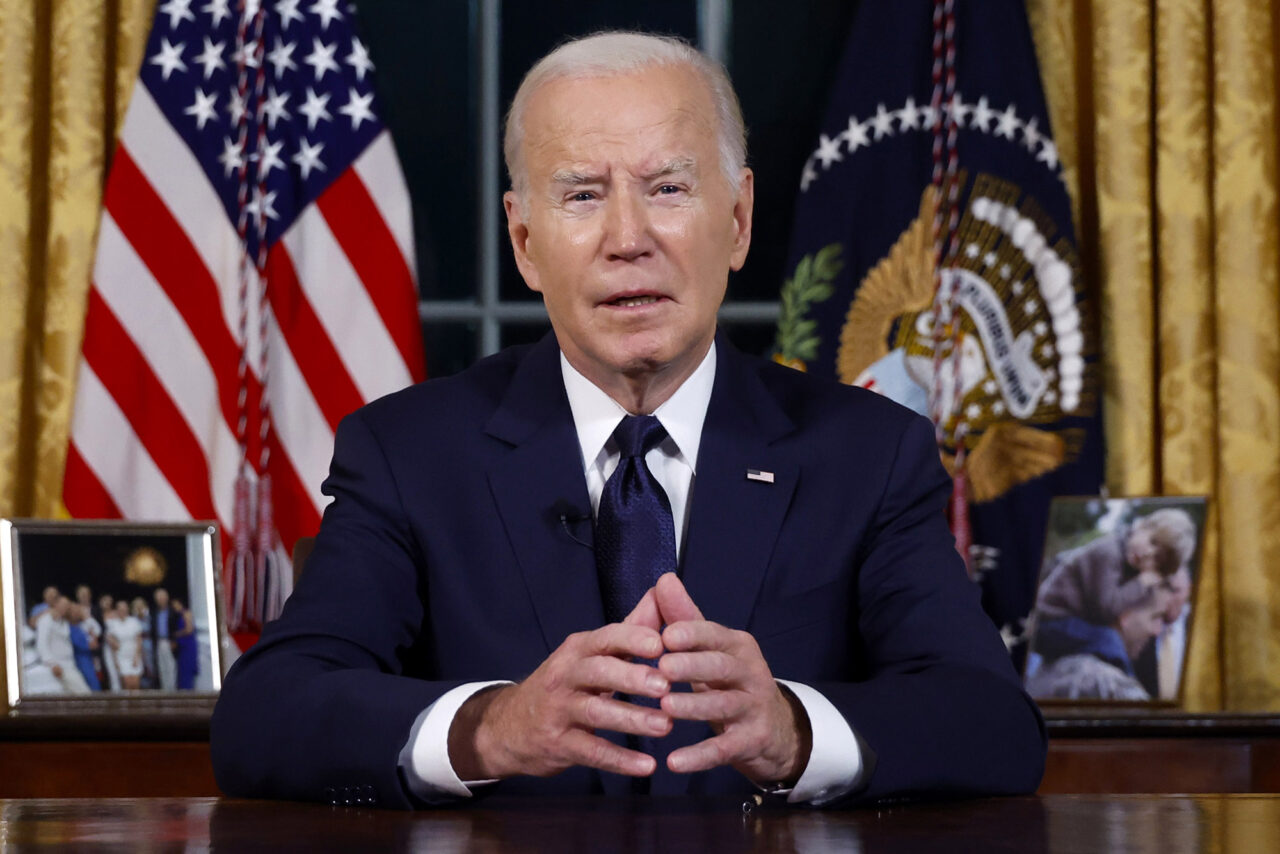
President Joe Biden speaks from the Oval Office of the White House Thursday, Oct. 19, 2023, in Washington, about the war in Israel and Ukraine. (Jonathan Ernst/Pool via AP)
In his book The Clinton Wars, Blumenthal justified this definition since “Only the United States had the power to guarantee global security: without our presence or support, multilateral endeavors would fail.”
Starting with Albright, the term “indispensable,” sometimes in combination with the “exceptional,” was and still is used by the by-partisan army of politicians and self-described patriots who are pushing the hegemonic unipolar agenda and some peculiar “rules-based order,” which only Washington has the right to interpret.
For example, during a February 1988 interview on the “Today Show,” Albright said: “If we have to use force, it is because we are America; we are the indispensable nation. We stand tall, see further than other countries into the future, and see the danger here to all of us.”
Barack Obama, in his commencement address to West Point cadets in 2014, said, “The United States is and remains the one indispensable nation. That has been true for the past century, and it will be true for the future century.”
Other “indispensables” like Hillary Clinton and Joe Biden repeated similar lines during their presidential campaigns, while Biden, after his victory in November 2020, added that “America is back… ready to lead the world and sit at the head of the table.”
Looking at what is going on inside the deeply polarized country and the results of its world leadership, one must agree with those who see the classification of America’s global role to persist as positive to mankind as patently false.
As Mark Warns says, “The report on the Costs of War compiled by the Watson Institute at Brown University and American University researchers should be required reading for all American voters.” However, it focuses only on the War on Terror and leaves out the costs of America’s other conventional, hybrid, or proxy wars.
This report reviews the latest research to examine the causal pathways that have led to an estimated 3.6-3.8 million indirect deaths in post-9/11 war zones, including Afghanistan, Pakistan, Iraq, Syria, and Yemen. The total death toll in these war zones could be at least 4.5-4.7 million and counting, though the precise mortality figure remains unknown. Some people were killed in the fighting, but far more, especially children, have been killed by the reverberating effects of war, such as the spread of disease.
America still has the most robust economy and military. Still, the present world power configuration is different from the relatively short period after the collapse of the USSR when such claims were more or less legitimate. Not anymore, and this is true in terms of hard and soft power.
Even Biden’s friendly CNN admits that “America’s political turmoil hampers its capacity to lead through yet another global crisis,” while the mouthpiece of indispensables and exceptionals, The Atlantic, warns that “America Is Headed Toward Collapse.”
Of course, the main question is: are we doomed, or is there a way out? Of course, there is, but first, let us sober up and admit that although the United States is exceptional, this is true for any other country on this planet with all its good or bad features. However, the United States is not an indispensable nation, and as Micah Zenko writes in the Foreign Policy, “This would help to save its human and financial costs, avoid the tremendous risks, and degree of political commitment required to do so.”
Once this is done, it would be much easier to find a common language with the adversaries, and with those allies and partners who are not always happy with Uncle Sam.
Look at what is going on in Europe, where ordinary folks are suffering and protesting while its leadership follows Washington’s line. Their ratings are at a record low, and only four countries have approval from more than 50% of the population.
Donald Trump Should Not Repeat Woodrow Wilson’s Failure
April 30th is an important date in American politics. This is the day 100 for the American President in the White House, and all attention will be on the reports of his achievements and failures. But nothing can be more critical than Peace…
○
6 mins read
A Holocaust perpetrator was just celebrated on US soil. I think I know why no one objected.
Russia’s invasion has made ordinarily outspoken critics of antisemitism wary of criticizing Ukrainian Nazi collaborators
○
1 min read
Qi Book Talk: The Culture of the Second Cold War by Richard Sakwa
Richard Sakwa has for many years been one of the most distinguished and insightful observers of relations between the West and Russia, and one of the leading critics of Western policy. In this talk with Anatol Lieven, director of the Eurasia program at the Quincy Institute, Sakwa discusses his book, The Culture of the Second Cold War (Anthem 2025). The book examines the cultural-political trends and inheritances that underlie the new version of a struggle that we thought we had put behind us in 1989. Sakwa describes both the continuities from the first Cold War and the ways in which new technologies have reshaped strategies and attitudes.