By Edward Lozansky The latest news about CATO, the libertarian think tank, firing its senior fellow Andrei Illarionov, a former economic advisor to Russian president Vladimir Putin since turned into one of his fiercest critics, brought to me some decades-old […]
The latest news about CATO, the libertarian think tank, firing its senior fellow Andrei Illarionov, a former economic advisor to Russian president Vladimir Putin since turned into one of his fiercest critics, brought to me some decades-old memories.
Back in September 1990, I helped CATO to organize conference in Moscow, still a capital of the communist USSR, to educate Russians about the advantages of Western values like freedom, democracy, free markets, and (obviously) freedom of speech and press.
Now, 30 years later, CATO fired Illarionov precisely for exercising freedom of speech. Why? Because his opinions about the January 6 events on Capitol Hill contradicted those of someone in CATO’s leadership.
As stated on CATO’s website, Andrei Illarionov was a senior fellow at the Cato Institute’s Center for Global Liberty [sic] and Prosperity from 2006 to 2021. From 2000 to December 2005 he was the chief economic adviser of Russian President Vladimir Putin and the president’s personal representative in the G8. At the end of 2005 Illarionov resigned and became an outspoken critic of Putin and the Kremlin. He is one of Russia’s most forceful and articulate advocates of an open society and democratic capitalism – values supposedly shared by CATO.
One would think that with such credentials and the current anti-Russia mood in Washington his position at CATO would be pretty secure. Evidently not.
Going back to the 1990 Moscow conference it was a great success, although it required months of preparation, including meticulous negotiations with the US State Department and Soviet officials. CATO President Ed Crane and a major sponsor, billionaire Charles Koch, took care of Washington bureaucracy and lining up American speakers, which included Nobel laureate James Buchanan, political scientist from American Enterprise Institute Charles Murray, Assistant Secretary of Treasury in the Reagan administration Paul Craig Roberts, and the future first winner of the Friedman Prize, Peter Bauer.
I was responsible for recruiting Soviet participants. At that time American popularity in Mikhail Gorbachev’s USSR was so high that, as described by Washingtonian, in an auditorium that held 700 more than 1,000 Soviets showed up—they were “hanging literally from the rafters.”Among the speakers were Moscow mayor Gavriil Popov, St. Petersburg mayor Anatoly Sobchak (mentor to future president Putin), and Grigory Yavlinsky, one of Russia’s leading liberal economists.
“When Cato’s president Ed Crane reminded the large audience that ‘the government that governs least governs best’ … hundreds of Russians clapped and cheered wildly,” the Wall Street Journal reported. “Only a handful of die‐hard Communists sat glum‐faced, arms folded.”
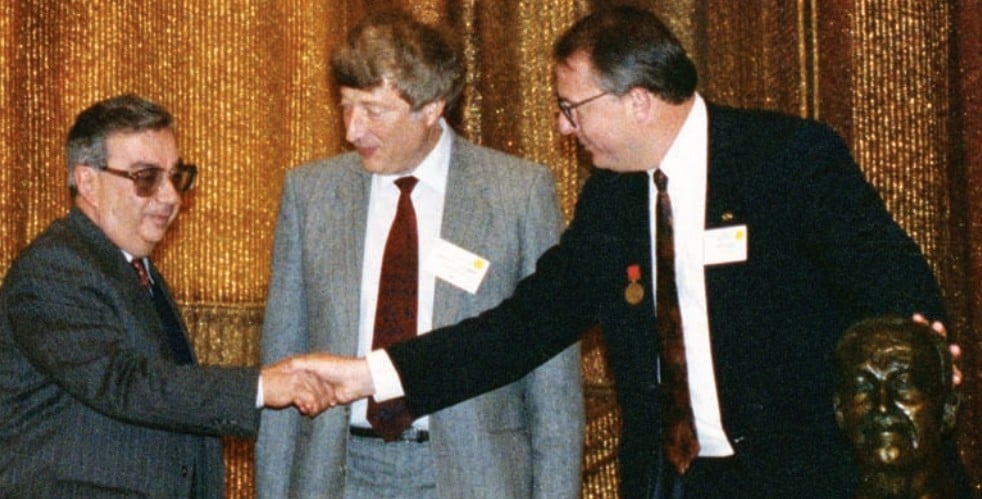
Crane was able to present a bust of famous libertarian economist and philosopher F. A. Hayek to Yevgeny Primakov, at that time chairman of the Council of the Union of the Supreme Soviet. The presentation took place at the Oktyabrskaya (now President) Hotel, used exclusively by the Communist Party Central Committee. CATO staff widely distributed institute pins ksto the hotel staff that had the words in Cyrillic, “private property” on the top and “capitalism” on the bottom.
The pins were a hot item and as Crane mentioned it “was probably a good indication that the end of communism was at hand.”
Fourteen years later, in early 2004 I got a call from Ed Crane asking if I could help in organizing another conference, this time in Putin’s Russia under the title “A Liberal Agenda for the New Century: A Global Perspective.”
Frankly, I hesitated a bit since at that time my connections in Russia’s high places were not as good as during Gorbachev’s and Boris Yeltsin’s days, so I asked for a few days to think about before agreeing.
However, the next day Crane called me to say that my help was no longer needed since they found another guy for this job. It was no one else but Andrei Illarionov, who at that time was sitting in the Kremlin not too far from Putin’s office.
For me it was a relief since I was not sure I could repeat success of 1990 since after NATO expansion, abrogation of ABM treaty, Iraq war, democracy promotion crusade, US popularity in Russia was rapidly fading.
Those who are interested, details of this conference can easily be found online, but here I only want to quote Crane’s words that for him this time “more impressive even than the conference was the energy and vitality in the streets of both Moscow and St. Petersburg. It is hard to describe, but people had a bounce in their step and a smile on their face. Economic activity was everywhere.”
With Illarionov’s help, nine conference VIPs had a four- and one-half-hour meeting with President Putin at his residence outside Moscow, where they urged the Russian president to speed up liberal reforms. Crane for his part, added the importance of the free press as the “first and foremost a civil liberties issue.”
I should mention that since 2012 Ed Crane is no longer CATO’s president, so he is not responsible for Illarionov firing.