Empty mall parking lot and existence of a munitions plant nearby raise questions about official narrative advanced in mainstream U.S. media
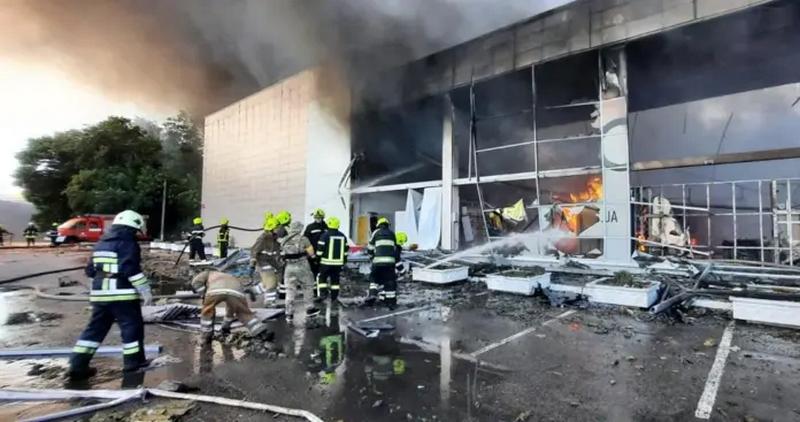
Firefighters put out blaze in Kremanchuk shopping center. [Source: nbcnews.com]
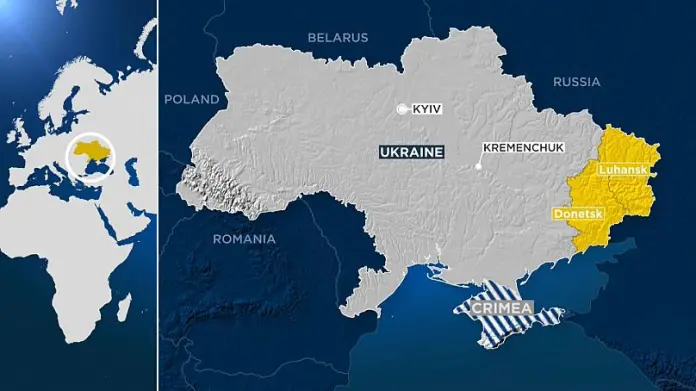
On Tuesday June 28, mainstream media outlets reported that at least 18 people were killed and dozens injured in a Russian missile strike on a “crowded shopping mall” in the central Ukrainian city of Kremenchuk on Monday.
Thirty-six other people were said to be missing and a survivor was on record saying that she had been shopping with her husband when the blast threw her into the air.
The Associated Press, Reuters, The New York Times, NPR and other news outlets reporting on the story used Ukrainian government officials as their primary source, notably Mayor Vitaliy Maletskiy—who wrote on Facebook that the attack “hit a very crowded area, which is 100% certain not to have any links to the armed forces.”
But they made no independent investigation as to the truth of the self-serving statement. Also without verification they quoted Ukrainian President Volodymyr Zelensky—who said in a Telegram post that the number of victims was “unimaginable,” and cited reports that more than 1,000 civilians were inside at the time of the attack.
However, other reports contradict Zelensky and suggest that the Russian missile attack in Kremenchuk is just one more false story about alleged Russian atrocities known to have been fabricated by Ukraine’s very active propaganda mill.
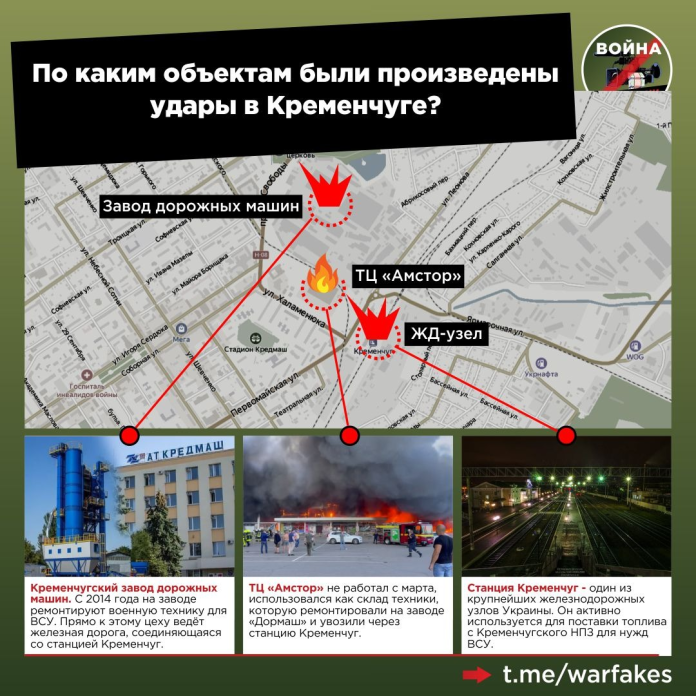
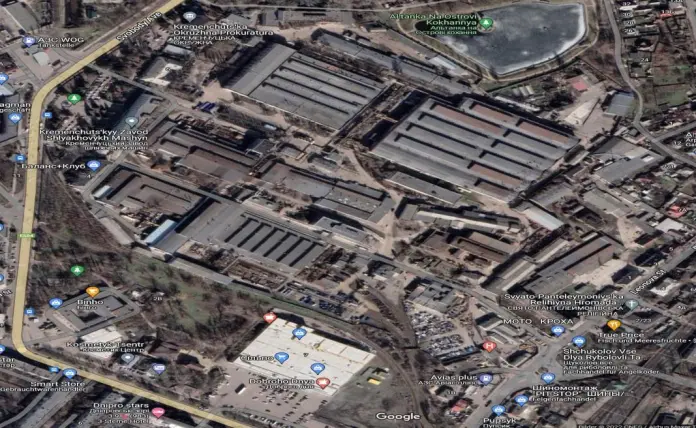
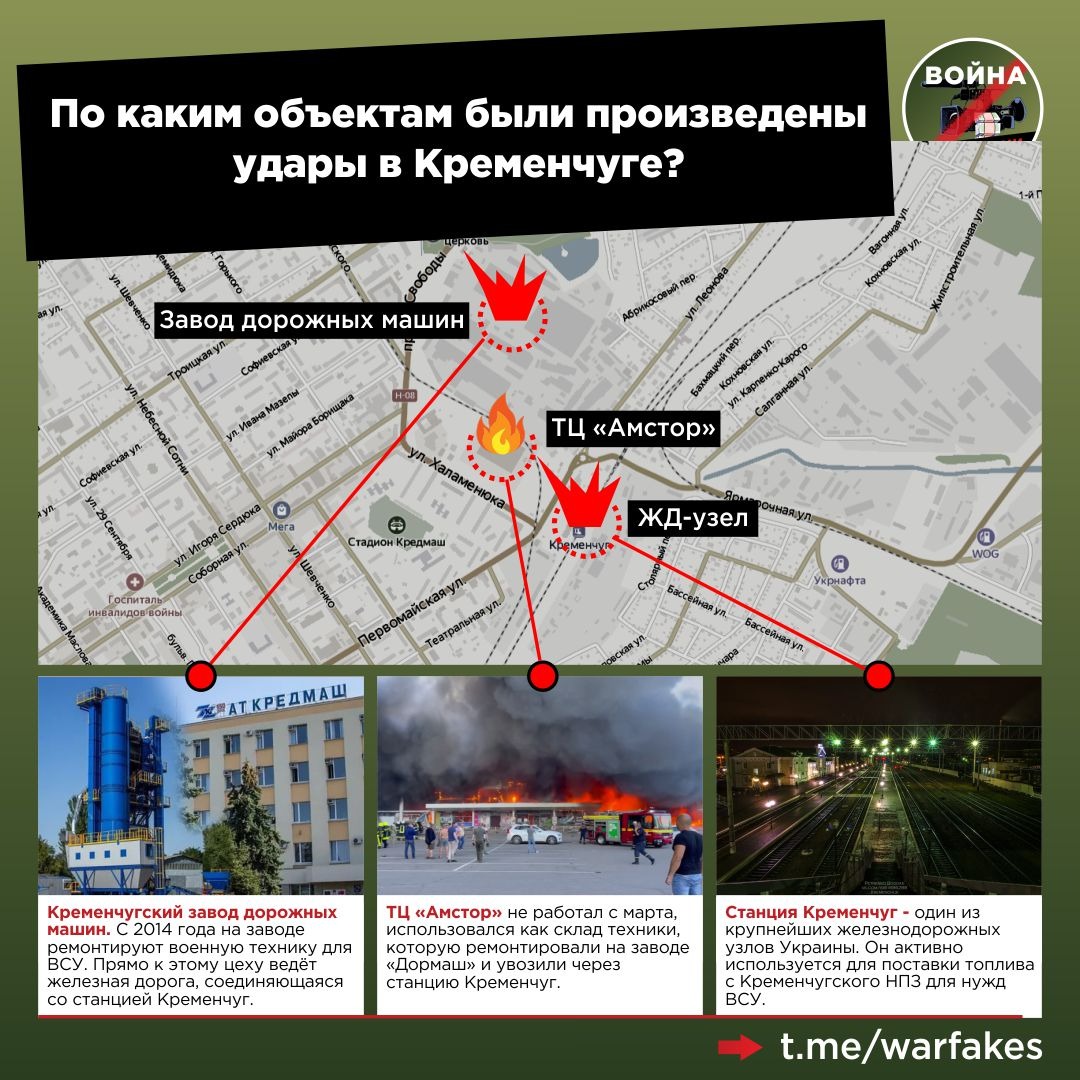
This seems credible because there were virtually no cars in the mall parking lot during the attack, let alone enough cars for 1,000 shoppers. And according to satellite imagery, adjacent to the mall was a machine plant that manufactured weapons.
This plant, Russia said, was the target of a legitimate military strike, which resulted in a fire in the adjacent mall that had been closed to business since the war began in February.
This looks potentially to be another case of that. Since the war began, a large percentage of the torture, mutilation, rape and mass killings featured daily in Western media have been committed by Ukrainian forces–sometimes out of mere brutality, as revealed by their own videos that they have posted online–but also as “false flag” events blamed on Russia to inflame world anger and encourage the West to send Ukraine more money and armaments.
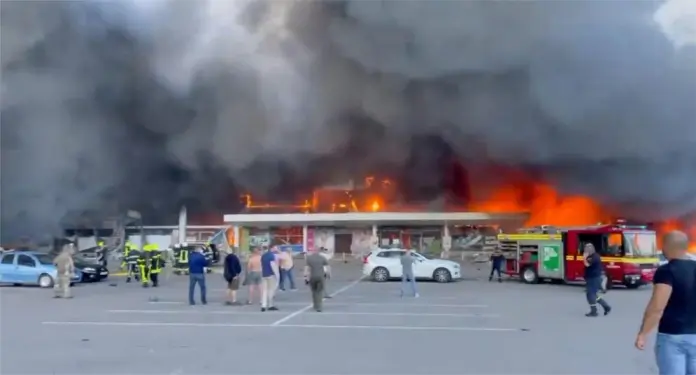
An RT News report featured Ukrainian government videos from the scene of the missile attack—videos which correlated with photographs featured on NPR’s website and those of other media outlets—that showed dozens of men, many in military uniforms, running in the mostly empty parking lot outside the burning building as black smoke rose into the sky.
The empty parking lot—with just the odd car. Not the sign of a crowded mall. [Source: cgtn.com]
The people running curiously did not seem to be running out of the building but next to it.
The article raised the legitimate question about why there were so few cars in the parking lot if 1,000 people were really inside the mall as Zelensky claimed.
It also referenced the factory next to the mall and a railway junction that was often a target of Russian missile strikes.
“Just Scrutinize the Facts”
Moon of Alabama’s June 28th political blog provided a link to satellite imagery confirming that the shopping mall in Kremanchuk was next to a large machine plant, which Moon said manufactured armaments that were being delivered to Ukrainian troops in Donbass.
After noting the Russian Defense Ministry’s claims, Moon wrote: “Ahhh—‘don’t trust the Russians!’ you say. Well, don’t trust anyone I say, just scrutinize the facts.”
Moon goes on to report about the empty parking lot and fact that only 16 people died and 25 were injured–meaning that over 900 survived unscathed. The video showed at most several dozen people in the parking lot, raising questions as to where all the survivors went.
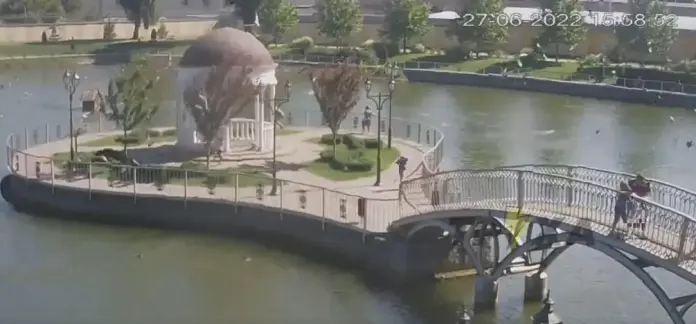
The Ukrainian government published surveillance video from a park located next to the machine plant which caught the moments of the two explosions, Moon notes.
A large flash appeared and people began running away as some debris—coming obviously from the machine plant after it was struck—fell down.
Satellite image. The light gray shopping area can be seen south of the machine plant in the center. The small park from which the surveillance videos come is directly north of it. The factory has direct rail access at its southern side with several rail tracks for loading and unloading machinery. Rail access makes it an ideal space for preparing or reparing heavy weapons. [Source: moonofalabama.org]
Moon concluded that: “the shopping center was obviously as empty as its large empty parking space…It somehow came on fire after the factory next door was bombed. Those who died were most likely soldiers or factory workers who were preparing ‘western’ weapons for delivery to the front.”
“People with far more commonsense than me posed a simple question: if it is a shopping mall then like all shopping malls around the world, there will be shoppers who will post—for good or for ill—their opinions of how good or bad their experience was. So they went out and looked and, sure enough, you can find online rating on a zero-to-five star scale for that shopping centre. All of those reviews—all of them—ceased at the end of February of this year i.e. when Russia launched its special military operation. The reasonable conclusion is that the moment this war began, that shopping mall was closed and its floor space turned over to the use of the Kredmash machine plant. 1,000 shoppers were inside that building? Bullsh**t.”
A video surfacing on telegram on June 25 did suggest that the mall was open by showing shoppers (the date though was hard to verify), and Human Rights Watch said it spoke to 15 people, including local officials and some of those they said were injured in the attack, who said the center was open.
Claims about a crowded mall being struck are still misleading, nevertheless, because a) we don’t yet know if the mall was ever directly struck by a missile; b) the empty parking lot could be explained by the mall’s having been evacuated earlier in the day if it was open to shoppers.
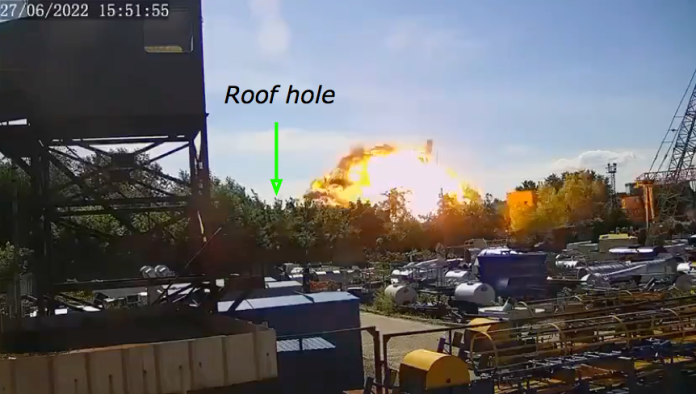
Additionally, all the structural vertical columns are still standing upright and no radial dispersion can be seen, making it clear that no blast occurred in this building, the roof simply molted down.
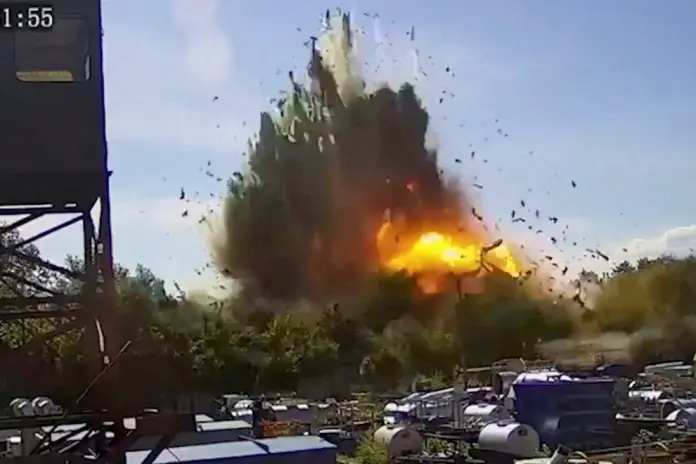
On June 29, President Zelensky released a new video published on CNN which claimed to provide more proof of the Russian strike on the shopping mall. However, the video actually showed an explosion next to some kind of industrial facility or scrap yard and no evidence of a mall being hit, lending greater credibility to the Russian narrative.
Video released by the Ukrainian government which does not actually show a mall being bombed. [Source: scmp.com]
The blast furthermore was too far to the right to have struck the mall directly.
[Source: captions courtesy of Raymond Lutz]
Whom Do You Believe?
The evidence, to be sure, is not yet conclusive, but at the very least the reporting by RT News and Moon of Alabama lays out some pertinent facts that are missing from the mainstream and even some alternative media.
RT and Moon of Alabama raise question marks about whether the mall had any shoppers at all at the time of the strike —let alone the 1,000 claimed by President Zelensky—based on the fact that its parking lot looked empty and people were not running from it but next to it as the building burned.
The Donbass Insider reported that the video released by Zelensky on June 29 shows that one of the two missiles launched by Russia hit the railway leading to the factory which are just behind the shopping centre. This is confirmed by satellite images from June 28 showing a crater on the rails that were used to bring in military equipment. This is where the fire most likely spread to the shopping centre.
Were Both Russia and Ukraine Wrong?
Raymond Lutz, a reader of the Moon blog who analyzed the videos from the blast in great depth, concluded that the Russian missiles hit neither the mall nor a machine plant, but rather a patch of vegetation and small trees just beyond the factory ground, which Lutz said was corroborated by the huge amount of earth being leveled up by the blast and the absence of a large crater at the impact point (the charge ignited with the missile deep into the ground, with a network of tree roots keeping soil projection limited).
According to Lutz, the two rectangles in the below photo are pivotal to disprove Kyiv assertions: they are the two walls that were illuminated by a flash of light emitted by the missile impact. This was not an explosion, but a bright flash of almost white color. Lutz says that if the flash lit those two external walls, then the flash was at the exterior of the mall.
The mall in turn caught fire because of the burning trees not because, as the Russians claimed, an armament cache was hit (or maybe the Ukrainian authorities set the fires themselves to create a media buzz).
Pretext For Further Escalation of War
The alleged mall attack is being used now to validate the further expansion of Western involvement in Ukraine.
At the G-7 summit in Madrid this week, President Joe Biden proclaimed that the United States was strengthening its forces in Europe and announced the establishment of a permanent military base in Poland, Russia’s traditional enemy.
French President Emmanuel Macron meanwhile on Tuesday called the Russian attack in Kremanchuk “a new war crime,” while Zelensky addressed the UN Security Council saying Russia was a “terrorist state,” committing “daily terrorist acts.”
“We need to act urgently to do everything to make Russia stop the killing spree,” Zelensky said.
References
The BBC disputed that the plant manufactured any military equipment, claiming that it made road equipment, and machines for road construction
The details of the peace deal presented today by US special envoy Steve Witkoff are consistent with the report in the Financial Times discussed in my previous article and with Larry Sparano in the posted interview. Putin will halt the Russian advance prior to driving Ukrainian soldiers out of all of the territory that has been reincorporated into Russia. It appears to be the case that the borders between Russia and Ukraine will be the current front line, so Putin is withdrawing Russia’s claim to the Russian territories still under Ukrainian occupation.
Russia and the US seem near a Ukraine peace deal. Kyiv’s role may be moot.
President Donald Trump’s hopes of securing a quick Ukraine peace deal hang in the balance after Washington’s envoy, Steve Witkoff, held his fourth Kremlin meeting with Russian President Vladimir Putin Friday.