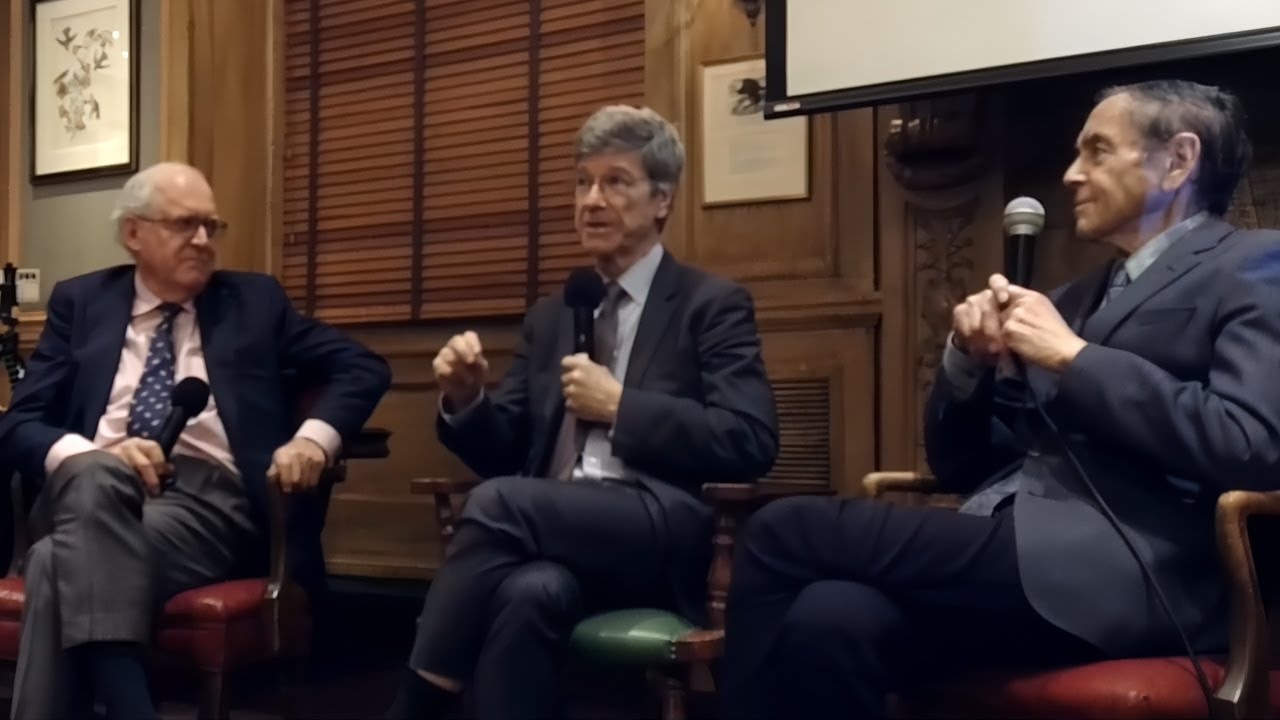
Columbia Professor Jeff Sachs will address the Ukraine war, the Israel-Palestinian war, the dollar as the world’s reserve currency, the nation’s burgeoning debt and the role the US military in the pandemic.
Introduction by Committee Chairman John Henry:
Tonight’s talk is with Jeff Sachs. Jeff graduated a few years behind me at Harvard College and went on to become one of the most celebrated economists of our generation.
Jeff is the perfect person to explain how the dollar reserve fiat currency silences political debate over the $1.5 trillion we spend annually on our imperial infrastructure and military adventures abroad. Jeff is passionate in his opposition to our war in Ukraine.
Indulge me for a moment in an act of political and historical imagination. Let us imagine we lived in an American Republic rather than an American Empire. Let us imagine that Congress did its job as it did than a century ago when we had the greatest legislature in the history of the world. Our foreign policy operated inside – not outside – the Constitution. Separation of powers was alive and well. Congress – bear with me, let’s imagine – exercised its exclusive Constitutional power to declare war. Let’s imagine Congress – rather than the Committee – invited Jeff to testify on whether to provide Ukraine with massive military assistance.
Here’s what the debate would sound like. Kentucky’s Senator Henry Clay insists on United States neutrality. Clay proclaims: “We must never forsake our wise policy of peace except in self-defense. Far better is it for us and the cause of liberty that we keep our lamp burning brightly on our shores as a light to all nations than to hazard its utter extinction on a cross of counterfeit national security.”
Then Massachusetts Congressman John Quincy Adams – who entered the House after his presidency – elaborates: “I am opposed to the United States becoming a co-belligerent or a belligerent except in response to aggression on our sovereignty that has already broken the peace. We have a spear and a shield, but the motto on our shield is freedom, independence and peace. We dare not go abroad in search of monsters to destroy. Our national glory would plunge from liberty to force, from the march of the mind to the march of the foot soldier.”
Illinois Congressman Abraham Lincoln denies that the war in Ukraine warrants the United States abandoning neutrality. Lincoln underscores we’re the safest country in the history of the world: “At what point shall we expect the approach of danger? Shall we expect some military giant to step the ocean and crush us at a blow? Never! All the armies of Europe, Asia and Africa combined with the treasure of earth in their military chest, with a Bonaparte for a commander, could not by force, take a drink from the Ohio or make a track on the blue ridge, in a trial of a 1,000 years. If danger ever reach us, it must spring up among us. It cannot come from abroad. If destruction be our lot, we must ourselves be its author. As a nation of freemen, we must live through all time, or die by suicide.”
Massachusetts Senator Daniel Webster thunders like a hammer on an anvil: “Invincible self-defense and influence abroad by example is the Constitution’s foreign policy unless disturbed by an act of Congress. I ask unanimous consent to approve a joint resolution demanding the filing of articles of impeachment against President Joe Biden for making the United States a co-belligerent with Ukraine in its war against Russia.”
Okay, the good dream is over. Back to reality. We are subjects of an empire – not citizens of a republic. Impeachment is off the table. The only choice we have is between a Republican Caesar and a Democratic Caesar. Jeff Sachs isn’t called to testify before Congress. Jeff, you win the consolation prize. I ask to join me in welcoming Jeff Sachs tonight to the Committee for the Republic.
Salon Announcement:
Columbia Professor Jeff Sachs will address the Ukraine war, the Israel-Palestinian war, the dollar as the world’s reserve currency, the nation’s burgeoning debt and the role the US military in the pandemic.
Sachs recently testified with Ray McGovern before the United Nations on the Ukraine War. He sees Russia’s fear of NATO expansion as rational and the principal factor in the outbreak of the war. What are the consequences of the US continuing to be NATO’s principal financier? Should the United States withdraw from NATO?
Sachs will explain the role of the dollar as the world’s reserve currency. How does our exorbitant privilege allow the United States to finance our militarized foreign policy to the tune of $1.5 trillion annually? Would the American people accept the tax increases needed to finance our imperial spending on a pay-as-you-go basis?
In 2023, we are seeing a massive long-term increase in government borrowing — estimated at $2–3 trillion a year by the CBO for the next 10 years. Sachs will address whether massive money printing will likely be needed to finance that debt. Is that level of borrowing and printing sustainable and, if not, what will happen to the economy?
The US military played a larger role in the pandemic than is commonly known. Sachs headed a panel of physicians sponsored by the Lancet investigating the origins of the Covid 19 virus.
Jeffrey Sachs is Director of the Center for Sustainable Development at Columbia University, where he directed the Earth Institute from 2002 until 2016. He is also President of the UN Sustainable Development Solutions Network and a commissioner of the UN Broadband Commission for Development. He has been advisor to three United Nations Secretaries-General, and currently serves as an SDG Advocate under Secretary General António Guterres. He spent over twenty years as a professor at Harvard University, where he received his B.A., M.A., and Ph.D. degrees. He has authored numerous bestseller books. His most recent book is The Ages of Globalization: Geography, Technology, and Institutions (2020). Sachs was twice named as one of Time magazine’s 100 most influential world leaders and was ranked by The Economist among the top three most influential living economists.
Donald Trump Should Not Repeat Woodrow Wilson’s Failure
April 30th is an important date in American politics. This is the day 100 for the American President in the White House, and all attention will be on the reports of his achievements and failures. But nothing can be more critical than Peace…
○
6 mins read
A Holocaust perpetrator was just celebrated on US soil. I think I know why no one objected.
Russia’s invasion has made ordinarily outspoken critics of antisemitism wary of criticizing Ukrainian Nazi collaborators
○
1 min read
Qi Book Talk: The Culture of the Second Cold War by Richard Sakwa
Richard Sakwa has for many years been one of the most distinguished and insightful observers of relations between the West and Russia, and one of the leading critics of Western policy. In this talk with Anatol Lieven, director of the Eurasia program at the Quincy Institute, Sakwa discusses his book, The Culture of the Second Cold War (Anthem 2025). The book examines the cultural-political trends and inheritances that underlie the new version of a struggle that we thought we had put behind us in 1989. Sakwa describes both the continuities from the first Cold War and the ways in which new technologies have reshaped strategies and attitudes.