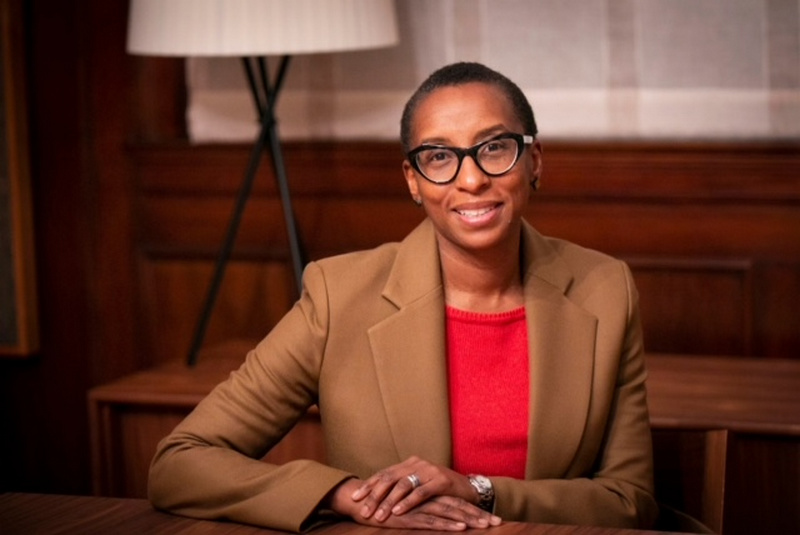
I sympathize with the former president of Harvard University, Claudine Gay, who was swiftly elevated to the pinnacle of academic Olympus by the will of the times and, after a short period of power and glory, was just as sensationally dethroned from her high pedestal.
Her time chose her
I haven’t studied the details of Claudine Gay’s biography and personal characteristics, but there is no doubt that she gained the status of president of the most famous university in the country and in the world not through intrigue and patronage, but because the new paradigm of American public life, the new system of moral and cultural values, demanded it. Diversity, inclusivity, and equality have been placed at the forefront as national priorities. These concepts can be interpreted in various ways, but the new ideology has given them the status of unassailable biblical commandments. Non-believers and dissidents were subjected to public condemnation and academic ostracism.
Claudine Gay was the right person at the right time in the right place, a symbol of the era, adequate to its values and morals. And democratic principles were not violated. Conservatives in higher education are in deep underground, and no academic freedoms will save them from the wrath and alienation of the new generation of colleagues and students. At Harvard, conservatives make up only 3%, and they are living out their last years. In these conditions, Claudine’s qualifications, publications, and organizational skills played no role. Soviet-era scientists and professors are well familiar with such a situation. The appointee to the position of director or university rector was not necessarily from the ranks of scientific and pedagogical authorities. The decisive role was played by working-peasant origin and loyalty to the party line. In student admissions and faculty selection, the party-class approach was also paramount. Former weaver and Komsomol activist Ekaterina Furtseva, having become the Minister of Culture, taught sense to scientists of world renown, great musicians, actors, artists. And this was not the worst period in the life of Soviet intellectuals and creative workers. Of course, there are still differences today between the position of academic institutions under party dictatorship and under the dictatorship of “awakening”. Nomenklatura appointees did not have to justify their lack of professional qualifications.
But Gay and her colleagues could not avoid public criticism. When they meekly babbled in Congress about freedom of speech and “context,” it was obvious that they were following lawyers’ instructions and did not believe what they were saying. And if the presidents had admitted that the tone in the life of elite universities is set by rabid antisemites, hatred would have fallen upon their heads.
Hearings in Congress, criticism in the press, complaints from Jewish students and organizations would not have shaken Gay’s position, she would have gained the status of a fighter for the right cause, for justice, and opponents and critics would have been labeled as Zionists and their accomplices. But… a plagiarism issue arose. Churchill is credited with saying that scandalous morals reign in academies because the stakes are so low. Indeed, in quasi-scientific disciplines and publications, it is hard to say something new, original; banalities and verbiage are common property, and who said it first matters little.
But in America, starting from school, very strict requirements for the protection of intellectual property are established, often reaching absurdity in social sciences. A schoolchild barely knows how to read and write, is profoundly ignorant, and can live with it and get a high school diploma. But some commonplace without citing the source – scandal, investigation, punishment.
I remember, my grandson showed me his first history essay, the topic was dedicated to the Russian October Revolution. The date of the Revolution had a footnote to some textbook. I said that in this case there is no need to reference, it is a well-known fact. I did not convince my grandson, he followed the school’s instruction. Teachers are equipped with a computer system that can detect every line that matches previously published ones, surely, Gay used it too. I cannot judge why she neglected the obvious requirements. Accusations of plagiarism came not from world-renowned scientists, not from fighters against affirmative actions, but from colleagues engaged in the same politically correct issues. Colleagues were offended that Gay borrowed material from their dissertations and publications without naming them. This did not look like an attack on the first black woman from racists, reactionaries, and Zionists. (However, there is no doubt that the masses will perceive her removal from office in exactly this way.)
Gay’s doctoral dissertation topic “The Effect of Black Representation in Congress on Participation in Politics.” If it were not for the dictate of ideology, the scientific advisor and the council would not have approved such a topic. Or at least would have named it differently, giving it some semblance of science. With any talents and diligence, such a topic is unlikely to lead to a scientific revelation. The concept, goals, conclusions are known a priori: racism, inequality, restriction of rights – bad, political activism, fighting for justice, advancement of minorities – the highway of progress and universal prosperity.
A question without a scientific basis may be relevant and the topic of a popular publication, corresponding to the demand of the times and the market of interests. “Critical Race Theory” reflects the worldview of millions, and the flow of such literature is not surprising. It is surprising that its authors become doctors of science and professors and determine who to trust with a university chair.
The problem of racial, ethnic, religious relations in America undoubtedly has colossal social significance and can and should be the subject of serious and objective scientific analysis. But if anyone has doubts about the dogmas, they wouldn’t think of seeking recognition in the current atmosphere in academic institutions.
Again, the situation is much like the conditions of life and work of Soviet social scientists. Among them were not only rabid fanatics but also erudite, creative people who saw better than others the essence and vices of the social system. But it was unthinkable to defend a dissertation or publish a work not in the spirit of the canon and the times. When the world-famous economist, president of Harvard Larry Summers doubted that rap, despite its popularity, is a scientific problem and also explained the small representation of women in mathematics by biological characteristics, he was forced to resign even without Congressional hearings. A lesson to all dissidents. In 1987, Alan Bloom’s monograph “The Closing of the American Mind” was published – about the transformation of universities into schools and centers of propaganda and agitation. At that time, there was still hope to resist intellectual degradation. Today, it is hard to imagine what forces can stop the complete and final victory of progressive demagoguery.
Half-educated is worse than uneducated
For centuries, education has been the hope and support of ideas of progress and social well-being. In America, having gathered children of different races, ethnicities, religions, traditions from the very foundation of the country, education was seen by the founding fathers, people of extensive knowledge and humanistic convictions, as a school for educating a citizen, a patriot, aware of the unique characteristics of the country and their obligations to it. Today, America spends one and a half trillion dollars a year on education, more than any other country in the world. The priority is obvious in spending on the material base of education, the latest technologies, and equipment. State and local allocations are supplemented by powerful sponsorship donations. Almost every year, federal and state reforms are conducted, new teaching methods are introduced by decrees and on their own initiative. Public school teachers have good salaries, an average of 70,000 and social guarantees, in private schools the conditions are even better. But overall, the level of education in the United States lags significantly behind the leading countries.
Today, widespread dissatisfaction is caused by the saturation of school programs with sexual education and progressive ideology, the revision of history and the literary canon, “Critical Race Theory” and the like, but this still does not explain such a low level of knowledge in mathematics, natural sciences, and language. The school could cope with the dual task of the times: to delude children with utopian ideas about the nature of man and society and at the same time teach them to read, write, and count.
One can criticize the state and progressive trends, but the main problems of the ineffectiveness of school education are family upbringing and environment. From elementary school to universities, there are clear differences in educational outcomes depending on family conditions and social groups. In the same schools and colleges, Asian students outperform their classmates even when they come to America without knowing English and live below the poverty line. Asians, especially the Chinese, the most successful group in education and socio-economic advancement, face a lot of racial prejudice, but they do not demand special rights and support. Asians make up 6% of the country’s population, but in elite schools and universities, they are about 50%, and such success did not require affirmative actions. On the contrary, the system of racial and economic privileges for other minorities hinders the even more successful advancement of Asians.
The most difficult situation is in the African American community. Pastor Corey Brooks of a church in South Chicago told Tablet about a school in his area where only 4% of children meet the requirements for math and 6% for English. “I get sick when I read about the culture war associated with DEI – diversity, equality, inclusivity during the process of Claudine Gay… Gay’s defenders convince that they are fighting for communities like mine… They say that systemic racism is in the DNA of America and that white supremacism, the opposition of oppressors and the oppressed, leaves no room for understanding what is happening.” A black pastor can say what others won’t: “DEI is the ideology of the privileged, and it helps people like Claudine Gay, who exploit racism for the sake of power and prestige and harm communities like mine… They use our pain to rise through American institutions. Their soul-destroying poison is as deadly for us as drugs… My community has been bombarded by liberal policy since the 1960s… The racial game is deadly for black Americans and for all of America.” Few hear this voice, but everyone knows about Gay’s rise and fall and the manifestos “Black Lives Matter”.
I have not had the experience of teaching in areas like those Pastor Brooks writes about. But my experience in Harlem and Jamaica, Queens, also left an impression of deadlock and hopelessness. Reading a chapter in a textbook is an impossible task for most students. Teachers, almost all hourly workers, are afraid of losing their precarious jobs and turn a blind eye to students’ unpreparedness for learning and attendance. Giving a poor grade is more expensive for themselves, a scandal with a student and the administration will not like it. For me, the hardest part was with the “Jewish question,” this topic has always been relevant. It usually started with a Jewish landlord-exploiter. I can’t figure out who’s right and who’s wrong, I myself then lived in Boro Park with a Hasidic host, about whom I do not remember fondly. Why religious Jews are so often landlords in black neighborhoods, I don’t know, it would be better for them to find another occupation. But it didn’t stop with landlords.
Sociology class, a lesson on the topic of crime. One of the students, about fifty years old, he needs a diploma to become a supervisor, explains why there are many blacks in prisons, but few Jews: “The Jew shows the Jewish judge a ring on his finger with a special sign, he won’t be put in jail.” The audience supports understandingly. There are no arguments that will convince that not all power and money are with the Jews. That Jews supported Martin Luther King more than any other. That today Jewish Soros spends money not on Jews, but on black activists. That Jewish Sanders raised a cohort of black politicians in power. That Jewish liberals care more about the socio-economic advancement of minorities than their own problems. The predictable response to these arguments: Jews are trying to create an illusion of goodwill to keep blacks under control. But even later, when I taught students who never knew poverty, lived in expensive areas, had parents in complete well-being, it was impossible to shake their confidence that Palestinians are victims, and Israel and the Zionist lobby are aggressors and occupiers.
Not only Jews, the entire white race has become oppressors and privileged. Ilya Bratman, an immigrant from Russia, a college teacher and Jewish activist, gave students an assignment to express their attitude to the colonization of Mars. Opinions were divided. One student wrote that resettlement is a good idea – whites will fly away and give others a chance to live freely. Another believes that whites, as is their custom, will colonize Mars and destroy the life of the local inhabitants. In one of Philip Roth’s most famous novels, “The Human Stain,” a light-skinned African American decided to change his family history and, in search of a job as a professor of classical literature, presented himself as a Jew in his resume. He thought it would be easier to live and work that way. In his class, two students were constantly absent. One day the professor asked: “Does anyone know these people? Do they exist or are they ghosts?” It turned out that the truants were black, and the question was deemed racist. The professor lost his job.
Roth’s novels seem to be the product of the author’s unrestrained imagination, but in American literature, there is no other classic who so openly and intensely drew plots from his own life and the life of close acquaintances. And in “The Human Stain,” the prototype of the victim of political correctness was Roth’s friend, a professor from Princeton. In another life, on another planet, I would say that young imbeciles, drawing a swastika in the school toilet or writing an essay about the genocide of Palestinians, are not racists, not anti-Semites, but just ignorant and naive, and it’s not their fault. But when they determine the atmosphere of the school, college, the fate of the teacher, when they go out with pogrom moods on large demonstrations in support of “Black Lives” and Hamas, they become a dangerous political force. Especially when those who have not lost common sense and understanding of what is happening are silent and feel powerless in the face of ignorance and hatred.
Donald Trump Should Not Repeat Woodrow Wilson’s Failure
April 30th is an important date in American politics. This is the day 100 for the American President in the White House, and all attention will be on the reports of his achievements and failures. But nothing can be more critical than Peace…
○
6 mins read
A Holocaust perpetrator was just celebrated on US soil. I think I know why no one objected.
Russia’s invasion has made ordinarily outspoken critics of antisemitism wary of criticizing Ukrainian Nazi collaborators
○
1 min read
Qi Book Talk: The Culture of the Second Cold War by Richard Sakwa
Richard Sakwa has for many years been one of the most distinguished and insightful observers of relations between the West and Russia, and one of the leading critics of Western policy. In this talk with Anatol Lieven, director of the Eurasia program at the Quincy Institute, Sakwa discusses his book, The Culture of the Second Cold War (Anthem 2025). The book examines the cultural-political trends and inheritances that underlie the new version of a struggle that we thought we had put behind us in 1989. Sakwa describes both the continuities from the first Cold War and the ways in which new technologies have reshaped strategies and attitudes.