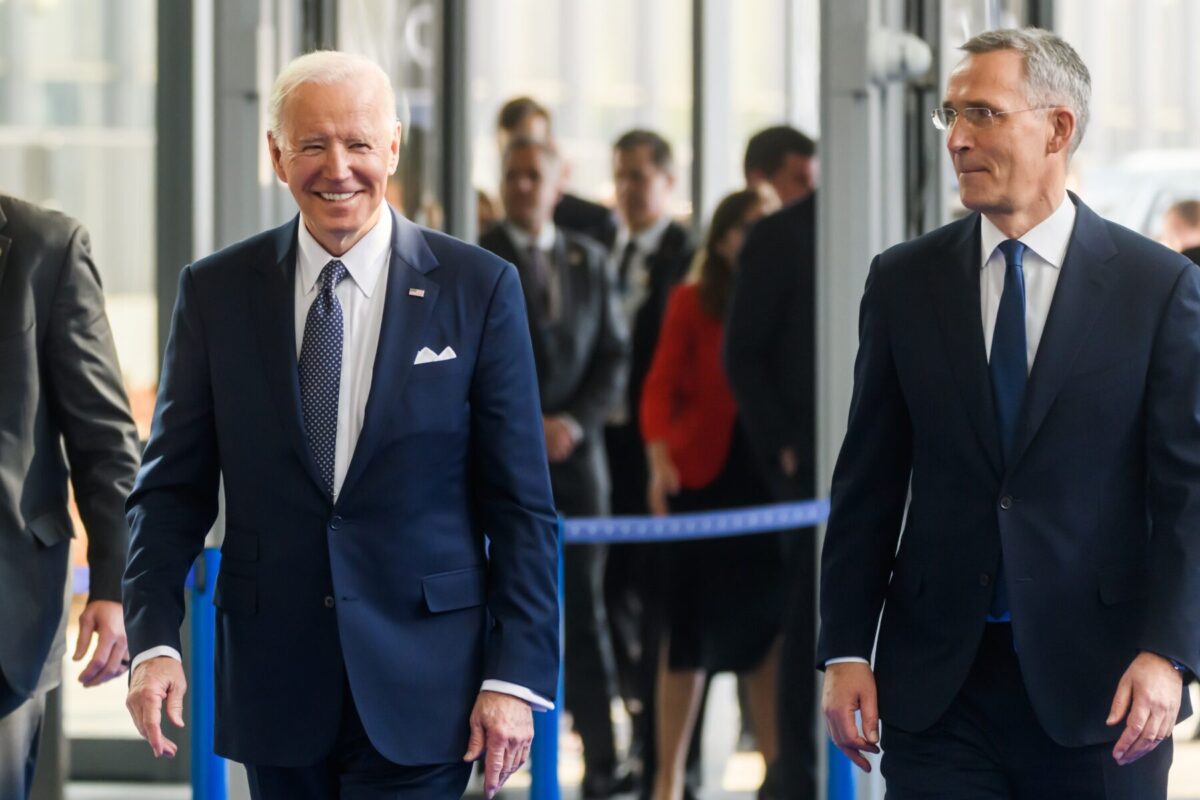
Rejecting membership for Kiev, the NATO summit reminds Ukrainians that the US and its allies won't defend them from Russia -- only use them to bleed it.
Photo by Sean Gallup/Getty Images
When it comes to military support for Ukraine, the Biden administration’s mantra has been “as much as it takes, for as long as it takes.” The recent NATO meeting in Lithuania put the limitations of that commitment on display.
Ukraine’s top priority was a road map for its long-promised admission to NATO. But President Biden ruled that out before the summit even began. “I don’t think it’s ready for membership in NATO,” Biden said of Ukraine, speaking to CNN.
Biden cited NATO’s collective self-defense pledge, which would mean that, if Ukraine joins, “we are at war with Russia.” He also argued that Ukraine, irrespective of NATO’s Article 5, is not up to the alliance’s standards. Admitting Ukraine would be “premature,” Biden said, “because there is other qualifications that need to be met, including democratization and some of those issues.”
Accordingly, the summit’s final communiqué moved Ukraine no closer to NATO membership than the 2008 statement in Bucharest, Romania that first promised it. NATO only ambiguously said that it will be “in a position to extend an invitation to Ukraine to join the Alliance when Allies agree and conditions are met.” The vague announcement did not specify when that “position” to invite Ukraine might come, or what those “conditions” are.
Having tethered his country’s future to NATO, Ukrainian President Volodymyr Zelensky responded with outrage. NATO’s new language, he said, is “unprecedented and absurd.” Zelensky singled out the absence of a “time frame for the invitation,” and that the “strange wording about ‘conditions’ is added even for inviting Ukraine.”
Zelensky’s protest did not last long. Within 24 hours, he reversed course and hailed the summit as “a meaningful success” that grants Ukraine “absolutely new security opportunities.” Zelensky’s newfound “appreciative tone,” the Wall Street Journal observed, indicated that he had “bowed to political reality” and “needed to show a positive attitude toward allies supplying his country with weapons and cash to keep its government running.”
In other words, Zelensky recognized the “political reality” that his NATO patrons allow for his political survival and personal enrichment.
Although Zelensky backed down, the US and its allies nonetheless made sure to remind him of his place. Western officials told the Washington Post that Zelensky’s outburst had prompted a reconsideration of their already tepid invitation. “Some wanted to withdraw the reference to ‘invitation,’” one NATO diplomat said. The US delegation also gave word that they were “furious” with Zelensky.
Attempting a positive spin, NATO Secretary-General Jens Stoltenberg declared that Ukraine is “now closer to NATO than ever before.” Yet Stoltenberg also let slip a condition that Zelensky would surely not welcome. “Unless Ukraine wins this war,” the NATO chief said, “there’s no membership issue to be discussed at all.”
If winning this war against Russia is NATO’s de-facto requirement for Ukrainian admission, then Kiev’s membership card has already been rescinded. And there are ample grounds to question whether the invitation was ever genuine to begin with.
Zelensky has previously admitted as much. In March 2022, the Ukrainian president disclosed that had played along with a charade intended to bait Russia. “I requested them [NATO] personally to say directly that we are going to accept you into NATO in a year or two or five, just say it directly and clearly, or just say no,” Zelensky said. “And the response was very clear, you’re not going to be a NATO member, but publicly, the doors will remain open.”
Speaking to CNN last week, Biden made another telling admission. At their June 2021 summit in Geneva, he recalled, Russian President Vladmir Putin “said ‘I want commitments on no Ukraine and NATO.’” But according to Biden, “I said we’re not going to do that, because it’s an open-door policy. We’re not going to shut anybody out.”
In fact, Russia was shut out when Putin raised the possibility of joining NATO two decades ago. But more importantly, Zelensky and Biden’s accounts raise an obvious question: why did the US and Ukraine risk a catastrophic war for the sake of an “open-door policy” that, as the NATO summit newly underscores, won’t actually open a door?
One possibility is that the real goal was not to admit Ukraine into NATO. Instead, under the guise of a perpetually “open door”, NATO has gained a back-door through which it has flooded Ukraine with Western weapons to attack ethnic Russians in the Donbas and threaten Moscow — all without the obligation to come to Kiev’s defense when the Kremlin strikes back.
Writing one month before Russia’s February 2022 invasion, New York Times national security correspondent David E. Sanger noted that a “complex” issue in the US-Russian standoff was “how the United States and NATO operate” inside the country – specifically, by flooding the country with weapons. Since 2014, Sanger wrote, the US and NATO allies have provided “Ukraine with what the West calls defensive arms, including the capability to take out Russian tanks and aircraft.” Russia believed that these “weapons are more offensive than defensive.”
Rather than entertain Putin’s June 2021 request for Ukrainian neutrality, the Biden administration put Ukraine’s NATO integration into overdrive. In August 2021 – two months after their summit in Geneva, and seven months before Russia invaded — Washington and Kiev signed the U.S.-Ukraine Strategic Defense Framework, which called for collaboration “to advance the military capabilities and readiness of Ukraine” and “progress toward NATO interoperability.” This was followed in November 2021 by the U.S.-Ukrainian Charter on Strategic Partnership, which declared U.S. support for “Ukraine’s aspirations to join NATO” and touted “Ukraine’s efforts to maximize its status as a NATO Enhanced Opportunities Partner.”
In multiple warnings ahead of the invasion, Putin said that Ukrainian integration into NATO – as a formal member or not – put Russia’s security at risk. “The threat on our western border is really growing,” Putin said in December 2021. “It is enough to see how close NATO military infrastructure has moved to Russia’s borders. This is more than serious for us… We suggest that substantive talks on this topic should be started.”
But when Russia attempted to resolve its concerns with two draft treaties in December 2021, the US and NATO rejected them.
Zelensky, having chosen to enable NATO’s “open door” deception, also refused to engage with Russia’s core demands. For years leading up to February 2022, Moscow insisted that Zelensky implement the Minsk Accords, the 2015 pact for ending the war between Kiev and Russian-backed Ukrainian rebels. Under pressure from Ukraine’s far-right and their bipartisan allies, Zelensky ultimately balked.
Zelensky shunned more opportunities after Russia invaded. As is now well established, Ukraine and Russia were close to a peace deal in April 2022. Sources close to Zelensky, US officials, NATO allies, and Putin himself have all confirmed that there was a deal premised on Ukrainian neutrality in exchange for a Russian withdrawal to its pre-invasion lines. But according to Ukrainian officials, UK’s Boris Johnson — presumably with US support if not direction — blocked the talks.
“The draft agreement between Russia and Ukraine, which was prepared in Istanbul and was subsequently tossed into the trash bin by the Ukrainian regime, set out in great detail the issues of ensuring Ukraine’s security,” Putin said this week. “Ukraine, of course, has a right to ensure its security,” Putin added, with one condition: “the work to achieve security for one country shouldn’t create threats for another country.”
Rather than accept Putin’s condition, Zelensky has instead let NATO set illusory conditions that have offered Ukraine no protection and no meaningful chance of joining NATO. Whereas Zelensky now claims that Ukraine has received “new security opportunities” from the alliance, in reality that means more of the same: a back-door through which the US and its partners can fight Russia by sacrificing Ukrainian lives.
The details of the peace deal presented today by US special envoy Steve Witkoff are consistent with the report in the Financial Times discussed in my previous article and with Larry Sparano in the posted interview. Putin will halt the Russian advance prior to driving Ukrainian soldiers out of all of the territory that has been reincorporated into Russia. It appears to be the case that the borders between Russia and Ukraine will be the current front line, so Putin is withdrawing Russia’s claim to the Russian territories still under Ukrainian occupation.
Russia and the US seem near a Ukraine peace deal. Kyiv’s role may be moot.
President Donald Trump’s hopes of securing a quick Ukraine peace deal hang in the balance after Washington’s envoy, Steve Witkoff, held his fourth Kremlin meeting with Russian President Vladimir Putin Friday.