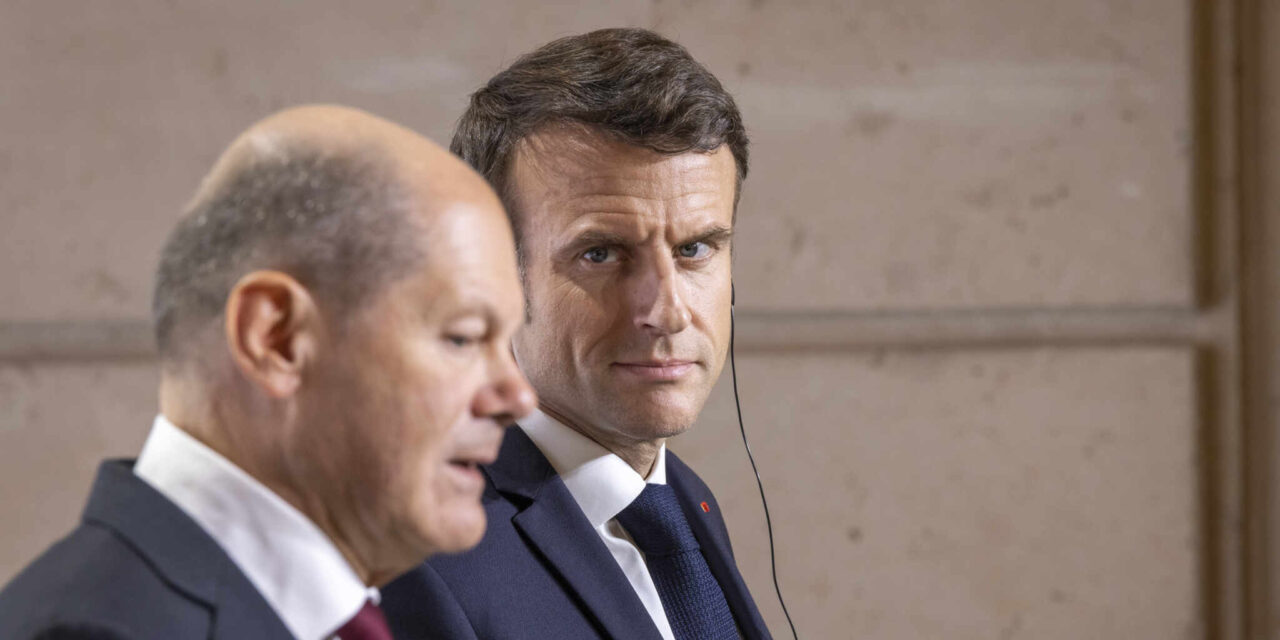
Russia's invasion of Ukraine has exacerbated a rivalry for leadership between Chancellor Olaf Scholz and President Emmanuel Macron, while revealing the profound differences in strategic approaches between the two countries.
JEAN-CLAUDE COUTAUSSE FOR LE MONDE
On the evening of Monday, February 26, it was raining in Paris. The courtyard of the Elysée Palace was pitch dark as Olaf Scholz discreetly took leave of Emmanuel Macron. Unlike other leaders who had come to attend the international conference in support of Ukraine, organized by the French president two years after the start of Russia’s invasion of the country, the German chancellor slipped away without making a statement to the press. Earlier, during festivities at the Elysée Palace, Scholz had joined forces with Spain’s Pedro Sanchez, Greece’s Kyriakos Mitsotakis and Slovakia’s Robert Fico to nip in the bud the debate initiated by on sending Western troops to Ukraine.
“There’s no consensus today to send in an official, endorsed manner troops on the ground. But in terms of dynamics, nothing can be ruled out,” maintained the French president at the end of the conference. He added: “Many of the people who say ‘never, never” today were the same people who said ‘never, never tanks; never, never planes; never, never long-range missiles.’ (…) I remind you that two years ago, many around this table said: ‘We will offer sleeping bags and helmets.'” It was a clear allusion to Germany, which made a fool of itself in the eyes of its allies in January 2022 by trumpeting the shipment of 5000 helmets to Ukraine.
Above all, it was a stern dig at Scholz, who has balked every time there’s been talk of taking military support for Kyiv to a new qualitative level. The Social Democrat leader’s response was swift. “What was agreed among ourselves and with each other from the very beginning also applies to the future, namely that there will be no ground troops, no soldiers on Ukrainian soil sent there by European countries or NATO states,” he replied the very next morning, on the sidelines of a visit to Freiburg im Breisgau, in southern Germany.
The episode gives an idea of the incomprehension plaguing cooperation between France and Germany in the face of the conflict in Ukraine, well beyond the obvious differences in style that pit the leaders of the two countries against each other. Between Macron, deliberately grandiose and disruptive, and Scholz, resolutely quiet and cautious, the gulf has been widening steadily over the months. Each is giving the impression of playing his own part, rather than seeking to coordinate, no longer hesitating to criticize the other publicly.
The way in which the French president launched the debate on Western military presence in Ukraine is leaving its mark. Scholz was very unpleasantly surprised that Macron would publicly report on discussions held behind closed doors, and rather annoyed by his account of them. “He [Macron] said that there was no consensus on the subject, but that’s not true: The truth is that France was isolated because most participants expressed their clear refusal,” said a source on the German side. The French government, on the other hand, is claiming that participants had come with full knowledge of the facts and that many of them expressed themselves neither for nor against the prospect.
To pick up the pieces, German Foreign Minister Annalena Baerbock was invited to Paris on March 5 by her French counterpart, Stéphane Séjourné. The two ministers spoke for an hour but did not risk holding a joint press conference after their exchange. The patch-up operation came to a halt the very same day, when Macron, from Prague, urged his allies to “equal to the challenge of history and the courage it implies,” saying that Europe was entering a moment “where we must not be cowards.” This time, it was German Defense Minister Boris Pistorius who reacted: “We don’t need really, from my perspective at least, talk about boots on the ground or having more courage or less courage. This is something which does not really help solve the issues we have when it comes to helping Ukraine.” On March 7, these two heavyweights of the German coalition were replaced at the follow-up meeting to the Paris conference, organized by their French counterparts via videoconference.
Europe’s strategic sovereignty
What are the reasons behind such disagreements? Why such discord, when the two countries have long had essentially similar policies toward Russia and Ukraine, going easy on the former at the risk of downplaying the threat it posed to the latter? Together, they’d been mediating the conflict between Moscow and Kyiv in Donbas since 2014 and had continued the dialogue with Vladimir Putin in the early months following the February 24, 2022 invasion.
In reality, this relative unity was put to the test from the very first days of the war. “In the week following February 24, Scholz and Macron both claimed that this war marked a ‘change of era,’ but they drew completely opposite conclusions,” explained Claudia Major, a defense specialist at the German Institute for International and Security Affairs in Berlin. “For Scholz, the war confirmed that Germany could not do without the United States when it comes to defense. For Macron, on the contrary, it has made it even more urgent to strengthen Europe’s strategic sovereignty. In this respect, the war has tended to consolidate Germany and France in their already long-standing positions.”
On the German side, the priority given to the transatlantic relationship has been reflected on several levels. Firstly, by the constant concern about taking all important decisions in coordination with the US. This was the case, in January 2023, when Scholz waited for Joe Biden to decide to supply Abrams tanks to Ukraine before resolving to send Leopard 2 tanks. Diplomatically, however, the chancellor’s procrastination on the subject of tanks has been costly for Germany, raising sharp tensions with Kyiv, as well as with several European countries, including Poland, which needed Berlin’s green light to send their own Leopard 2 tanks to Ukraine – these being German made.
Three months earlier, Macron had been angered by another of Scholz’s initiatives, reflecting the same transatlantic orientation: the announcement of the creation, within NATO, of an anti-missile shield (European Sky Shield Initiative), bringing together 17 European countries, including 15 alliance members, anxious to strengthen their air protection by acquiring American and Israeli equipment. France – along with Poland – has refused to join the project. Paris believes such an instrument runs the risk of actually inciting the Russians to relaunch a kind of arms race, including at a strategic level. The French government argues the priority is in developing European equipment, rather than sourcing it from non-continental allies.
Conversely, Berlin is emphasizing the urgency of the situation to justify off-the-shelf purchases of existing equipment, such as the 35 American-made F-35 fighter jets whose acquisition Germany announced in March 2022. A few days after Scholz declared the creation of a €100 billion “special fund” to modernize the Bundeswehr in response to the invasion of Ukraine, this order for American equipment worth over €10 billion was interpreted in Paris as a sign of Germany’s lack of appetite for developing a European approach to defense.
Thomas Gomart, director of the French Institute of International Relations, noted, “After 30 years of underfunding, Germany’s military apparatus has appeared very deficient in the light of the conflict. Since 2022, it has been undergoing a profound reorganization, which has surprised analysts by its speed, and is accompanied by a desire to seize power over defense issues in the next Commission to be set up in Brussels, following the European elections in June.”
The very transatlantic and hardly European tone of the Zeitenwende (“change of era”), officially declared by Scholz three days after the start of the war in Ukraine, is not enough to explain the misunderstanding encountered with France. With the chancellor’s decision to reinvest in defense, the balance of the French-German partnership has been shattered. “Before the war, there was an implicit division of labor between France and Germany in the world: Berlin provided economic leadership, Paris had pre-eminence on international and security issues,” said several French sources. “This implicit pact is now being called into question, as Scholz has decided to invest in both fields, which is basically unacceptable to the French,” said one. “Scholz’s public announcement of the Sky Shield anti-missile shield, without any prior consultation, illustrated the Germans’ desire to shift into our lane. It was a gesture of total disrespect; Scholz said nothing and is going it alone.”
Leadership battle
By triggering a battle for leadership in a field – defense – where, after over half a century, France was no longer accustomed to seeing Germany as an equal partner, the war in Ukraine has also revealed the profound differences that exist between the two countries when it comes to strategic culture. From this perspective, it’s hardly surprising that these differences were brought to the fore by Macron’s debate on the possibility of sending ground troops to Ukraine.
Macron’s office explained that the aim is to restore the West’s “strategic ambiguity.” After the failure of the Ukrainian 2023 counter-offensive, the French president believes that promising tens of billions of euros in aid and delivering – delayed – military equipment to Kyiv is no longer enough. Especially if Putin is convinced that the West has permanently ruled out mobilizing its forces. As Moscow continues its offensive, increasingly targeting Ukraine’s allies with cyberattacks and disinformation, Macron considers that it’s high time to get tough.
Germany, in contrast, does not intend to brandish the threat of involvement on Ukrainian soil, so as not to trigger a dangerous escalation with the Kremlin. This was the reason Scholz gave on the morning of the Ukraine aid conference, in order to justify his refusal to deliver Taurus missiles to Kyiv’s forces. Handling them, he explained, would require the presence of Bundeswehr soldiers, thereby risking putting Germany in the role of a Kriegspartei, i.e. a belligerent. He was sticking with the mantra repeated since the first day of the invasion by Ukraine’s allies – first and foremost the US – who refused to intervene in order to avoid precipitating an open war between NATO and nuclear-armed Russia.
“Germany is gaining in power in strategic matters, without having the culture or the tools to do so,” said a senior French civil servant and specialist in continental issues. The implication is that, within the European Union (EU), France is the only country since Brexit to have a permanent seat on the United Nations Security Council. Above all, it is the only country to possess nuclear weapons. In this respect, Macron’s offer to share France’s nuclear strike force at the European level has met with indifference from Chancellor Scholz, who is very attached to the American deterrent approach. “Germany recognizes that it is afraid of escalation, while France wants to give the impression that it isn’t afraid,” summed up one diplomat, according to whom President Macron may have wanted to make it clear to Scholz that their two countries are not in the same league, since the friction that has arisen in recent months over arms deliveries to Ukraine.
In this area, it’s Berlin that’s now giving Paris the runaround. Germany has pledged to supply some €8 billion worth of weapons to Ukraine this year, and in recent weeks Scholz has been urging his European partners to substantially increase their aid volume. According to Major, the defense specialist, this change in rhetoric is linked to fear that Ukraine will lose and that the American umbrella, which has protected Western Europe since the Cold War, will close if Donald Trump wins the presidential election in November. “Scholz, who has invested heavily in his relationship with Joe Biden, seems to be beginning to understand that Europeans have an interest in taking charge if Trump returns to the White House,” she noted. “Very clearly, he’s looking to share responsibility and position himself as a leader vis-à-vis his European partners, something which is a relatively new stance.”
After the US, Germany has become Ukraine’s second-largest source of supplies. It has also urged France to step up its efforts in recent months, calling on it to be transparent about the level of its support. German Economy Minister Robert Habeck has said: “I’m pleased that France is thinking about how to increase its support for Ukraine, but if I could give it a word of advice − supply more weapons.” Paris believes that it has never failed to meet Ukrainian demands and that it has always delivered the equipment agreed upon with Zelensky on time. It doesn’t hesitate to imply, or to say explicitly, that this has not always been the case with the UK and Germany.
A difficult change of mentality
“Scholz’s change of era has not yet been accompanied by a real change of mentality. Germany is helping Ukraine a lot, that’s for sure,” said Major. “It’s modernizing its army, but the Germans have a lot of trouble admitting that the world has changed, that war is back and that it must once again be viewed as a possibility for themselves. Given their history, it’s very difficult to accept.” This is particularly true for the core voters of Scholz’s Social Democratic Party (SPD), with its deeply pacifist sensibilities and decades-long policy of reaching out to Moscow.
“Scholz is so weakened politically that he can’t afford to lose the 20% or 30% of his voters who, come what may, will always say no to a policy of militarization,” explained political scientist Joseph de Weck, columnist for the German magazine Internationale Politik Quarterly. “Above all, he doesn’t want to risk appearing to be a Kriegstreiber, a warmonger, because he knows that would kill him politically.”
Naturally cautious, the German chancellor is only encouraged to be more so, three months ahead of the European elections, six months ahead of regional races in three states of former East Germany – where a significant proportion of the population remains strongly opposed to any policy of confrontation with Russia – and less than a year and a half ahead of the parliamentary elections. “Scholz is completely stuck politically, because of all these elections, and if he wants to have a small chance of being re-elected in 2025 – which at the moment seems highly unlikely – he’s certainly not going to alienate an SPD that’s down to 15% in the polls [10 points lower than its score in the 2021 legislative elections],” said de Weck. “In France, the presidential election is in 2027, and Macron can’t run again, which gives him more freedom. In addition, debate on foreign policy and defense is much weaker in France than in Germany.”
A number of German political leaders are watching the current tensions between Paris and Berlin with dismay. “I can’t remember their relationship being this bad since I’ve been in politics,” wrote Christian Democrat MP Norbert Röttgen, former president of the Bundestag’s Business Committee, on X, on February 27. “Is it still fixable with the Scholz-Macron duo? I don’t know, but they both have to at least try. There’s a war going on in Europe.”
‘Broad consensus on the essentials’
MP Nils Schmid, the SPD group’s foreign policy spokesman, believes this diagnosis is highly exaggerated. “Since the start of the war [in Ukraine], France and Germany have obviously not agreed on everything, but there is a broad consensus on the essentials, such as the need to coordinate speeding up the manufacture of munitions, or on the European Union’s €50 billion in aid to Ukraine,” said the MP, who is also co-chairman of the Franco-German Parliamentary Assembly. “There are also new areas of agreement, for example on the accession of the Western Balkans to the EU, where France has moved closer to the German position.”
“Beyond that, we need to understand and respect each other,” Schmid continued. “On the one hand, there’s a president who’s always on the move, who likes to shake things up and throw ideas around, without necessarily leading to anything. On the other, there’s a cautious chancellor living with the constraints of a parliamentary system where decisions take longer and who is concerned to always have on his side the population, whose mindsets cannot be changed overnight.”
Ulrike Franke, a specialist in defense issues at the European Council on Foreign Relations, is not surprised by the disagreements coming to the fore lately: “Everyone knows that there are huge differences in strategic vision between France and Germany,” she pointed out. “What’s changed with the war is that differences that were previously theoretical could now lead to different political choices. But nor should we over-interpret disagreements. In the debate on ground troops, Macron made it clear that he wasn’t thinking of combat soldiers. So, certainly, it’s already too much for the Germans, but that shouldn’t obscure the fact that the two countries are broadly in agreement when it comes to assessing the danger posed by Russia.”
From this perspective, the speeches delivered within 24 hours of each other by Macron in Paris on February 16 and Scholz in Munich the following day demonstrated a clear evolution in both men’s attitudes. On the very day of the deat of Russian opposition figure Alexei Navalny in prison, Macron asserted that “Today, Vladimir Putin’s Russia has become a methodical player in the destabilization of the world.” Scholz said that “the threat from Russia is real” and that “we, the strongest military alliance in the world, are capable of defending every square meter of our alliance’s territory” in the event of an attack by Moscow.
Even so, the chancellor’s statement on February 26 – revealing the presence of British and French soldiers in Ukraine to deploy Scalp and Storm Shadow long-range missiles – stunned his close allies. In London, former defense minister Ben Wallace called Scholz “the wrong man in the wrong job at the wrong time.” In Paris, no one has made any official comment, but the remarks were a great irritation.
Both men can draw on the tragic history of their countries to support their position. “Olaf Scholz wants to avoid a fatal chain of events, similar to the one that led to Worde War I,” observed a diplomat. Meanwhile, Macron pointed to the somber memory of the Munich Agreement of September 1938 with Nazi Germany – the prelude to the dismantling of Czechoslovakia – as justification for his “unwavering” support for Kyiv.
Donald Trump Should Not Repeat Woodrow Wilson’s Failure
April 30th is an important date in American politics. This is the day 100 for the American President in the White House, and all attention will be on the reports of his achievements and failures. But nothing can be more critical than Peace…
○
6 mins read
A Holocaust perpetrator was just celebrated on US soil. I think I know why no one objected.
Russia’s invasion has made ordinarily outspoken critics of antisemitism wary of criticizing Ukrainian Nazi collaborators
○
1 min read
Qi Book Talk: The Culture of the Second Cold War by Richard Sakwa
Richard Sakwa has for many years been one of the most distinguished and insightful observers of relations between the West and Russia, and one of the leading critics of Western policy. In this talk with Anatol Lieven, director of the Eurasia program at the Quincy Institute, Sakwa discusses his book, The Culture of the Second Cold War (Anthem 2025). The book examines the cultural-political trends and inheritances that underlie the new version of a struggle that we thought we had put behind us in 1989. Sakwa describes both the continuities from the first Cold War and the ways in which new technologies have reshaped strategies and attitudes.