President Volodymyr Zelenskyy has fired leading security officials in the middle of a war. But the president's public rebuke only obscures the real problem: lack of reform, says Eugen Theise.
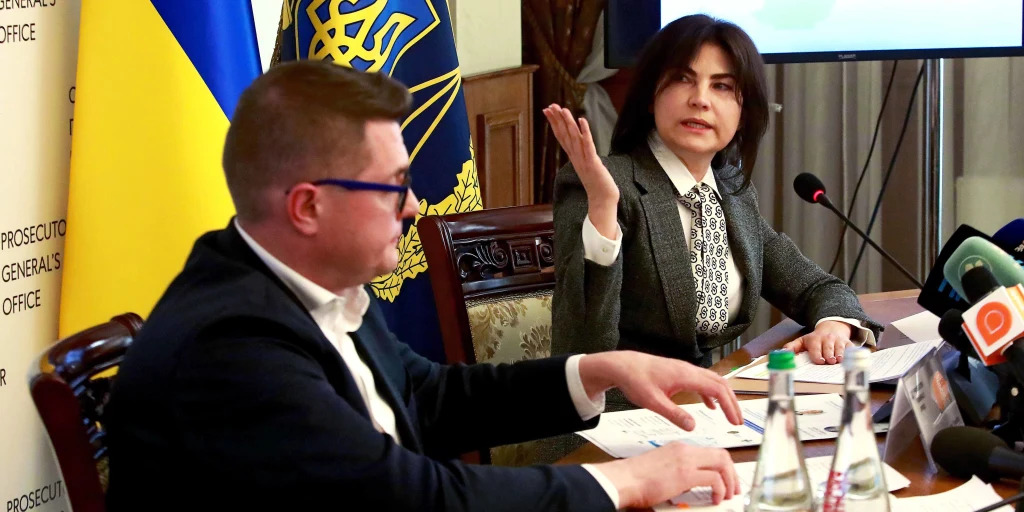
The firings of the SBO boss (left) and the prosecutor general (right) has cast Zelenskyy in an unflattering light
The firing of SBU intelligence services boss Ivan Bakanov and Prosecutor General Iryna Venediktova is akin to a political earthquake in Ukraine. During a war, one would expect maximum solidarity from a government. Such dismissals register as a very public rejection of one’s closest confidants.
In a video address on Sunday, the Ukrainian president said he was suspending both heads. His only voiced criticism was that too many officials of both agencies in the south and east of Ukraine had deserted after their regions had been occupied by Russian forces.
Maybe war has forced Volodymyr Zelenskyy to change his approach to politics after surrounding himself mainly with friends and former business partners? Hardly. His actions only look decisive on the surface.
At first, there was only talk of suspension, not firing. The office of the president later announced that it wanted to investigate treason in both cases. Then the situation suddenly snowballed: On Tuesday, parliament dismissed both Bakanov and Venediktova at Zelenskyy’s behest. There was no longer any talk of the investigations announced the day before.
Known cases of treason and desertion in the ranks of intelligences services occurred within the first weeks of the war. But the president needed months to find an effective way to publicly address the situation. Perhaps the most sensational example is the case of General Andriy Naumov of the Security Service of Ukraine (SBU), who fled Ukraine on February 23, one day before the Russian invasion.
Naumov was Bakanov’s right hand at the SBU. In just a few short months, Naumov’s patron had promoted him to intelligence services general. As director of Ukraine’s domestic security headquarters, it would have been his task to sniff out corruption or moles. Naumov’s flight was reason enough to immediately fire Bakanov.
The farce surrounding the firing of Zelenskyy’s closest confidants comes at the worst possible time
Zelenskyy’s obfuscation
Bakanov is not really the problem though, Zelenskyy — who appointed him head of the SBU — is the problem. But Bakanov happens to be Zelenskyy’s best friend. The two have known each other since kindergarten. They studied at university together and later became show business partners. The only reason for Bakanov’s appointment is Zelenskyy’s thirst for power and the desire to control the SBU by appointing a close friend to run it. Rather than admitting that the appointment was a mistake, the president instead tried to create a diversion by announcing Bakanov’s suspension.
The fact of the matter is that both men bear responsibility for not cleaning house at SBU — which never enjoyed a good reputation in Ukraine — before the Russian invasion. For the fact that corruption, and now treason, are still the order of the day. The back-and-forth on this issue doesn’t instill much confidence that the president has reflected upon his own mistakes. It was never a good idea to appoint someone to a key position in the security apparatus, simply because he had known him all his life.
G7 ambassadors have repeatedly criticized the fact that Ukraine’s election oversight commission has done nothing for two years. So far, the president has largely ignored Western demands for action. Just as he has ignored criticism over Kyiv’s lack of political will when it comes to finally wrapping up the glacial reform of Ukraine’s bloated and scandal-ridden intelligence services.
But now, Zelenskyy can no longer ignore criticism from his Western partners, as he was able to do before the war. Without guns and money from the EU and the US, Ukraine would have gone broke long ago and would scarcely be able to resist Russia’s onslaught. The reforms that are so essential for the strengthening of the Ukrainian state will now have to be implemented in the middle of a war. For this, the most experienced professionals are crucial, and not the president’s kindergarten pals.
This commentary was translated from German by Jon Shelton
The details of the peace deal presented today by US special envoy Steve Witkoff are consistent with the report in the Financial Times discussed in my previous article and with Larry Sparano in the posted interview. Putin will halt the Russian advance prior to driving Ukrainian soldiers out of all of the territory that has been reincorporated into Russia. It appears to be the case that the borders between Russia and Ukraine will be the current front line, so Putin is withdrawing Russia’s claim to the Russian territories still under Ukrainian occupation.
Russia and the US seem near a Ukraine peace deal. Kyiv’s role may be moot.
President Donald Trump’s hopes of securing a quick Ukraine peace deal hang in the balance after Washington’s envoy, Steve Witkoff, held his fourth Kremlin meeting with Russian President Vladimir Putin Friday.