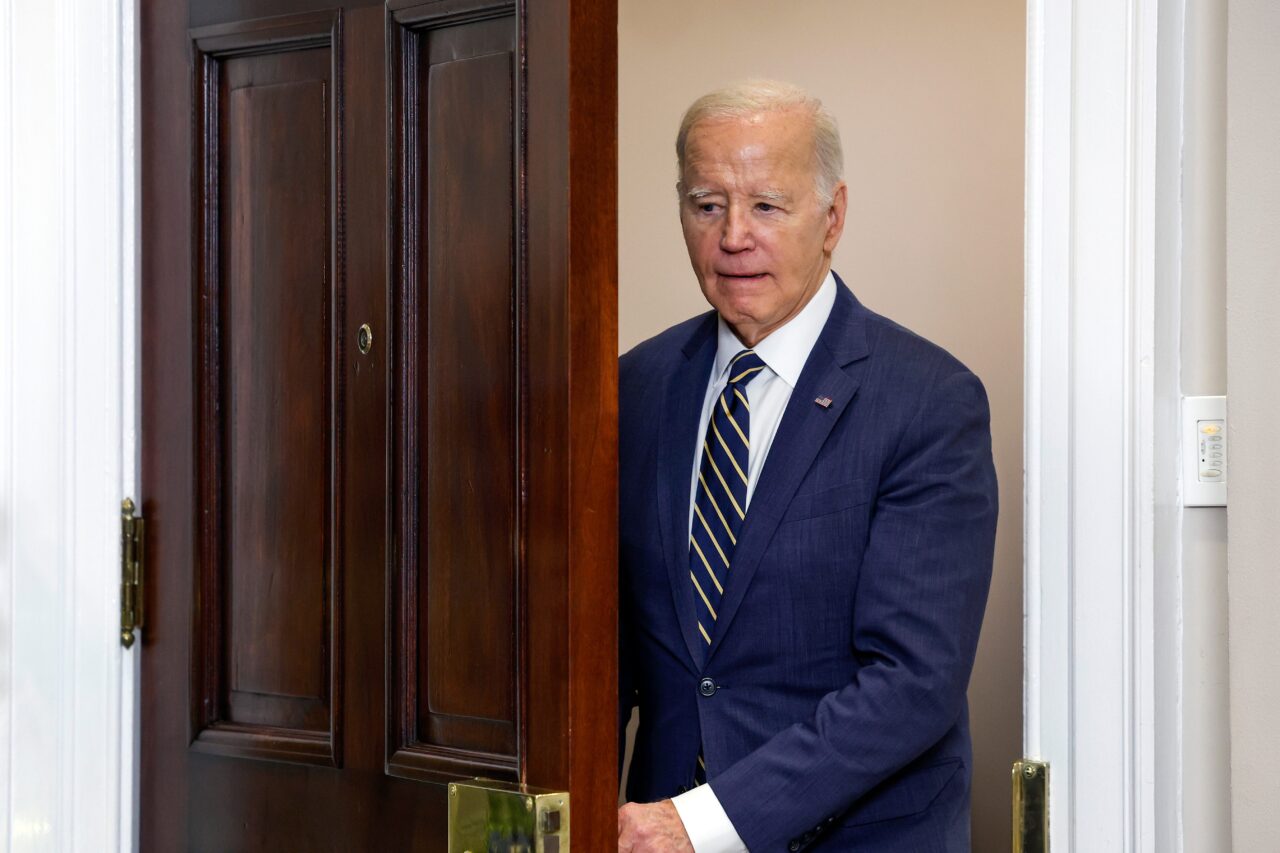
In July, President Biden declared that “Putin has already lost the war.” Begging Congress for $60 billion in funding to prolong the war, he now says that “we can’t let Putin win.”
Despite a White House warning that the US will run out of funds to arm Ukraine by the end of the year, Congress appears poised to run out the clock.
After marching in lockstep on the Ukraine proxy war, Democrats and Republicans are now refusing each others’ demands for approving the $60 billion that President Biden has requested to prolong it. The prospects are so bleak that Ukrainian President Volodymyr Zelensky pulled out at the last-minute from a Congressional briefing where he was scheduled to make an urgent plea.
Republicans, who blocked the latest Ukraine funding measure on Wednesday, insist that money for Kyiv should be paired with billions of additional dollars on border militarization, a condition that Democrats have so far rejected. Lindsay Graham, the Republican Senator who has openly celebrated that US assistance will help Ukraine “fight to the last person,” and gloated that killing Russians the accounts for “the best money we’ve ever spent,” now has no problem giving Kyiv the cold shoulder. “I will not vote for any [Ukraine] aid until we secure our border,” Graham told CNN. “I’m not helping Ukraine until we help ourselves.”
Given both sides’ devotion to the proxy war until this point, it is hard to believe that their stated differences could not be overcome. And despite Wednesday’s failed vote, such a deal could still materialize. But the standoff over extending the proxy war not only underscores Ukraine’s total dependence on its Washington sponsor, but the deceit deployed by the White House to manufacture public support.
After nearly two years of confident proclamations that Ukraine is handing Russia a resounding defeat, the Biden administration is now begging for a lifeline. President Biden, who in July declared that “Putin has already lost the war,” has now reversed course and pleaded that “we can’t let Putin win.” After claiming in February that “Russia has already lost this war,” National Security Advisor Jake Sullivan likewise warned that a failure to approve more funding “will make it easier for Putin to prevail.”
As recently as August, Sullivan also insisted that: “We do not assess that the conflict is a stalemate.” Ukraine, he said, is taking territory on a “methodical, systematic basis.” Yet on November 1st, Gen. Valery Zaluzhny, the head of Ukraine’s armed forces, acknowledged to the Economist that the war has put the two sides “into a stalemate,” and that there “will be most likely no deep and beautiful breakthrough.” Despite chiding Zaluzhny for speaking out of turn, Zelensky has nonetheless admitted that Ukraine’s widely hyped counteroffensive “did not achieve the desired results.” According to the Washington Post, Ukraine has recaptured just 200 square miles of territory this year.
Accordingly, once daily proxy war cheerleading has been released by a somber mood. “As Russia’s war against Ukraine approaches its third year, Moscow holds the advantage on the military, political and economic fronts,” the Wall Street Journal reports. “The situation is rather bad,” a European official recently remarked. “You have to have serious leverage for Putin to take you seriously. If they [Ukraine] were forced to the table now, they don’t have the leverage. The way it looks now, Putin has the leverage.” In a lengthy account of the counteroffensive’s failures, the Washington Post concludes that Ukrainian losses “make victory for Ukraine far less likely than years of war and destruction.”
Those who have made the same argument throughout the last many years of war and destruction in Ukraine were roundly dismissed as Kremlin apologists.
The same can be said for those who advocated diplomacy with Russia, long dismissed by proxy warriors as an act of “appeasement.” But now even the Biden administration is quietly changing its tune. In leaks to NBC News, a current and former US senior official recently disclosed that the White House and European allies are leaning on Kyiv to discuss “what possible peace negotiations with Russia might entail to end the war.” According to these officials, the US is “worried that Ukraine is running out of forces” and “struggling with recruiting.” Russia, on the other hand, “has a seemingly endless supply.”
“Manpower is at the top of the administration’s concerns right now,” one source said. Even if Congress manages to authorize another $60 billion in US weaponry, if the Ukrainians “don’t have competent forces to use them it doesn’t do a lot of good.” Accordingly, the prevailing view in Washington is that “Ukraine likely only has until the end of the year or shortly thereafter before more urgent discussions about peace negotiations should begin.”
This picture, while accurate, is also tragically incomplete: as was recently newly confirmed by a high-level Ukrainian source, Ukraine could have ended the war – and kept almost all of its territory – had it gone through with a peace deal with Russia in April 2022, rather than let the US and UK block it. This thwarted peace opportunity has yet to be reported in any establishment US media outlet.
While now floating the possibility of diplomacy, Washington has also backtracked on the issue that helped spark Russia’s February 2022 invasion: Ukrainian membership in NATO. According to Ukrainian parliamentarian Alexey Goncharenko, US Secretary of State Antony Blinken has instructed European leaders to “stop talking to Ukraine about NATO.” As I wrote in July, this dictate is perfectly consistent. The US was happy to talk about NATO when it could be used to bait Russia into invading Ukraine and getting locked in a quagmire. Now that Washington is running out of Ukrainians to sacrifice, and money to spend, NATO’s “open-door” to Ukraine has outlived its utility.
Proxy warriors’ unfolding abandonment of Ukraine was long foreseen by anyone willing to give a moment’s thought to their public statements. Amid the White House’s paeons to defending “democracy versus autocracy,” their more honest neoconservative allies have never bothered to hide the real goals.
As Sen. Tim Scott recently explained to a Republican audience, “America’s vital interest in Ukraine” is not in defending Ukraine, but in “actually degrading the Russian military.” And because Ukrainian lives are expendable, the policy was successful: “We have been very effective using our resources and our weaponry and the incredibly high price of Ukrainian blood to achieve that objective.” To Scott, that high price of Ukrainian blood was worth the vital interest of degrading Russia – and not to mention the incredibly high profits for US companies that provide the weaponry. To appeal to Republicans, even the Biden administration has begun invoking the war profiteering imperative, which is now openly described in Washington as “Bombenomics.”
President Biden, who has overseen this disastrous policy, still pretends that he is on the right side of history. Republicans who oppose Ukraine funding, he said Wednesday, are “willing to literally kneecap Ukraine on the battlefield and damage our national security in the process.” In reality, Biden’s willingness to use Ukraine to fight a war that it could never win has bludgeoned Ukraine not just on the battlefield today, but for generations to come.