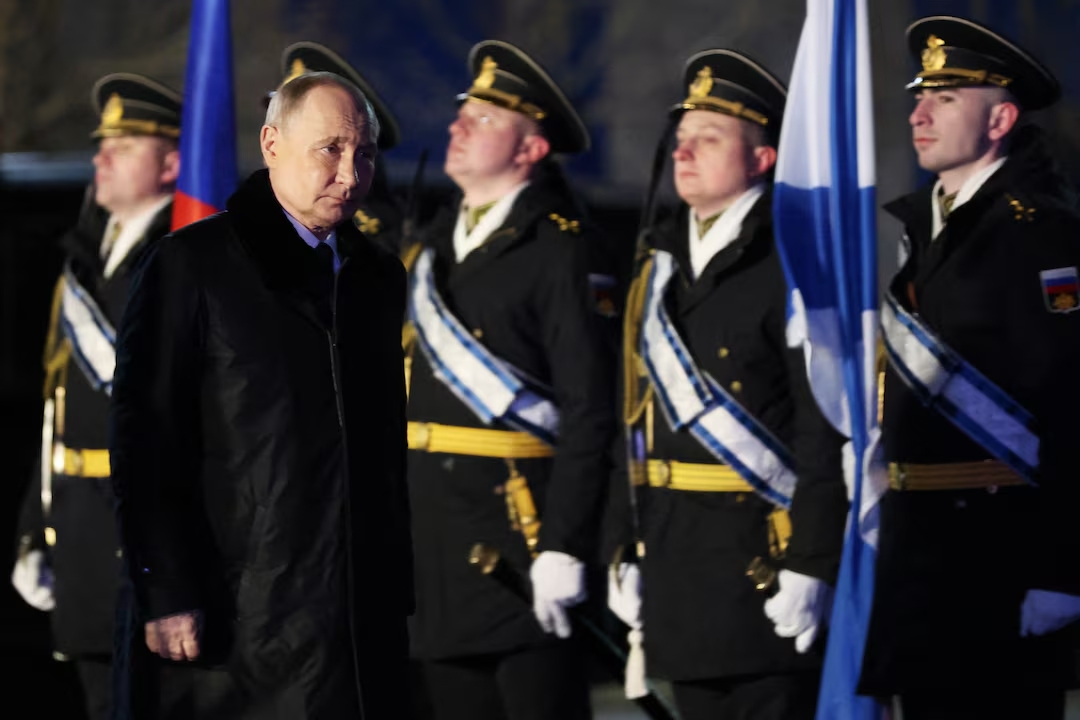
MOSCOW, March 27 (Reuters) - Geopolitical rivalries are intensifying in the Arctic but Russia is willing to cooperate with foreign partners, including from the West, in economic ventures there that will benefit all sides, Russian President Vladimir Putin said on Thursday.
Russian President Vladimir Putin visits a nuclear-powered submarine Arkhangelsk in Murmansk, Russia March 27, 2025. Sputnik/Sergei Karpukhin/Pool via REUTERS
In a major speech, Putin said U.S. President Donald Trump’s stated intention to acquire Greenland was “serious”, and it was clear that the U.S. would continue to promote its interests in the Arctic. The Greenland question had nothing to do with Russia, he said.
But Moscow was concerned that “NATO countries in general are increasingly designating the far north as a springboard for possible conflicts, practising the use of troops in these conditions, including by their ‘new recruits’, Finland and Sweden,” he said, referring to the alliance’s latest members.
Russia was monitoring the situation and building a response, including by boosting its military capabilities in the region.
“We will not allow encroachments on the sovereignty of our country and will reliably protect our national interests,” Putin said.
Focus on the Arctic’s strategic importance for mining, shipping and security has increased sharply because of repeated statements by Trump that he wants to acquire Greenland. He has not ruled out doing so by force.
The Arctic holds fossil fuels and minerals beneath the land and the seabed that could become more accessible with global warming. It is also an area of military competition, where defence analysts say Russia has built up its presence much faster than the West by reopening Soviet-era bases and modernising its navy.
The United States sees the Arctic as crucial for natural security, including for its early warning system against nuclear attacks.
The Kremlin says the Arctic is a zone of Russian strategic interest, and suggested in February that Russia and the U.S. could work together to develop natural resources there as the two countries pursue a fast-moving rapprochement that has unnerved Ukraine and its European allies.
Northern Sea Route
On the economic front, Putin has made it a top priority to ramp up commerce via the Northern Sea Route (NSR) through Arctic waters as Russia shifts trade towards Asia and away from Europe because of Western sanctions. Oil shipments from Russian ports to China via the NSR rose by a quarter last year.
Foreign partners prepared to cooperate with Russia on investment projects in the region would be guaranteed a good return, Putin said.
He called for an expansion of Russia’s northern ports and the building of a merchant fleet in the Arctic, supported by new-generation icebreakers including nuclear-powered ones.
But he said Russia’s domestic capabilities were insufficient for this at the moment, and that it would also require buying vessels and interacting with foreign shipbuilders.
Russia was already successfully shipping oil and liquefied natural gas via the NSR, he said.
“Now we need to create conditions for the growth of effective domestic operators that will engage in transporting containers of coal, bulk and other cargo through the Arctic. We are also open here to the creation of joint ventures,” he added.
International logistics firms could supply capital, technology and merchant ships to support this, he said.
Putin delivered his speech to a conference on the Arctic in Murmansk, a port from which the NSR runs eastward across the top of Russia to the Bering Strait near Alaska.
He said Murmansk’s port capacity should be at least trebled in the coming years, with construction of new terminals and railway links, and “partners” from Belarus, China, the United Arab Emirates and other countries were showing interest in this project.
Additional reporting by Maxim Rodionov, Anastasia Lyrchikova, Andrew Osborn and Alexander Marrow; Writing by Mark Trevelyan; Editing by Andrew Heavens
Donald Trump Should Not Repeat Woodrow Wilson’s Failure
April 30th is an important date in American politics. This is the day 100 for the American President in the White House, and all attention will be on the reports of his achievements and failures. But nothing can be more critical than Peace…
○
6 mins read
A Holocaust perpetrator was just celebrated on US soil. I think I know why no one objected.
Russia’s invasion has made ordinarily outspoken critics of antisemitism wary of criticizing Ukrainian Nazi collaborators
○
1 min read
Qi Book Talk: The Culture of the Second Cold War by Richard Sakwa
Richard Sakwa has for many years been one of the most distinguished and insightful observers of relations between the West and Russia, and one of the leading critics of Western policy. In this talk with Anatol Lieven, director of the Eurasia program at the Quincy Institute, Sakwa discusses his book, The Culture of the Second Cold War (Anthem 2025). The book examines the cultural-political trends and inheritances that underlie the new version of a struggle that we thought we had put behind us in 1989. Sakwa describes both the continuities from the first Cold War and the ways in which new technologies have reshaped strategies and attitudes.