Russian president Vladimir Putin has said that Moscow should consider limiting exports of uranium in retaliation for Western sanctions.
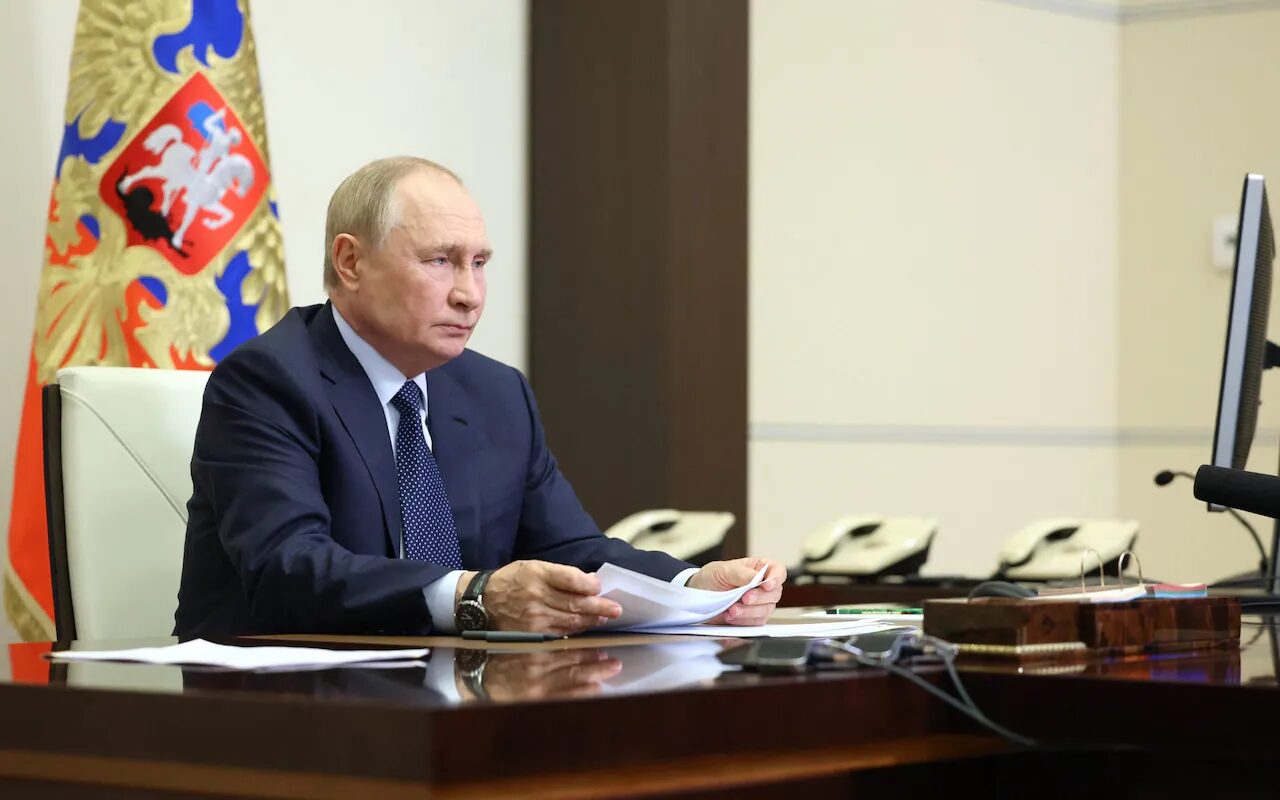
Vladimir Putin chairs a videoconference meeting with members of the government at the Novo-Ogaryovo state residence outside Moscow today Credit: Alexander Kazakov/AFP via Getty Images
In televised comments addressed to Russian government ministers, Mr Putin said such restrictions could also be introduced for other commodities, and noted that Russia was a major producer of natural gas, diamonds and gold.
“Please take a look at some of the types of goods that we supply to the world market … Maybe we should think about certain restrictions – uranium, titanium, nickel,” he urged Russian prime minister Mikhail Mishustin.
Uranium, a naturally occuring metallic element, is extracted from ore and used to power nuclear reactors.
Mr Putin’s remarks drove shares in uranium mining firms upwards on the expectation of higher prices for the commodity.
In 2023 the US and China topped the list of Russian uranium importers, followed by South Korea, France, Kazakhstan and Germany. Russia is the world’s largest exporter of nuclear fuel and technology.
Since the start of the war in Ukraine, Western governments have been attempting to limit their reliance on Russian exports.
In May, US president Joe Biden signed into law a ban on enriched uranium imports from Russia, a trade worth around $1bn (£767bn) annually. However, it contained waivers in case of supply concerns that would allow the US Department of Energy to maintain normal levels of Russian uranium imports through to 2027.
Russia accounted for 27pc of the enriched uranium supplied to US commercial nuclear reactors last year.
“It will be really hard to replace, especially in the short term, the next 2-3 years,” said Citi analyst Arkady Gevorkyan.
“Western enrichers are only making plans to build additional enrichment capacity, which would require at least three years to be completed. We anticipate that utilities in the US might be able to partially replace it by importing low enriched uranium from China.”
In January last year, the UK government launched a Nuclear Fuel Fund to bolster domestic nuclear fuel production. At the time, it said that Russia owned around 20pc of global uranium conversion capacity and 40pc of enrichment capacity.
Tom Greatrex, chief executive of the Nuclear Industry Association, told The Telegraph that the UK does not use any Russian uranium and that the industry has more than 12 months’ supply in storage.
EDF, which operates eight British nuclear power stations, is understood not to use Russian uranium in the UK. Last year, it told a Commons select committee: “We are determined to eliminate Russian material completely from the UK fuel cycle”.
Any limits by Russia could prove lucrative for hedge funds, which have stockpiled barrels of raw uranium, and would benefit from higher global prices.
Donald Trump Should Not Repeat Woodrow Wilson’s Failure
April 30th is an important date in American politics. This is the day 100 for the American President in the White House, and all attention will be on the reports of his achievements and failures. But nothing can be more critical than Peace…
○
6 mins read
A Holocaust perpetrator was just celebrated on US soil. I think I know why no one objected.
Russia’s invasion has made ordinarily outspoken critics of antisemitism wary of criticizing Ukrainian Nazi collaborators
○
1 min read
Qi Book Talk: The Culture of the Second Cold War by Richard Sakwa
Richard Sakwa has for many years been one of the most distinguished and insightful observers of relations between the West and Russia, and one of the leading critics of Western policy. In this talk with Anatol Lieven, director of the Eurasia program at the Quincy Institute, Sakwa discusses his book, The Culture of the Second Cold War (Anthem 2025). The book examines the cultural-political trends and inheritances that underlie the new version of a struggle that we thought we had put behind us in 1989. Sakwa describes both the continuities from the first Cold War and the ways in which new technologies have reshaped strategies and attitudes.