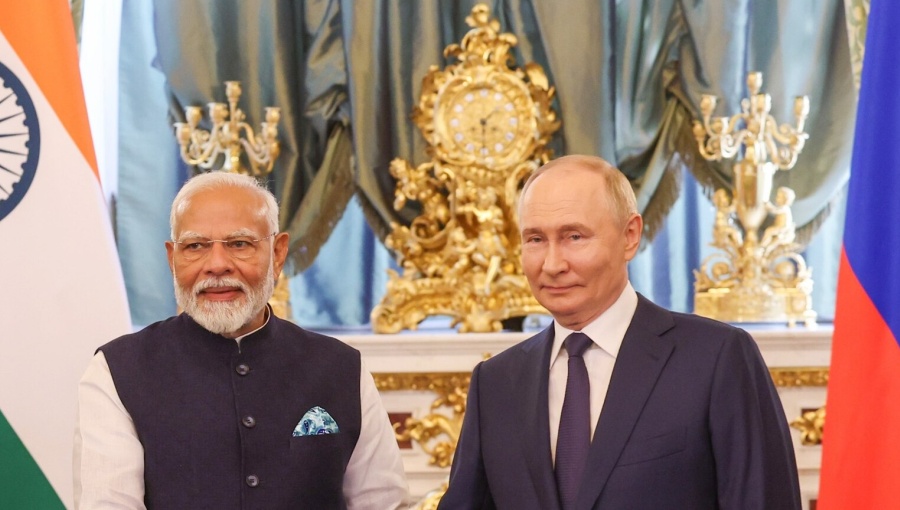
Russian President Vladimir Putin is poised to visit India in the near future, marking his first trip to the South Asian nation since December 2021. According to a report by TASS, Russian Foreign Minister Sergei Lavrov confirmed the upcoming visit while speaking at a Russia International Affairs Council(RIAC) forum. However, neither the Kremlin nor the Russian Foreign Ministry - including Lavrov - has announced any specific dates.
Prime Minister's' Office - Government of India
In the wake of Western sanctions following Russia’s 2022 invasion of Ukraine, India has emerged as a significant consumer of discounted Russian hydrocarbons. Beyond energy, India has capitalised on the exodus of Western firms from Russia by supplying a range of goods that were previously sourced from the West, Japan, and South Korea. Indian enterprises have stepped in to provide fast-moving consumer goods, luxury items, healthcare supplies, and electronics, to some extent filling the void left by departing companies.
This diversification has not only bolstered India’s export sector but also reinforced its role as a dependable trade partner for Russia during tumultuous times. However, this burgeoning trade relationship has not been without controversy. Investigative reports by outlets such as the Financial Times and The Insider have highlighted the involvement of Russian intelligence-backed networks in orchestrating sanctions evasion schemes.
These networks allegedly utilise entities from the so called Global South to circumvent the extensive sanctions imposed by the Group of Seven (G7) member nations and others. These revelations have cast a spotlight on the complexities and challenges inherent in India’s balancing act between fostering economic and strategic ties with Russia and the West. The geopolitical landscape has further evolved with the inauguration of US President Donald Trump in January 2025.
Departing from his predecessor’s hardline stance, President Trump has adopted a more conciliatory approach toward Russia, actively seeking to mediate a peace deal between Moscow and Kyiv.
This shift was dramatically underscored by a sensationalised exchange in the Oval Office involving Ukrainian President Volodymyr Zelensky, President Trump, and Vice President J.D. Vance, which also followed a brief pause in US support for Kiev against Russia.
Concurrently, the Trump administration’s tariff and economic policies have introduced new variables into the international trade equation that despite the prospects of lifting sanctions on Russia may not bring global trade back to the January 2022 status quo ante.
According to a report by the Economic Times, Russian state owned oil giant Rosneft, for instance, is contemplating an exit from its Indian joint venture, Nayara Energy. The impetus behind this move stems from the challenges Rosneft faces in repatriating revenues due to sanctions that have severed its access to conventional banking networks, leaving only specialised channels willing to navigate the risks associated with US secondary sanctions.
Rosneft is likely conscious of the Trump administration’s entirely tentative and conditional ability to lift sanctions against it and has decided to cut its losses where things are unsustainable even in ventures in countries which don’t endorse G7 style unilateral sanctions such as India.
Amid these economic and geopolitical shifts, defence cooperation remains a cornerstone of India-Russia relations. During President Putin’s anticipated visit, both nations are expected to finalise the Reciprocal Exchange of Logistics Agreement (RELOS), a pact that has faced repeated delays since 2021.
Once signed, RELOS will facilitate mutual access for India and Russia to each other’s military facilities for purposes such as refueling and maintenance, thereby enhancing operational synergy. This agreement is particularly significant as it would place Russia on strategic parity with the United States, which has already established similar logistics agreements with India, including the Basic Exchange and Cooperation Agreement (BECA).
Donald Trump Should Not Repeat Woodrow Wilson’s Failure
April 30th is an important date in American politics. This is the day 100 for the American President in the White House, and all attention will be on the reports of his achievements and failures. But nothing can be more critical than Peace…
○
6 mins read
A Holocaust perpetrator was just celebrated on US soil. I think I know why no one objected.
Russia’s invasion has made ordinarily outspoken critics of antisemitism wary of criticizing Ukrainian Nazi collaborators
○
1 min read
Qi Book Talk: The Culture of the Second Cold War by Richard Sakwa
Richard Sakwa has for many years been one of the most distinguished and insightful observers of relations between the West and Russia, and one of the leading critics of Western policy. In this talk with Anatol Lieven, director of the Eurasia program at the Quincy Institute, Sakwa discusses his book, The Culture of the Second Cold War (Anthem 2025). The book examines the cultural-political trends and inheritances that underlie the new version of a struggle that we thought we had put behind us in 1989. Sakwa describes both the continuities from the first Cold War and the ways in which new technologies have reshaped strategies and attitudes.