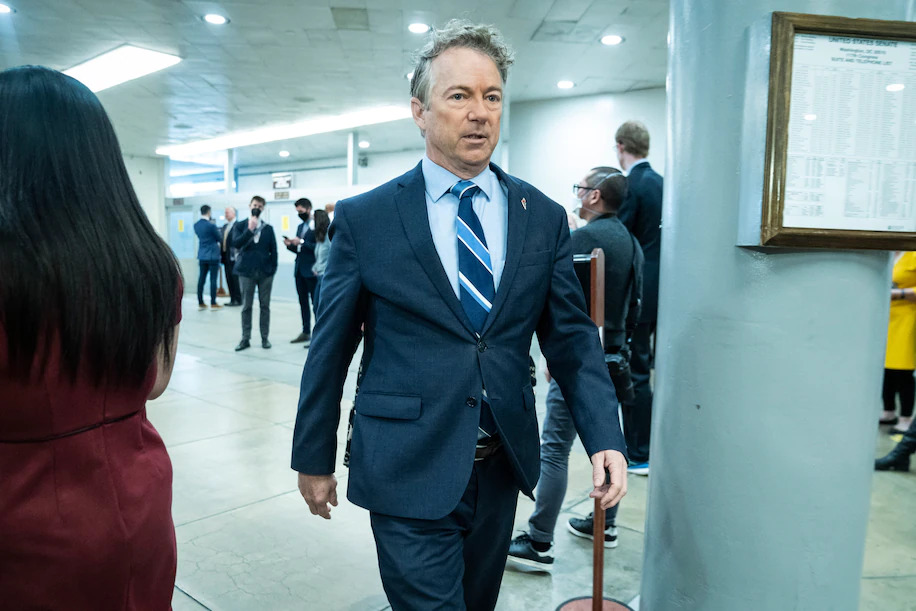
Sen. Rand Paul (R-Ky.) had a testy exchange with Secretary of State Antony Blinken over NATO. (Jabin Botsford/The Washington Post)
The big idea
Sen. Rand Paul (R-Ky.) had a testy exchange Tuesday with Secretary of State Antony Blinken, pushing him on the idea that decades of eastward NATO expansion — all the way to Russia’s doorstep — played a role in Moscow launching a fresh war in Ukraine two months ago.
The headline from the five-minute confrontation in the Senate Foreign Relations Committee hearing room was that President Biden would accept Ukraine as a neutral nation, outside of NATO, if Ukraine itself decided to go that route.
“We, Senator, are not going to be more Ukrainian than the Ukrainians. These are decisions for them to take,” Blinken testified, largely restating a position the Biden administration has publicly held for weeks.
But let’s look at Paul’s characterization of NATO expansion since the end of the Cold War as a casus belli in Moscow. “While there is no justification for Putin’s war on Ukraine,” Paul said, “it does not follow that there’s no explanation for the invasion.”
Paul took some knocks on social media for seeming at times to excuse Russian President Vladimir Putin’s military action against Ukraine, Georgia and Moldova by noting they had been part of the U.S.S.R. And blaming NATO enlargement is popular in Russia and among its apologists.
On the other hand, one of the hardest things to convey to American readers is how other countries have their own perception of their national interests, and commit resources accordingly, quite legitimately outside of Washington’s globe-spanning influence.
And on principle, Paul is right: Explaining a thing is not necessarily the same as defending it.
To be clear: The Daily 202 takes the view NATO expansion did not by itself lead Putin to start the war. Nor was it an automatic cause of an unavoidable effect, as though the Russian leader had no agency. Moreover, Putin has repeatedly reminded us over the years how driven he is to recapture some of what used to be the U.S.S.R. And just look at his speech on the eve of his latest invasion!
‘Beating the drums’ for NATO
“The U.S., including the Biden administration, insisted on beating the drums to admit Ukraine to NATO,” Paul scolded, describing holding out the mere possibility of alliance membership for Kyiv as “agitating for something that we knew our adversary absolutely hated and said was a red line.”
Blinken disputed the “agitating” image, and countered the United States has always upheld the principle that Russia doesn’t get to veto a country joining NATO. That’s up to would-be joiners and the alliance’s existing members.
But Paul is hardly alone in making this broader argument about NATO, which unites, to varying degrees, the iconic architect of America’s “containment” strategy toward the U.S.S.R., George Kennan and Biden’s current CIA director, Bill Burns. Burns also served as ambassador to Moscow.
Expanding NATO, Kennan wrote in February 1997, would be “the most fateful error of American policy in the entire post-cold-war era” and would “inflame the nationalistic, anti-Western and militaristic tendencies in Russian opinion.”
A year later, Kennan dubbed it “a tragic mistake,” predicted “a new cold war” and forecast “the Russians will gradually react quite adversely and it will affect their policies.”
‘Needlessly provocative’
“Hostility to early NATO expansion is almost universally felt across the domestic political spectrum here,” Burns, one of the most gifted diplomats of his generation, cautioned in a diplomatic cable from Russia in 1995.
The U.S. push to admit Poland, Hungary and the Czech Republic, Burns wrote in his memoir “The Back Channel” looked “premature at best, and needlessly provocative at worst” when seen from Moscow. Those countries joined in 1999.
Fiona Hill — yes, *that* Fiona Hill, the Putin expert who had a star turn in President Donald Trump’s first impeachment — warned President George W. Bush about NATO expansion.
In 2008, with Putin fuming after the alliance said Ukraine and Georgia would ultimately join, Hill and other national security aides warned him it was “a provocative move that would likely provoke pre-emptive Russian military action.” (Russia invaded Georgia in August 2008.)
One of the starkest warnings came in March 1998 from Sen. John Warner (R-Va.), as the senate debated ratifying membership for Poland, Hungary and the Czech Republic.
The U.S. push to admit Poland, Hungary and the Czech Republic, Burns wrote in his memoir “The Back Channel” looked “premature at best, and needlessly provocative at worst” when seen from Moscow. Those countries joined in 1999.
Fiona Hill — yes, *that* Fiona Hill, the Putin expert who had a star turn in President Donald Trump’s first impeachment — warned President George W. Bush about NATO expansion.
In 2008, with Putin fuming after the alliance said Ukraine and Georgia would ultimately join, Hill and other national security aides warned him it was “a provocative move that would likely provoke pre-emptive Russian military action.” (Russia invaded Georgia in August 2008.)
One of the starkest warnings came in March 1998 from Sen. John Warner (R-Va.), as the senate debated ratifying membership for Poland, Hungary and the Czech Republic.
“I do believe this replaces, symbolically, the Iron Curtain that was established in the late forties, which faced west, with now an iron ring of nations that face east to Russia,” Warner said on the Senate floor. “That causes this senator a great deal of concern.”
Paul regularly stands alone on foreign policy — and seems to enjoy it. But here, he’s firmly embraced a long-standing NATO critique.
The details of the peace deal presented today by US special envoy Steve Witkoff are consistent with the report in the Financial Times discussed in my previous article and with Larry Sparano in the posted interview. Putin will halt the Russian advance prior to driving Ukrainian soldiers out of all of the territory that has been reincorporated into Russia. It appears to be the case that the borders between Russia and Ukraine will be the current front line, so Putin is withdrawing Russia’s claim to the Russian territories still under Ukrainian occupation.
Russia and the US seem near a Ukraine peace deal. Kyiv’s role may be moot.
President Donald Trump’s hopes of securing a quick Ukraine peace deal hang in the balance after Washington’s envoy, Steve Witkoff, held his fourth Kremlin meeting with Russian President Vladimir Putin Friday.