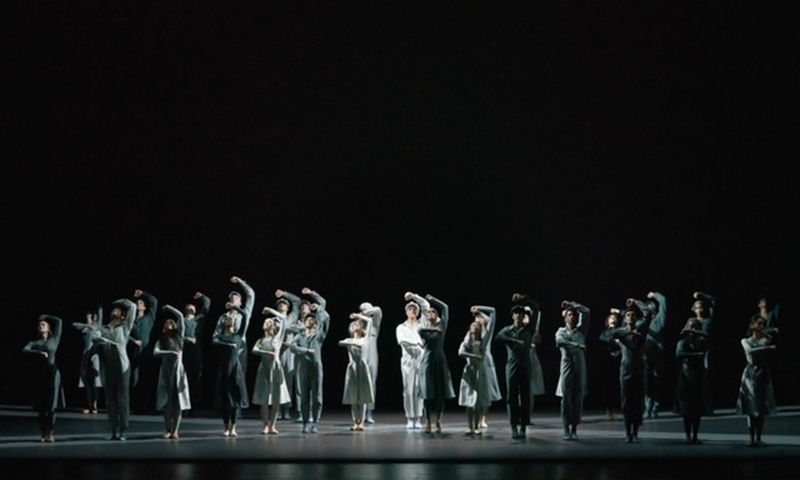
By a strange coincidence, two ballet productions of Crime and Punishment are being shown at the same time—Helen Pickett in New York (American Ballet Theater) and Boris Eifman in St. Petersburg. I saw the American production at Lincoln Center and the Russian one in a video recording.
Scene from Helen Pickett’s Crime and Punishment. Photo: Kyle Froman.
Pickett tries, as far as the peculiarities of the genre allow, to follow the main plot lines of Dostoevsky’s novel, with choreography and music complemented by video. Eifman does not retell the novel and is freer in interpretation. For Pickett, this is her first experience with the Russian classics; Eifman has presented “The Idiot” and “The Brothers Karamazov” in previous years. For him, “Dostoevsky’s work is an inexhaustible source of wisdom, capable of illuminating the darkest corners of existence with the light of hidden truth.” He said that he had been working towards “Crime and Punishment” all his life. Picket expressed her attitude: “As a choreographer, I feel the book’s rhythm, its tempo – the qualities that awaken the dance… I love the Roller coaster”.
Eifman, a living legend, is a world-renowned master of ballet; Pickett does not have his regalia, and comparing the two interpretations is no small risk for her. But it should be noted that her prominent role in America’s most famous ballet theater is not a product of the politics of women’s advancement and diversification and is well deserved, as is Cassandra Trenary’s performance as Raskolnikov. Heated battles are going on in American ballet over the right of men to perform women’s roles and women to perform men’s roles, a global trend in these times.
Both productions give an idea of the events and characters for those who have not yet read the novel; the American program includes descriptions of the scenes. But I don’t think the main moral and philosophical problem of the novel is obvious to all the audience: “Am I a trembling creature, or do I have the right?”. Raskolnikov divides people into two categories – the ordinary, “trembling creatures”, and the chosen, those who have the right. The lower category lives by norms and rules in accordance with the prohibitions and boundaries of permissible. The highest category is Napoleon, Mohammed, Lycurgus (legendary political figure of Sparta), Salon (Athenian politician and legislator), Newton, Kepler (astronomer, mathematician) and the like. The chosen ones have an army and a powerful mind, but Raskolnikov has an axe. It is perceived as a Russian solution, but the Americans have the same idea: “People are different, but Colt leveled the playing field.” In Eifman’s work the dilemma of inequality is clearly visible, in Pickett’s it is not even hinted at, although the video screening gave an opportunity to do so.
Both choreographers paid great attention to the theme of the city. The topography of St. Petersburg is presented in the novel in detail and with expressiveness. In Dostoevsky’s St. Petersburg, it is gloomy and overwhelmed with hopelessness. Dostoevsky considered St. Petersburg to be the most abstract and artificial city in the world and hoped that one morning, it might disappear. The Russian production has a lot of ingenuity and detail, while the American production has only ascetic, heavy moving white walls, with little understanding of what they are saying.
Critics view both productions as modernist, but the skill of the classical school dancers is impeccable, and the choreographers are masters of high class. I’m not a ballet connoisseur with a thousand performances to my credit; my interests are only in the musical classics. Great music is not enriched or supplemented by words, gestures, and scenery, but both ballet versions of Crime and Punishment made a strong impression on me. However, I confess I didn’t think much about Dostoevsky and his ideas during the performance. In any case, aesthetic and emotional perception is more potent than rational perception, especially in relation to art.
Russian critics highly praised Eifman’s ballet, while American critics were very harsh about their compatriot’s production. “The New York Times: “Another favorite book, another disappointing ballet.” Nor better other assessments: ‘There is almost nothing enjoyable’; ‘The choreography is repetitive and ineffective’, ‘A great punishment for the audience’. It seems that the morality and psychology of “mad haters” have spread from politics to high art.
However, my life partner, who spent 30 years as a soloist on the ballet stage, thinks the production is excellent and the criticism is unfair. Both ballets are available on videotape, and anyone can form their impression without asking others. I don’t think anyone else’s opinion can convince or change one’s mind here.
***
If Dostoevsky had confined himself to the story of the poor young man and the sufferers in his surroundings, there would have been another detective story about the humiliated and insulted victims of injustice. But the question of rights and conscience meets us in any society, at any time, and at every step, leaving no one aside. Oswald Spengler saw the essence of the problem very deeply in The Decline of Europe: “Raskolnikov is only ‘we.’ His guilt is the guilt of all, and even to assess his sin as special for him is pride and vanity.”
“Crime and Punishment” vividly reflects the national conditions and character, where the duel of the icon and the axe, mercy and cruelty, rationalization and unbridled passion, is perceived as one of the most ‘Russian novels.’ World critics see it as an expression of the Russian soul and its difference from the Faustian spirit of the Western world. This understanding is close to the worldview of the Slavophiles, Solzhenitsyn and Dugin. Spengler evaluates Dostoevsky’s views differently: “Tolstoy is the Russia of the past, Dostoevsky is its future”. Spengler quotes Dostoevsky: “I have two fatherlands, Russia and Europe”. “Crime and Punishment” is not an ethnographic testimony limited by place and time; it is a narrative about eternal questions of existence, consciousness, and morality perceived in the value system of Judeo-Christian civilization. Dostoevsky saw man’s and humanity’s salvation in living according to the biblical commandments. Still, for non-believers and atheists, his novels also established the norms and limits of the human in man.
In Soviet times, the novel’s interpretation was mainly reduced to criticism of the cruel conditions of existence and social injustice; the conclusions were straightforward and unambiguous: it is necessary to change social conditions to give everyone the opportunity to show their abilities and talents, and there will be peace, goodness, and happiness on Earth.
However, the novel transcended both religious dogmas and the orthodoxy of socialist realism. Once again Spengler: “Dostoevsky … does not belong to a school… Such a soul as his can look beyond everything that we call social… What has the agony of soul to do with Communism? A religion that takes up social problems ceases to be a religion….. Dostoevsky is a saint, Tolstoy is only a revolutionary.”
I am far from the idea of elevating Dostoevsky to sainthood and Spengler to apostles; suffice to recall that both were convinced anti-Semites. Dostoevsky’s “Diary of a Writer” is full of anti-Semitic invectives. Spengler denied pogrom anti-Semitism but argued that Judaism and the Jews were destructive to civilization and should be removed from influence. Contrary to Pushkin’s Mozart, genius and villainy are compatible, and examples abound.
Dostoevsky occupies a leading place in the canon of literary classics; his works are published in colossal editions, widely discussed, and studied in schools and universities. “Crime and Punishment,” the most famous of his novels, was the basis for many stage productions and screen adaptations. He overcame national and ideological barriers, and he is read and his merits recognized even by those who do not share and condemn his views and have a negative attitude toward his personality. Perhaps the main secret of success is that he brings to the utmost acuteness questions about the purpose and meaning of life, moral choice and imperative, who I am, what my place in the world is, and what my rights and duties are.
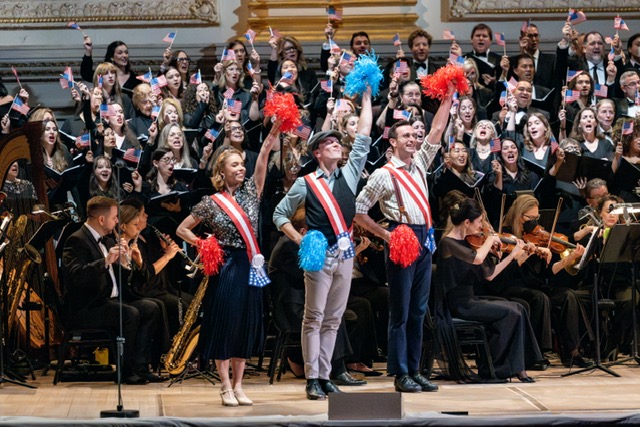
The universal significance of these questions is obvious. That is why they are addressed again and again. Brothers George and Ira Gershwin, in the thirties, when America was no less shaken than it is today by battles and protests about social justice, participation in wars, and the lies and hypocrisy of the ruling elite, created the musical “Strike Up the Band” – a satirical show, which has undergone numerous revisions, experienced failures and successes, and was recently revived and performed at Carnegie Hall by the MasterVoises Chorus and Orchestra under the direction of conductor Ted Sperling and choreographer Alyson Solomon.
The show’s hero, Horace Fletcher, a self-serving and vain capitalist, America’s premier cheese producer, does not torment himself with eternal questions, nor does he doubt his right to control the destenies of the country and the world. He learns that Switzerland, where the cheese is better, is seeking to penetrate the American market and, in an attempt to hold on to his monopoly and satisfy his ambitions, induces the government to wage war on his competitors. Fletcher is willing to subsidize the war if it is named after him. Corrupt government officials and the president favor the idea.
For all the absurdity of the stage situation, it is typical at all times. Motives, interests, and methods of achieving goals can be decorated with patriotic demagogy in different modifications, but the essence remains unchanged – the thirst for power and money. In other productions of the musical, cheese was replaced by chocolate, it could be modernized by spheres of influence, oil, cars, electronics, armaments – the theme is inexhaustible. Gershwin was well known in the Soviet Union, and it is even strange that Soviet propaganda did not use his anti-capitalist musical for its purposes; it usually did not miss such an opportunity.
The plot looks banal nowadays. There are no new ideas here and nothing to think about, but the music of the great Gershwin, the most popular composer in America and author of “Rhapsody in Blue”, “Porgy and Bess,” “An American in Paris,” always attracts full halls and gets an enthusiastic reception.
Ted Sperling is an excellent conductor with extensive Broadway experience, a superb chorus known for performing popular classics and lesser-known works, and the show left a vivid impression.
The audience is unlikely to be infected with the revolutionary pathos of the struggle against greedy capitalism. Still, the question of rights has become even more complex today than at any time in the country’s history. Big money and the interests of its owners still determine big politics, but the usurpation of power by the oligarchy is to certain degree balanced by democracy and laws. However, the threat from below, from an angry mob that believes in its right to dictate its version of justice by violence, is becoming increasingly dangerous to social cohesion and preserving democratic gains. The current dissenters do not suffer from a split personality; they do not doubt their convictions, they do not think about the moral imperative, and the law is not an option for them. “The banality of evil,” in the words of Hannah Arendt, correlates not only with fascism. Freedom and democracy are not exempt from it.
It is a fantastic time when freedom leads to the suppression of freedom, the struggle for rights to disenfranchisement, protests to save democracy to its destruction, and progress, culture, enlightenment to savagery and lawlessness. Dostoevsky’s “The Demons”, the great foresight about radicals and terrorists, destroyers of civilization and moral foundations, whose literary images have been revived in the present realities, says it all. “We’ll get substance abuse, gossips, denunciation going, we’ll get unheard of depravity going, we’ll stifle every genius in infancy. Everybody to the same denominator, full equality”. Dostoevsky hoped that beauty would save the world, but ballet and musicals will not save us from these threats.
Donald Trump Should Not Repeat Woodrow Wilson’s Failure
April 30th is an important date in American politics. This is the day 100 for the American President in the White House, and all attention will be on the reports of his achievements and failures. But nothing can be more critical than Peace…
○
6 mins read
A Holocaust perpetrator was just celebrated on US soil. I think I know why no one objected.
Russia’s invasion has made ordinarily outspoken critics of antisemitism wary of criticizing Ukrainian Nazi collaborators
○
1 min read
Qi Book Talk: The Culture of the Second Cold War by Richard Sakwa
Richard Sakwa has for many years been one of the most distinguished and insightful observers of relations between the West and Russia, and one of the leading critics of Western policy. In this talk with Anatol Lieven, director of the Eurasia program at the Quincy Institute, Sakwa discusses his book, The Culture of the Second Cold War (Anthem 2025). The book examines the cultural-political trends and inheritances that underlie the new version of a struggle that we thought we had put behind us in 1989. Sakwa describes both the continuities from the first Cold War and the ways in which new technologies have reshaped strategies and attitudes.