MOSCOW, March 31 (Reuters) - Russia and the United States have started talks on joint rare earth metals and other projects in Russia, and some companies have already expressed an interest in them, President Vladimir Putin's investment envoy said in remarks published on Monday.
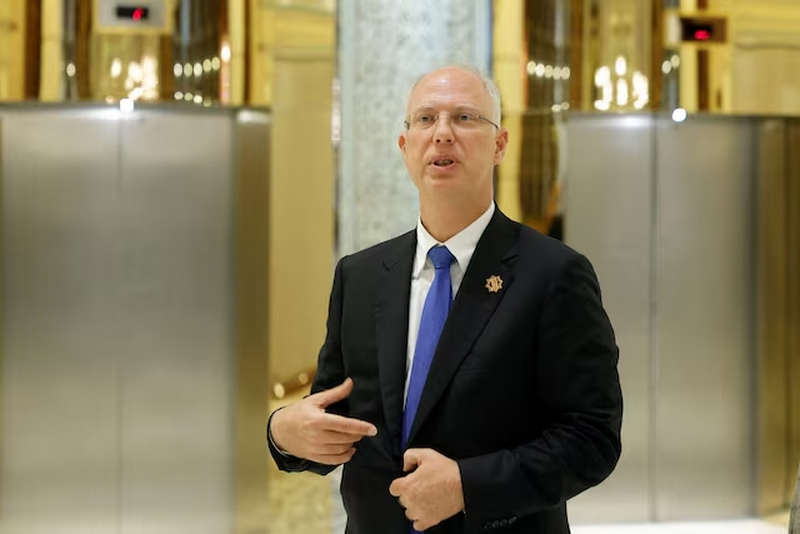
The head of Russia's sovereign wealth fund Kirill Dmitriev speaks to members of the delegation and journalists after the U.S.-Russia talks in Riyadh, Saudi Arabia, February 18, 2025. REUTERS/Maxim Shemetov/File Photo
Amid efforts by U.S. President Donald Trump to end the war in Ukraine, minerals cooperation has been floated by both Kyiv and Moscow, though Trump said on Sunday that Ukrainian President Volodymyr Zelenskiy wants to back out of a proposed deal.
Putin in February suggested that the United States might be interested in exploring joint exploration for rare earth metals deposits in Russia, which has the world’s fifth-largest reserves of the metals used in lasers and military equipment.
Kirill Dmitriev, Kremlin special envoy on international economic and investment cooperation, told the Izvestia newspaper in remarks published on Monday that talks had already begun.
“Rare earth metals are an important area for cooperation, and, of course, we have begun discussions on various rare earth metals and (other) projects in Russia,” said Kirill Dmitriev, who is also the CEO of the Russian Direct Investment Fund.
Dmitriev, who was part of Russia’s negotiating team at talks with U.S. officials in Saudi Arabia in February, said some companies have already shown interest in the projects. He did not name any companies and did not reveal further details.
Trump said on Sunday he was “pissed off” at Putin and will impose secondary tariffs of 25% to 50% on buyers of Russian oil if he feels Moscow is blocking his efforts to end the war in Ukraine.
Trump told NBC News he was very angry after Putin last week criticised the credibility of Zelenskiy’s leadership, the television network reported. Trump later reiterated to reporters he was disappointed with Putin but added: “I think we are making progress, step by step.”
China’s control of 95% of global production and supplies of rare earth metals, crucial for industries such as defence and consumer electronics, has focused the rest of the world on trying to develop their own supplies.
The U.S. Geological Survey estimates Russia’s reserves of rare earth metals at 3.8 million metric tons but Moscow has far higher estimates.
According to the Natural Resources Ministry, Russia has reserves of 15 rare earth metals totalling 28.7 million tons as of January 1, 2023 and that 3.8 million tons is the amount of reserves under development or ready for development.
Izvestia reported the cooperation may be further discussed at the next round of Russia-U.S. talks that may take place in mid-April in Saudi Arabia.
Reporting by Lidia Kelly in Melbourne and Guy Faulconbridge in Moscow; Editing by Bill Berkrot, Chris Reese and Ros Russell
As Moscow bureau chief, Guy runs coverage of Russia and the Commonwealth of Independent States. Before Moscow, Guy ran Brexit coverage as London bureau chief (2012-2022). On the night of Brexit, his team delivered one of Reuters historic wins – reporting news of Brexit first to the world and the financial markets. Guy graduated from the London School of Economics and started his career as an intern at Bloomberg. He has spent over 14 years covering the former Soviet Union. He speaks fluent Russian.
Donald Trump Should Not Repeat Woodrow Wilson’s Failure
April 30th is an important date in American politics. This is the day 100 for the American President in the White House, and all attention will be on the reports of his achievements and failures. But nothing can be more critical than Peace…
○
6 mins read
A Holocaust perpetrator was just celebrated on US soil. I think I know why no one objected.
Russia’s invasion has made ordinarily outspoken critics of antisemitism wary of criticizing Ukrainian Nazi collaborators
○
1 min read
Qi Book Talk: The Culture of the Second Cold War by Richard Sakwa
Richard Sakwa has for many years been one of the most distinguished and insightful observers of relations between the West and Russia, and one of the leading critics of Western policy. In this talk with Anatol Lieven, director of the Eurasia program at the Quincy Institute, Sakwa discusses his book, The Culture of the Second Cold War (Anthem 2025). The book examines the cultural-political trends and inheritances that underlie the new version of a struggle that we thought we had put behind us in 1989. Sakwa describes both the continuities from the first Cold War and the ways in which new technologies have reshaped strategies and attitudes.