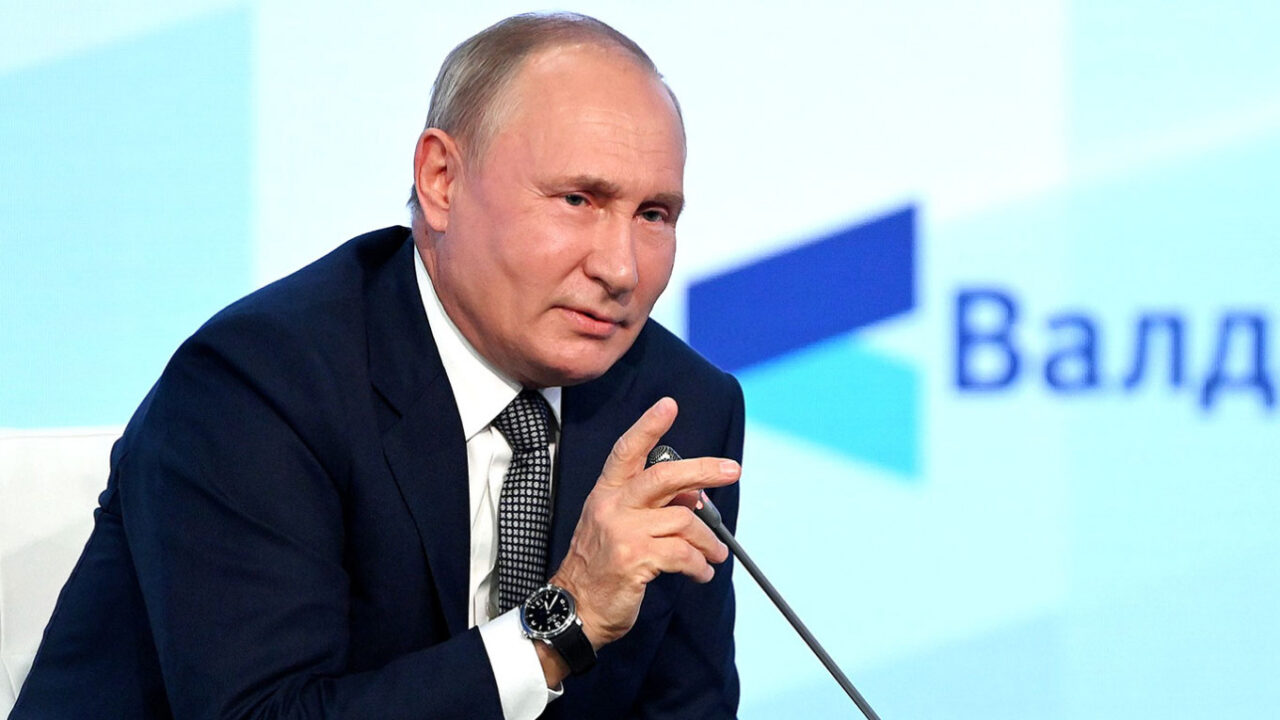
Vladimir Putin took part in a plenary session of the 18th annual meeting of the Valdai International Discussion Club.
PUTIN VALDAI SPEECH. Eng, Rus. I would say that the principal theme – but read it yourself, it’s an important speech (I’m almost tempted to say valedictory) – is that the West is going down. Russia, thanks to its historical experience, has lived the experience from start to finish – twice. As Putin pointed out there was plenty of “human engineering” in the early Soviet days; the USSR failed at imposing its system. Russians know that exceptionalism doesn’t work; not because they’re wiser but because they’ve lived the failure. “These examples from our history allow us to say that revolutions are not a way to settle a crisis but a way to aggravate it. No revolution was worth the damage it did to the human potential.” Russia, says he, has an advantage in these times when the geopolitical tectonic plates are shaking: “our society has developed what they now refer to as herd immunity to extremism that paves the way to upheavals and socioeconomic cataclysms”.
CONSERVATISM. “This conservative approach is not about an ignorant traditionalism, a fear of change or a restraining game, much less about withdrawing into our own shell. It is primarily about reliance on a time-tested tradition, the preservation and growth of the population, a realistic assessment of oneself and others, a precise alignment of priorities, a correlation of necessity and possibility, a prudent formulation of goals, and a fundamental rejection of extremism as a method.” He mentions Berdyaev several times. Paul Robinson, who knows a lot about Russian conservatism, takes this further: the conservatism that Putin is talking about is derived from a realisation that Western “liberalism” is no longer liberal; it has become a species of totalitarianism.
ARMAGEDDON. Big but: “Arguably, political history has no examples of a stable world order being established without a big war.” If it should happen, Russia is well-positioned: lots of land, lots of water, lots of energy, self-sufficient in food, a conventional military strong enough to defeat any invader and a continually-tested nuclear arsenal for deterrence. Putin said that reducing poverty was his greatest achievement but I think that that is.
NATO. Moscow breaks relations with NATO: waste of time from start to finish, despite some hopes back then. Meanwhile, now it’s forbidden to use the word “Afghanistan”, NATO emits something.
Donald Trump Should Not Repeat Woodrow Wilson’s Failure
April 30th is an important date in American politics. This is the day 100 for the American President in the White House, and all attention will be on the reports of his achievements and failures. But nothing can be more critical than Peace…
○
6 mins read
A Holocaust perpetrator was just celebrated on US soil. I think I know why no one objected.
Russia’s invasion has made ordinarily outspoken critics of antisemitism wary of criticizing Ukrainian Nazi collaborators
○
1 min read
Qi Book Talk: The Culture of the Second Cold War by Richard Sakwa
Richard Sakwa has for many years been one of the most distinguished and insightful observers of relations between the West and Russia, and one of the leading critics of Western policy. In this talk with Anatol Lieven, director of the Eurasia program at the Quincy Institute, Sakwa discusses his book, The Culture of the Second Cold War (Anthem 2025). The book examines the cultural-political trends and inheritances that underlie the new version of a struggle that we thought we had put behind us in 1989. Sakwa describes both the continuities from the first Cold War and the ways in which new technologies have reshaped strategies and attitudes.