Foreign firms have sold assets worth over $21 billion. Third wave of business elite swoops in to grab bargains
Customers dine in a “Vkusno i tochka” (tasty and that’s it!) restaurant, formerly McDonald’s Corp., in Moscow. Photographer: Alexander Nemenov/AFP/Getty Images
A new cohort of Russian business elite has emerged to benefit from the void left when international firms suddenly exited following President Vladimir Putin’s invasion of Ukraine.
The latest wave of entrepreneurs to seize their chance have snapped up assets at discounted prices after the war prompted multinationals to leave because of pressure from sanctions and their own investors.
Fast food giant McDonald’s Corp., packaging group Ball Corp. and chemicals maker Henkel AG are among the companies that have sold businesses worth at least $21 billion in 2022 and the first half of this year, according to an estimate from AK&M news and research agency.
In an example of how the war is reshaping Russia’s business world, the buyers don’t come from the ranks of the country’s wealthiest and most aren’t well-known outside the country. They’ve been in business for decades, in some cases at the operations they purchased and in several cases alongside famous billionaires. And unlike most of the old guard, they haven’t been put on US or EU sanctions lists.
The tycoons are beneficiaries of Russia turning further inward in the latest wave of asset re-distribution. The original oligarchs built their wealth from resources and banking more than three decades ago after the collapse of the Soviet Union. They were largely replaced by a group who made their fortunes under Putin.
New Wave of Investors
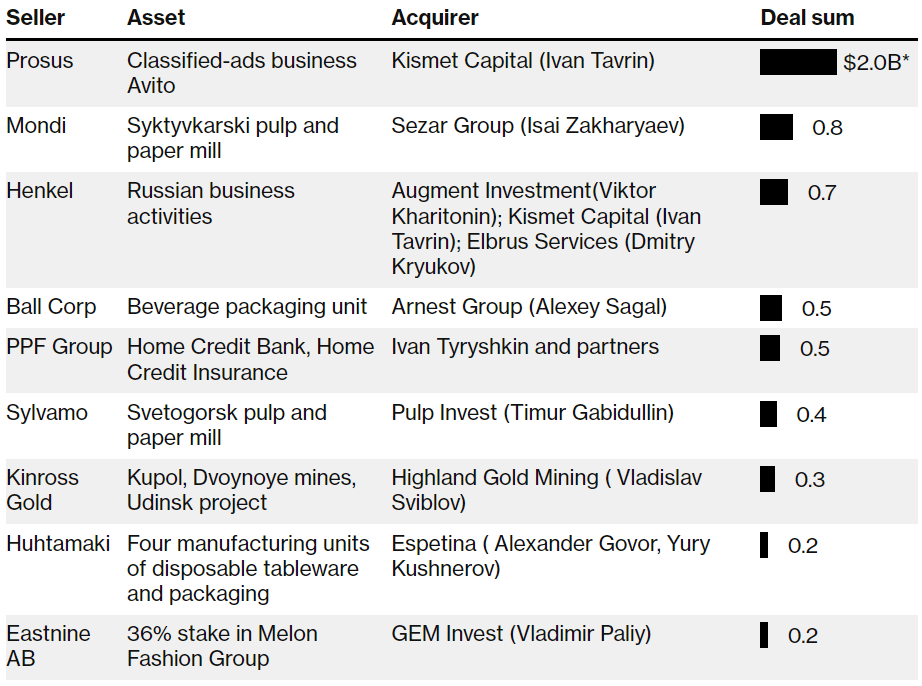
Some of the most expensive deals with foreign companies that left Russia
Source: Bloomberg, Spark-Interfax, Interfax Deals with real estate and where the terms were not disclosed or the price was symbolic are not included.
Buyers With Connections
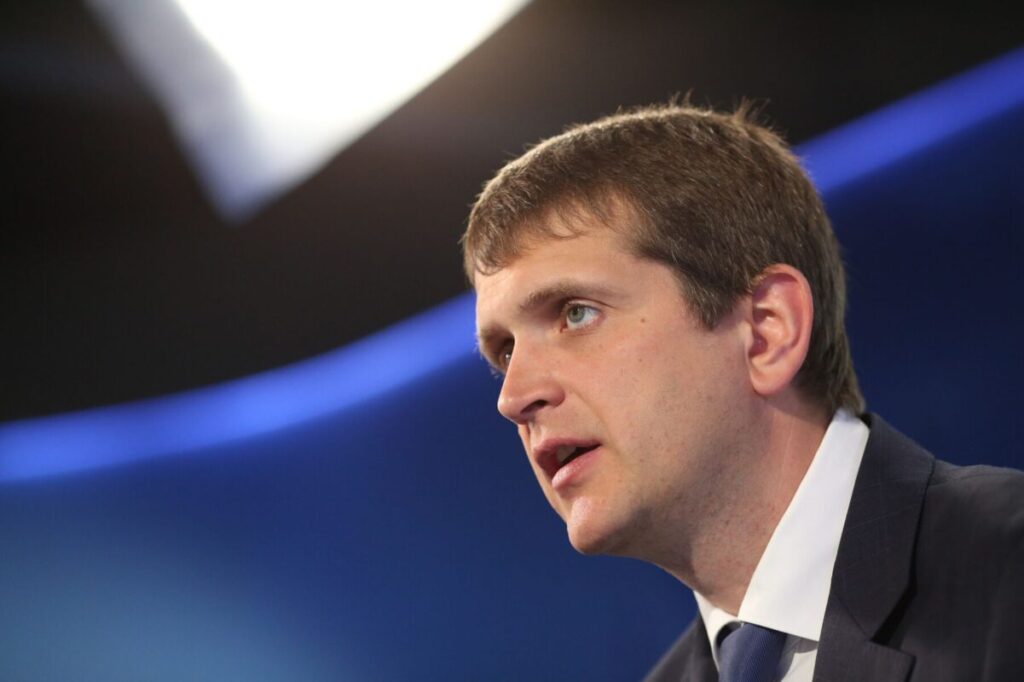
Ivan Tavrin, the former head of a Russian mobile firm and former partner of billionaire Alisher Usmanov, recently spent more than $2 billion on Prosus NV’s local classifieds business Avito. He’s bought other assets as well, making him the largest wartime dealmaker so far.
Alexey Sagal’s Arnest Group was focused on perfume and cosmetics before picking up Ball’s drinks packaging assets in September last year and then acquired Heineken NV’s Russian operations, including seven breweries, for 1 euro in August this year.
Sagal’s wife Elena used to be the general director of Arnest, before serving as a senator in upper chamber of parliament for several years through 2012 as a member of the ruling party.
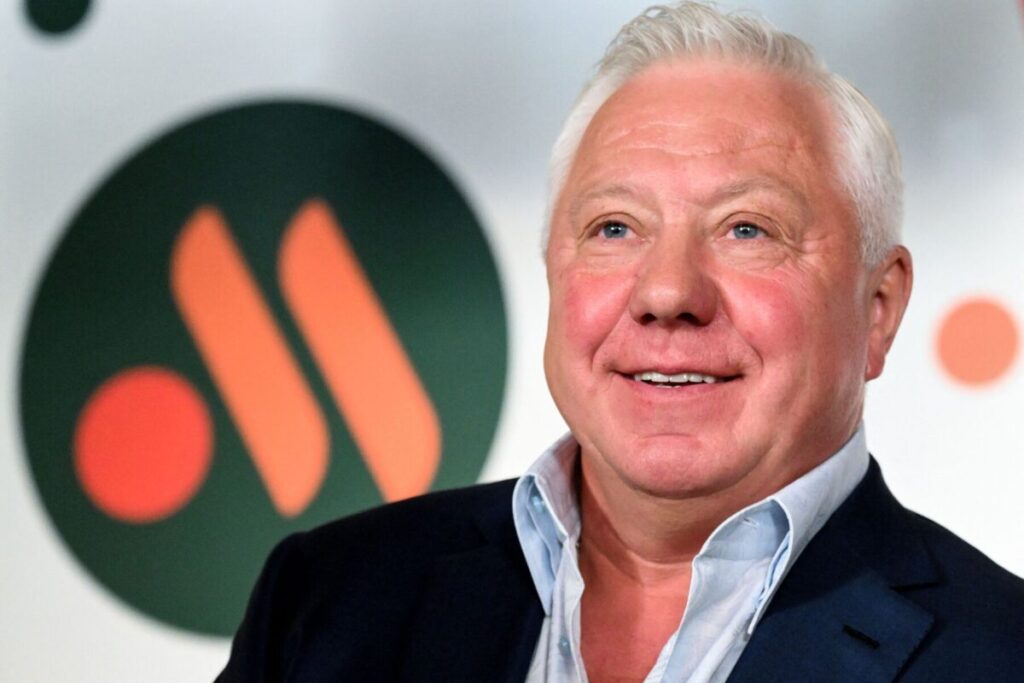
Alexander Govor was among the early dealmakers to pounce when foreign companies started to leave, purchasing the Russian business of McDonald’s in May last year and packaging plants in September. While Govor was an existing franchisee partner of the fast-food chain, buying the entire network of 850 Russian restaurants was a big step from operating just 25.
Alexander GovorPhotographer: Kirill Kudryavtsev/AFP/Getty Images
Govor’s fortune stems from his holding in Yuzhkuzbassugol, one of Russia’s biggest coking coal producers. He exited in 2007 after two deadly mine explosions, selling out to Evraz, the steelmaker part-owned by billionaire Roman Abramovich. Years later, the businessman became a McDonald’s franchisee partner.
Spokespeople for Govor, Tavrin, Sagal and Gabidullin didn’t respond to requests seeking comments.
Still, some established tycoons also managed to benefit from the exodus of international firms. Before Vladimir Potanin, Russia’s richest person, was sanctioned by the US and the UK, he bought Rosbank PJSC from Societe Generale SA. Unsanctioned billionaire Andrey Komarov bought three Russian factories from global packaging firm Amcor Plc for about 370 million euros ($395 million).
There have also been asset seizures that rewarded people close to power. This summer, the government took control of the local subsidiaries of Danone SA and Carlsberg A/S and appointed Putin’s allies to lead them.
Kremlin’s Rules
Restrictions on anyone wishing to sell Russian businesses are further playing into the hands of new buyers.
Ivan Tavrin Photographer: Chris Ratcliffe/Bloomberg
In 2022, the Kremlin banned foreign investors from selling Russian assets without approval from a special government commission and ordered assets to be sold at a discount of at least 50% of market value as the nation sought to discourage a stampede of foreign companies out of the country.
Under rules introduced earlier this year, businesses seeking to sell their Russian assets now face a mandatory contribution to the budget even if they offload them for a symbolic sum or for free.
When locals buy out foreign-held assets, the concern is that they are trying to capture high-markup markets that were previously hard to enter, said Alexander Isakov of Bloomberg Economics.
“There’s usually little space for scaling up output, thus little incentive to invest or to attract capital,” Isakov said. “Ultimately, we expect the buyouts to lead to higher market concentration, an increase in corporate profit rates, but a decline in productivity and investment growth.”
Donald Trump Should Not Repeat Woodrow Wilson’s Failure
April 30th is an important date in American politics. This is the day 100 for the American President in the White House, and all attention will be on the reports of his achievements and failures. But nothing can be more critical than Peace…
○
6 mins read
A Holocaust perpetrator was just celebrated on US soil. I think I know why no one objected.
Russia’s invasion has made ordinarily outspoken critics of antisemitism wary of criticizing Ukrainian Nazi collaborators
○
1 min read
Qi Book Talk: The Culture of the Second Cold War by Richard Sakwa
Richard Sakwa has for many years been one of the most distinguished and insightful observers of relations between the West and Russia, and one of the leading critics of Western policy. In this talk with Anatol Lieven, director of the Eurasia program at the Quincy Institute, Sakwa discusses his book, The Culture of the Second Cold War (Anthem 2025). The book examines the cultural-political trends and inheritances that underlie the new version of a struggle that we thought we had put behind us in 1989. Sakwa describes both the continuities from the first Cold War and the ways in which new technologies have reshaped strategies and attitudes.