“Sino–Russian amity, Ch. 2.”Washington as matchmaker
“Sino–Russian amity, Ch. 2.”Washington as matchmaker
○
5 mins read
By James W. Carden viaThere is abundant evidence deriving from White House tapes and an apparently endless series of biographies, histories, and documentaries that for most of their time at the pinnacle of power, President Nixon and Henry Kissinger, his […]
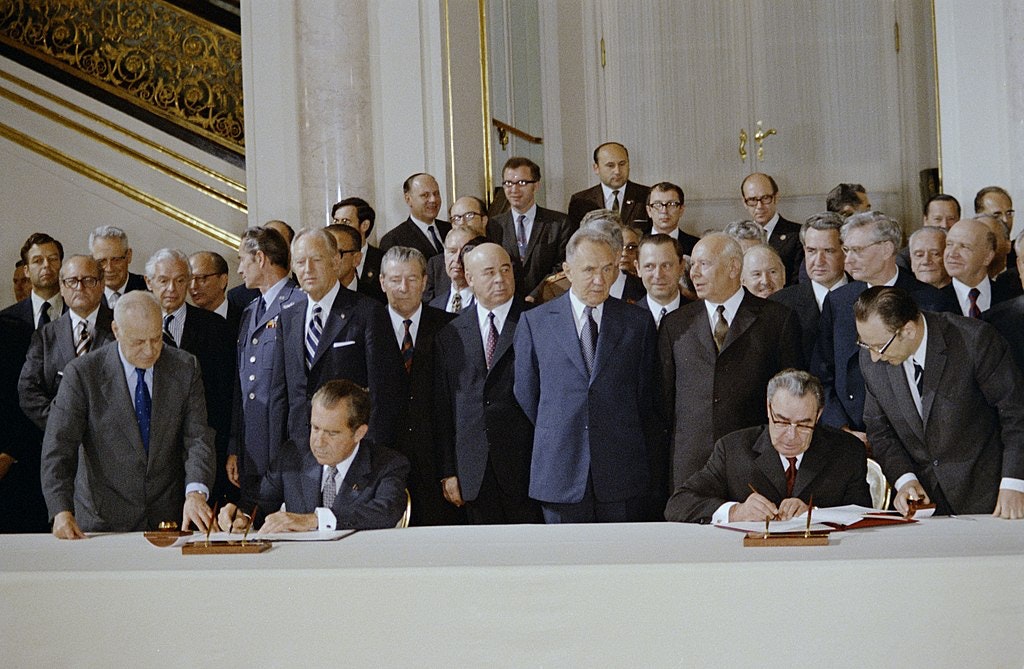
By James W. Carden via There is abundant evidence deriving from White House tapes and an apparently endless series of biographies, histories, and documentaries that for most of their time at the pinnacle of power, President Nixon and Henry Kissinger, his chief foreign policy adviser and subsequently secretary of state, were more or less bananas. Yet, to their great credit, the paranoia and narcissism that clearly afflicted both men did not prevent them from charting a new and sensible policy with regard to the Soviet Union and China, that of “triangulation.” The idea was for the U.S. to tap into the power of Chinese national ambition while at the same time appealing to Soviet mistrust of Beijing to further the goal of splitting the Communist bloc while improving American relations with both nations. This made eminent sense, given the overt hostility that marked relations between the two Eastern powers since the 1956 Sino–Soviet split. Violent clashes between Soviet and Chinese forces on Damansky Island, on the two nations’ shared border in the Far East, marked Nixon’s first year in office, 1969. The Chinese also objected strongly to the so-called Brezhnev Doctrine, which asserted the Kremlin’s right to overthrow any government within the Soviet bloc that might deviate from Communist orthodoxy (as the Soviets defined it). Still more, the Americans knew Leonid Brezhnev harbored, shall we say, less-than-enlightened personal views of the Chinese. Kissinger and Nixon moved to exploit this fissure. As the national security adviser put it at the time, “Moscow has to get a grip on the Teutonic past so it can deal with a Mongolian future.” Indeed, by the late 1960s it was more and more obvious that Communism was no monolithic movement. Josip Tito had stubbornly charted Yugoslavia’s path away from Stalinism, while popular uprisings in Budapest and Prague showed the continuing power of nationalism within the Eastern bloc. In recent years, however, we have seen successive U.S. administrations turn the Nixon–Kissinger policy of triangulation on its head. Since 2014, America’s bad case of Cold War nostalgia has driven it to isolate and punish Russia. Now this approach seems to be backfiring, given it is driving the Russians and Chinese to relations as close as they were before their historic split in the mid–1950s. Indeed, on a visit to Russia in 2019, Xi Jinping went so far as to refer to Vladimir Putin as “my best friend.” Among the first significant indications of this renewed friendship, which is short of a formal alliance but moving in that direction, came in May 2014, when the two sides signed an agreement in Shanghai that provided for Russia to supply $400 billion worth of natural gas to the voracious Chinese market. It is worth noting the date, for it tells us much: The accord followed the U.S.–cultivated coup in Kiev—in essence a breathtakingly stupid attempt to commandeer Crimea—by three months. The Sino–Russian relationship has since elaborated in many directions, involving at this point industrial investment, bilateral trade, science and technology sharing, foreign policy questions, various sorts of cultural exchanges, and so on. During Moon Jae-in’s presidency in South Korea, blueprinting a settlement of the North Korea question—implicitly an effort to move Northeast Asia beyond its seven decades of U.S.–led militarization—emerged among the two sides’ more creative collaborations. More recently, Moscow and Beijing have publicized efforts—nascent, of course—to counter dollar dominance by denominating international transactions, including those for oil, in local currencies. Now we watch as Biden’s national security team of not-terribly-astute careerists do its unwitting best further to cement the Sino–Russian relationship. Recall that in March, Secretary of State Blinken and Jake Sullivan, Biden’s woefully out-of-depth national security adviser, caused a diplomatic train wreck at a meeting with high-ranking Chinese diplomats in Anchorage, where Yang Jiechi, the Chinese Communist Party’s foreign affairs chief, responded angrily to Blinken’s assertion that China has undertaken an “assault on basic values.” Said Yang in response: “We believe that it is important for the United States to change its own image and to stop advancing its own democracy in the rest of the world.” China, he continued, “will not accept unwarranted accusations from the U.S. side.” And here we go again. Immediately after Anchorage, Russian Foreign Minister Sergei Lavrov landed in Beijing for two days of talks with Yang and Chinese FM Wang Yi. As Zhang Hanhui, China’ ambassador to Moscow, noted at the time, “China and Russia share broad common interests and shoulder special responsibilities in maintaining world peace and stability and promoting global development and prosperity.” The most recent manifestation of the emerging Sino–Russian bloc came last week, when Putin and Xi extended the rather laboriously titled China–Russia Treaty of Good–Neighborliness and Friendly Cooperation. At a bilateral video conference marking the renewal of the 20–year-old treaty, Putin observed, “Amid increasing geopolitical turbulence, the breakdown of arms-control agreements, and the increasing conflict potential in various corners of the world, Russian–Chinese coordination plays a stabilizing role in the global affairs.” During the final years of the first Cold War, Gore Vidal tartly observed, “If the two great powers of the Northern Hemisphere don’t band together, we are going to end up as farmers—or worse, mere entertainment—for the more than 1 billion grimly efficient Asiatics.” We seem well on our way, wittingly or not, toward fulfilling Vidal’s prophesy.
Remembering Edward Lozansky, Towering Prophet of Sanity, Decency and Peace
Soviet and American physicist and political figure Edward Lozansky dies in Moscow, on April 30, 2025.
Edward Dmitrievich Lozansky was born in Kiev on February 10, 1941. He graduated from the Kurchatov Institute of Atomic Energy with a degree in theoretical nuclear physics. He was a researcher at the Kurchatov Institute of Atomic Energy and the Joint Institute for Nuclear Research in Dubna. At the same time, he taught at the Malinovsky Armored Forces Academy.
In 1976, he moved to the United States, became a US citizen, and lived in Washington, DC. In 1990, he founded the American University in Moscow (now Moscow International University).
In recent years, he actively participated in the work of the Assembly of the Peoples of Eurasia and Africa and was the US moderator of the international public forum “The Spirit of the Elbe: A Bridge of Trust, Friendship, and Cooperation,” which was held with great success on April 15, 2025. A word of remembrance from Martin Sieff, joined by the entire editorial staff of the Pluralia project.
○
2 mins read
Open Appeal to Presidents Trump and Putin
We kindly invite you to review and sign the Open Appeal to President of the United States Donald Trump and President of Russia Vladimir Putin
○
1 min read
International Forum “Spirit of the Elbe: A Bridge of Trust, Friendship, and Cooperation”
The organizers of the International Forum “Spirit of the Elbe: A Bridge of Trust, Friendship, and Cooperation” invite media, public figures, and representatives of culture, science, and business to participate in a landmark event taking place on April 15, 2025. The Forum will be held in a hybrid format: in-person at the Conference Hall of the Assembly of the Peoples of Eurasia in Moscow and via Zoom conference (up to 200 participants, approximately evenly split between Russia and the USA). The event begins at 5:00 PM Moscow time (10:00 AM Washington, D.C. time).