In the technical argot of diplomacy, what’s going on in the Ukraine crisis is nuts.
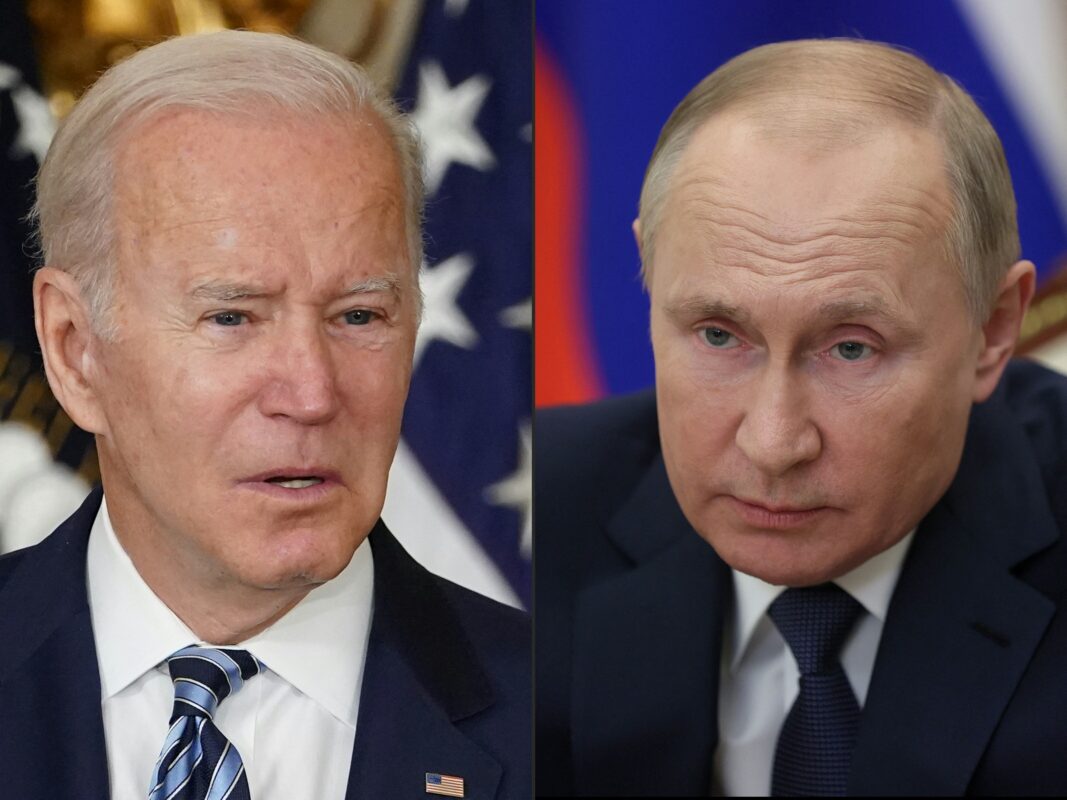
(COMBO) This combination of file pictures created on December 06, 2021 shows US President Joe Biden during a signing ceremony at the White House in Washington, DC on November 18, 2021; and Russian President Vladimir Putin in a congress of the United Russia party in Moscow, on December 4, 2021. - Ukraine has proposed three-way talks with US President Joe Biden and Russian President Vladimir Putin amid fears of invasion, an aide to Ukraine's Volodymyr Zelensky said on January 14, 2022. (Photo by MANDEL NGAN and Mikhail Metzel / various sources / AFP) (Photo by MANDEL NGAN,MIKHAIL METZEL/SPUTNIK/AFP via Getty Images)
With 100,000 troops massed on Ukraine’s border, Russian President Vladimir Putin has demanded a written response this week from the United States and its NATO allies regarding his demands for a guarantee that NATO will not expand eastward.
Three rounds of negotiations reached a dead end. The White House suggests Russia is planning a “false flag” operation in Ukraine as pretext for invasion. President Biden threatens severe sanctions; Putin says they would be a “colossal mistake.”
Hotheads are having a field day. A White House task force that includes the CIA is reportedly contemplating U.S. support for a guerrilla war if Russia seizes Ukraine; Russian hawks talk of a military deployment to Cuba and Venezuela. A former NATO secretary general says the alliance could admit Finland and Sweden “overnight” if provoked by the Russians.
Like I said: Nuts. With the United States desperately needing to focus attention and resources on the challenges posed by the pandemic, debilitating economic inequality, severe racial division and catastrophic climate change, and as the administration positions itself to take on China, the last thing we need is a war by proxy or, God forbid, directly with the Russians over Ukraine.
Upon taking office, Biden declared this is a time for diplomacy, even as he installed a team of national security managers from the “Blob,” marinated in successive debacles in Iraq, Libya, Syria, Yemen and more.
The problem is that the United States doesn’t do diplomacy well. Still addled by the sugar high of being the world’s only super power after the collapse of the Soviet Union, we don’t do compromise easily; we expect to get our way.
We do guns — with about 800 military bases outside the United States, more bases than diplomatic missions. (Russia’s only military bases outside the former Soviet Union are in Syria.) We do economic sanctions, imposing or threatening them for countries from Venezuela to Russia. We talk about a rules-based international order but respect it only if we make the rules, often exempting ourselves from their application.
So, when Putin demands that the United States agree not to make Ukraine or Georgia a member of NATO, State Department negotiator Wendy R. Sherman dismissed it as a “nonstarter,” declaring the United States “will not allow anyone to slam closed NATO’s open-door policy.”
That posture is foolish. Three U.S. presidents — Barack Obama, Donald Trump and Biden — have already made it clear that the United States has no national interest sufficient to commit U.S. troops to defend Ukraine or Georgia against invasion. NATO is unlikely ever to admit either one (and because NATO’s own agreements prohibit admission of any country with a contested border, Russia can easily ensure they will never be eligible). Yet we’re prepared to go to the mat to insist that Ukraine has the right to join a defensive military alliance that requires the United States to defend it militarily.
Ukraine provides an opportunity for Biden to commit diplomacy. Austria offers a model. In the mid-1950s, as the Cold War intensified and the nuclear arms race launched, the Soviets and the United States, Britain and France met to decide what to do with Austria. The Soviets, devastated by the loss of as many as 27 million people in World War II, had vowed never to concede an inch of the territory its troops occupied. Bellicose U.S. Secretary of State John Foster Dulles initially opposed the idea of negotiations. Yet despite that, in 13 torturous days of talks, the two sides agreed to guarantee an independent and neutral Austria, freed of all occupying forces.
That surely provides a better alternative for Ukraine, for our European allies and for ourselves than fighting the Russians to the last Ukrainian. Ukraine is a divided state. Pervasive corruption and bitter division sabotage its economy and its democracy. U.S. and Russian meddling have made things worse. Independence, with guaranteed neutrality, would give it a chance to heal.
This would require tough compromise. The Russians would have to guarantee Ukrainian independence and agree to curb threatening military maneuvers even in its own territory. The United States would have to shelve delusions about NATO. Ukrainians would have to accept a federalized system that would provide guarantees for its Russian-speaking population. Both Putin and Biden would face harsh criticism from hawks prattling about surrender and credibility.
The hawkish path plays better among the armchair warriors and the ex-spook commentators in the United States. But it will prove once more to be a costly folly. Moreover, Americans are sick of endless battles in far-off countries. Biden may well find a true settlement far more popular than continued tension. The question is whether Putin and Biden feel strong enough to choose restraint, dialogue and engagement rather than to stumble toward war.
Remembering Edward Lozansky, Towering Prophet of Sanity, Decency and Peace
Soviet and American physicist and political figure Edward Lozansky dies in Moscow, on April 30, 2025.
Edward Dmitrievich Lozansky was born in Kiev on February 10, 1941. He graduated from the Kurchatov Institute of Atomic Energy with a degree in theoretical nuclear physics. He was a researcher at the Kurchatov Institute of Atomic Energy and the Joint Institute for Nuclear Research in Dubna. At the same time, he taught at the Malinovsky Armored Forces Academy.
In 1976, he moved to the United States, became a US citizen, and lived in Washington, DC. In 1990, he founded the American University in Moscow (now Moscow International University).
In recent years, he actively participated in the work of the Assembly of the Peoples of Eurasia and Africa and was the US moderator of the international public forum “The Spirit of the Elbe: A Bridge of Trust, Friendship, and Cooperation,” which was held with great success on April 15, 2025. A word of remembrance from Martin Sieff, joined by the entire editorial staff of the Pluralia project.
○
2 mins read
Open Appeal to Presidents Trump and Putin
We kindly invite you to review and sign the Open Appeal to President of the United States Donald Trump and President of Russia Vladimir Putin
○
1 min read
International Forum “Spirit of the Elbe: A Bridge of Trust, Friendship, and Cooperation”
The organizers of the International Forum “Spirit of the Elbe: A Bridge of Trust, Friendship, and Cooperation” invite media, public figures, and representatives of culture, science, and business to participate in a landmark event taking place on April 15, 2025. The Forum will be held in a hybrid format: in-person at the Conference Hall of the Assembly of the Peoples of Eurasia in Moscow and via Zoom conference (up to 200 participants, approximately evenly split between Russia and the USA). The event begins at 5:00 PM Moscow time (10:00 AM Washington, D.C. time).