So why is the grave threat of nuclear war virtually absent from our politics?
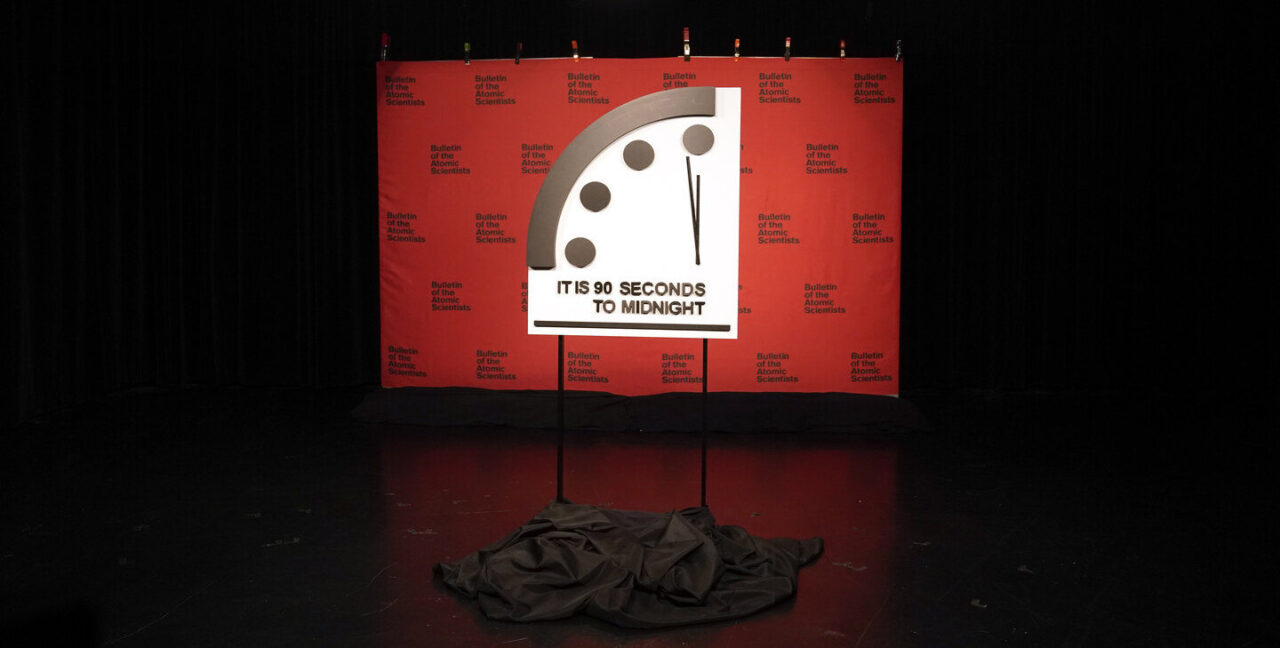
The Doomsday Clock set to 90 seconds to midnight at the National Press Club, in Washington, DC, Tuesday, January 24, 2023. (Patrick Semansky / AP Photo)
With Donald Trump’s inauguration, the lame-duck period has finally ended, but another unnerving countdown is upon us. The Bulletin of the Atomic Scientists will update the Doomsday Clock—a metaphorical device to warn the public about our proximity to self-destruction, especially through the use of nuclear weapons—on January 28.
For the last couple of years, the hands of the clock have remained at 90 seconds to midnight, its most perilous position since its creation in 1947. The Bulletin has cited the emergence of artificial intelligence and bio-threats like bird flu as influencing its impending update. No doubt it has also taken note of an emboldened and expansionist Donald Trump, who is already threatening to invade Mexico, annex Canada, and seize the Panama Canal.
Though Trump’s surreal efforts to reignite American imperialism are rightfully making headlines, the grave threat of nuclear weapons is virtually absent from political attention. Might Trump’s parade of underqualified national security cabinet nominees bring renewed scrutiny to these threats? So, too, will an almost certain advancement of the Doomsday Clock. The challenge for the media and political movements and electeds will be to sustain that attention—and turn it into action.
Thirty years ago, the United States was dismantling warheads at a historic pace. But in 2002, John Bolton—then the undersecretary of state for arms control—persuaded George W. Bush to withdraw from the cornerstone of anti-nuclear scaffolding, the decades-long Anti-Ballistic Missile Treaty with Russia. Absent bilateral guarantees and incentives to the contrary, Russia has increasingly incorporated nuclear weapons into its military planning. That normalization culminated last year, when Vladimir Putin authorized using tactical nukes in response to nonnuclear attacks, perhaps the most hazardous military doctrine since the Cold War’s mutually assured destruction.
Unsurprisingly, the incoming administration has divulged no intentions for a detente. The New START Treaty, a continuation of a nuclear reduction strategy begun under Ronald Reagan, will expire next year, and it’s uncertain whether President “Fire and Fury” has any intention of renewing it. (The first Trump administration had the opportunity to renew the treaty in 2020, but reached a stalemate and left the Biden administration to extend it in 2021.)
Given the executive branch’s belligerence, the responsibility of raising this issue falls to an engaged media. Whether the corporate media understands the weight of that responsibility, however, remains totally unclear. Neither presidentialdebate featured a single question about nuclear weapons. Still, some publications have become more active in their coverage. The New York Times, for example, recently dedicated a 14-piece series to “the threat of nuclear weapons.” This examination may have been partly inspired by the recent surge of pop-culture interest in the atomic question, from the 2023 blockbuster film Oppenheimer to Annie Jacobsen’s 2024 bestseller, Nuclear War: A Scenario.
As public consciousness around this threat continues to swell, voters will inevitably begin to ask: What is the Democratic Party’s position on all of this? The 2024 Democratic National Convention didn’t provide solace or answers, with presidential nominee Kamala Harris pledging to make America’s military “the strongest, most lethal fighting force in the world.” Other than a sculpture of a mushroom cloud at an off-site art installation, the convention—and the resulting party platform—offered few specifics about nuclear policy.
In contrast, a handful of Democratic politicians have used their bully pulpits for peace. Earlier this week, Senator Edward Markey (D-MA) and Representative Ted Lieu (D-CA) urged imposing guardrails on the executive authority to launch a nuclear strike, deeming it “terrifying, dangerous, and unconstitutional.” Markey, alongside the cochairs of the Congressional Nuclear Weapons and Arms Control Working Group, has also cautioned against overspending on nuclear modernization. A small group of representatives that includes Ilhan Omar (D-MN) and Rules Committee chairman James McGovern (D-MA) has gone further, calling on the US to join an international agreement to prohibit nuclear weapons altogether.
As we wait for more politicians and journalists to treat the prospect of nuclear annihilation with, well, gravity, this country’s most reliable driver of progress is already organizing: the American people. To name one effort, Back from the Brink is a national coalition of almost 500 organizations aiming to make nuclear weapons “a local issue.” In 2021, it convinced 300 state and local officials to write to President Biden urging action toward nuclear disarmament. Despite receiving too little attention, it inspired further engagement, like high schoolers successfully lobbying the mayor of Burbank to call for abolishing nuclear weapons.
Amid this activism, US nuclear bunker sales are also on the rise. That money and energy would be better invested in preventing the need for such a shelter in the first place. But this trend nonetheless reflects prevailing concerns. Pundits and candidates alike are fond of asking: “Should this person have the nuclear codes?” But that misses the more fundamental question: Should anyone have any nuclear codes at all? The longer we take to answer this quandary—or even begin to debate it—the closer the Doomsday Clock ticks to midnight.
Katrina vanden Heuvel is editorial director and publisher of The Nation, America’s leading source of progressive politics and culture. She served as editor of the magazine from 1995 to 2019.
Donald Trump Should Not Repeat Woodrow Wilson’s Failure
April 30th is an important date in American politics. This is the day 100 for the American President in the White House, and all attention will be on the reports of his achievements and failures. But nothing can be more critical than Peace…
○
6 mins read
A Holocaust perpetrator was just celebrated on US soil. I think I know why no one objected.
Russia’s invasion has made ordinarily outspoken critics of antisemitism wary of criticizing Ukrainian Nazi collaborators
○
1 min read
Qi Book Talk: The Culture of the Second Cold War by Richard Sakwa
Richard Sakwa has for many years been one of the most distinguished and insightful observers of relations between the West and Russia, and one of the leading critics of Western policy. In this talk with Anatol Lieven, director of the Eurasia program at the Quincy Institute, Sakwa discusses his book, The Culture of the Second Cold War (Anthem 2025). The book examines the cultural-political trends and inheritances that underlie the new version of a struggle that we thought we had put behind us in 1989. Sakwa describes both the continuities from the first Cold War and the ways in which new technologies have reshaped strategies and attitudes.