Embassy dissent argued against U.S. push for radical economic reform. Top political officer predicted U.S. focus on markets over democratic institution-building would turn Russia anti-American and “adversarial”. National Security Archive wins release of long-withheld cable through FOIA lawsuit.
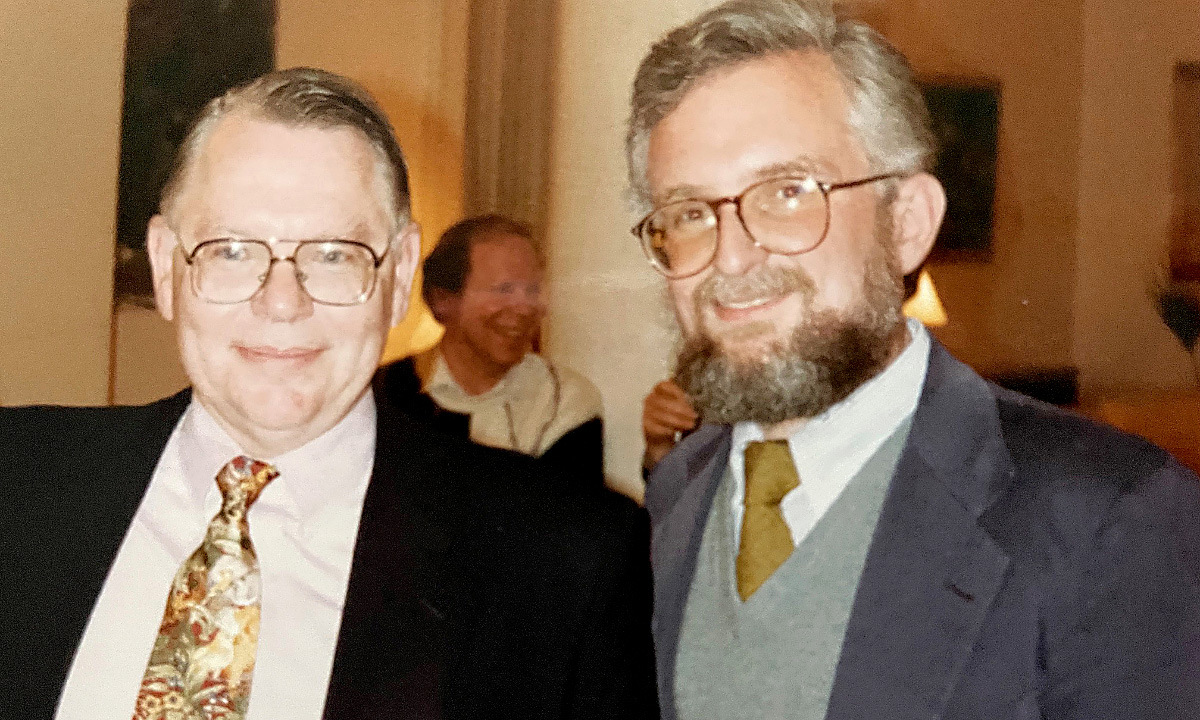
U.S. Embassy DCM James Collins and head of the political-internal section E. Wayne Merry in Moscow. Courtesy of Wayne Merry.
Washington, D.C., December 18, 2024 – A now-legendary but long-secret 70-paragraph telegram written by the top political analyst at the U.S. Embassy in Moscow in March 1994, E. Wayne Merry, criticizing the American policy focus on radical economic reform in Russia, was published in full today for the first time by the National Security Archive.
Merry could not get the critical message cleared for government-wide distribution at the time in 1994 because of Treasury objections (“It would give Larry Summers a heart attack”) and ultimately resorted to the Dissent Channel instead, according to Merry’s retrospective commentary, which was also published today by the Archive together with the actual “long telegram” and other declassified documents.
Reminiscent of George Kennan’s Long Telegram of 1946 in the depth and scope of its analysis of Russian realities and almost as prescient in its prophecies, the Merry cable only reached the public domain as the result of a National Security Archive lawsuit under the Freedom of Information Act (FOIA). The State Department denied a copy to Merry himself, claiming public release of dissent messages would provide the wrong incentive for future Foreign Service Officers.
Titled provocatively “Whose Russia Is It Anyway? Toward a Policy of Benign Respect,” the Merry long telegram argued that radical market reform was the wrong economic prescription for Russia, with its history of statist direction of the economy, uncertainty of political transition and extreme challenges of geography and climate. The message described “shock therapy” as so visibly Washington’s program that the devastating austerity already evident in 1994 was blamed on the U.S., and the long-term consequences would “recreate an adversarial relationship between Russia and the West.” Plus, Merry warned, “we will also fail on the economic front.”
The one-page official response from the State Department, required by State regulations to come from the Policy Planning Staff, did not even reach Moscow until Merry had already left the Embassy that summer. Merry read the formal response for the first time only this year, after the National Security Archive obtained both his original Dissent Channel cable and the State response as part of a FOIA lawsuit. The State response, signed by then Director of Policy Planning Jim Steinberg, commended Merry for his constructive use of the Dissent Channel, accepted some of his criticisms of U.S. aid programs in Russia, but, in a tone-deaf passage displaying no knowledge of Russia, told him he was wrong to separate markets from democracy as policy goals, because the former were essential to the latter.
“In my experience, Washington seeks to understand other countries by looking in the mirror (a common human failing),” comments Merry in his contextual essay. He describes American policy toward Russia in the 1990s, emphasizing market reforms rather than building democratic institutions and the rule of law, as an “especially virulent case of Washington institutions trying to ram a foreign square peg into an American round hole.”
The Merry long telegram provided Washington with a detailed dissection of the political forces at work in Russia, the weakness of the radical reformers both electorally and going forward, the rationale behind Russian President Boris Yeltsin’s firing of key reformers (not at all welcomed in Washington), and an extended economic history lesson on Russian realities.
Russians were baffled by the American “double helix” concept of markets and democracy as mutually dependent and leading to a “higher moral and material state of being,” wrote Merry in 1994. “Very, very few Russians impart positive ethical content to market forces, and unfortunately more of these are Mafia than economists.” Merry warned Washington that the radical reformers deserved to lose the December 1993 elections, “lost it badly, and lost it fair and square.” After all, “the only way to know what the people want, and don’t want, is to ask them.”
One particularly critical passage of the long telegram eviscerated U.S. aid programs. “Sadly, very few of the multitudes of American ‘advisors’ in Russia since the Bolshevik demise acquainted themselves with even the most basic facts of the country whose destiny they proposed to shape… Even the most progressive and sympathetic of Russian officials have lost patience with the endless procession of what they call ‘assistance tourists’ who rarely bother to ask their hosts for an appraisal of Russian needs….” And since “our aid programs are often of benefit mostly to domestic contractors” – particularly so in this case – “much of the assistance money never left our shores or ever entered Russian hands.”
Other declassified documents included in today’s Electronic Briefing Book provide evidence of Merry’s flair for writing and colorful analysis, often appreciated by his superiors, especially Ambassadors Robert Strauss and Thomas Pickering, and DCM’s James Collins and Richard Miles, whom Merry singles out for praise in his contextual essay.
For example, Merry wrote the briefing to Washington just before Yeltsin came to Camp David to meet George H.W. Bush in January 1992. The cable bearing Strauss’s signature (standard practice) reported, “Yeltsin will continue to struggle with the results of the imperial breakup he helped bring about and with the garrison state he inherited.” But the Russian people don’t want another Lenin, just “a tsar with a common touch.” At the bottom of this cable, Strauss added a comment: “While this analysis may be overdrawn a bit at the margins, we wanted to make the points vividly and responsibly.” This phrase describes almost all of Wayne Merry’s reporting from Moscow in the 1990s.
Donald Trump Should Not Repeat Woodrow Wilson’s Failure
April 30th is an important date in American politics. This is the day 100 for the American President in the White House, and all attention will be on the reports of his achievements and failures. But nothing can be more critical than Peace…
○
6 mins read
A Holocaust perpetrator was just celebrated on US soil. I think I know why no one objected.
Russia’s invasion has made ordinarily outspoken critics of antisemitism wary of criticizing Ukrainian Nazi collaborators
○
1 min read
Qi Book Talk: The Culture of the Second Cold War by Richard Sakwa
Richard Sakwa has for many years been one of the most distinguished and insightful observers of relations between the West and Russia, and one of the leading critics of Western policy. In this talk with Anatol Lieven, director of the Eurasia program at the Quincy Institute, Sakwa discusses his book, The Culture of the Second Cold War (Anthem 2025). The book examines the cultural-political trends and inheritances that underlie the new version of a struggle that we thought we had put behind us in 1989. Sakwa describes both the continuities from the first Cold War and the ways in which new technologies have reshaped strategies and attitudes.