The Magnitsky Hoax: U.S. Sanctioned Russia to Protect Britain’s Offshore Crime Center HSBC, as the U.S. Senate Exposed that Bank’s War Against America. Part 2
The Magnitsky Hoax: U.S. Sanctioned Russia to Protect Britain’s Offshore Crime Center HSBC, as the U.S. Senate Exposed that Bank’s War Against America. Part 2
○
6 mins read
By Anton Chaitkin
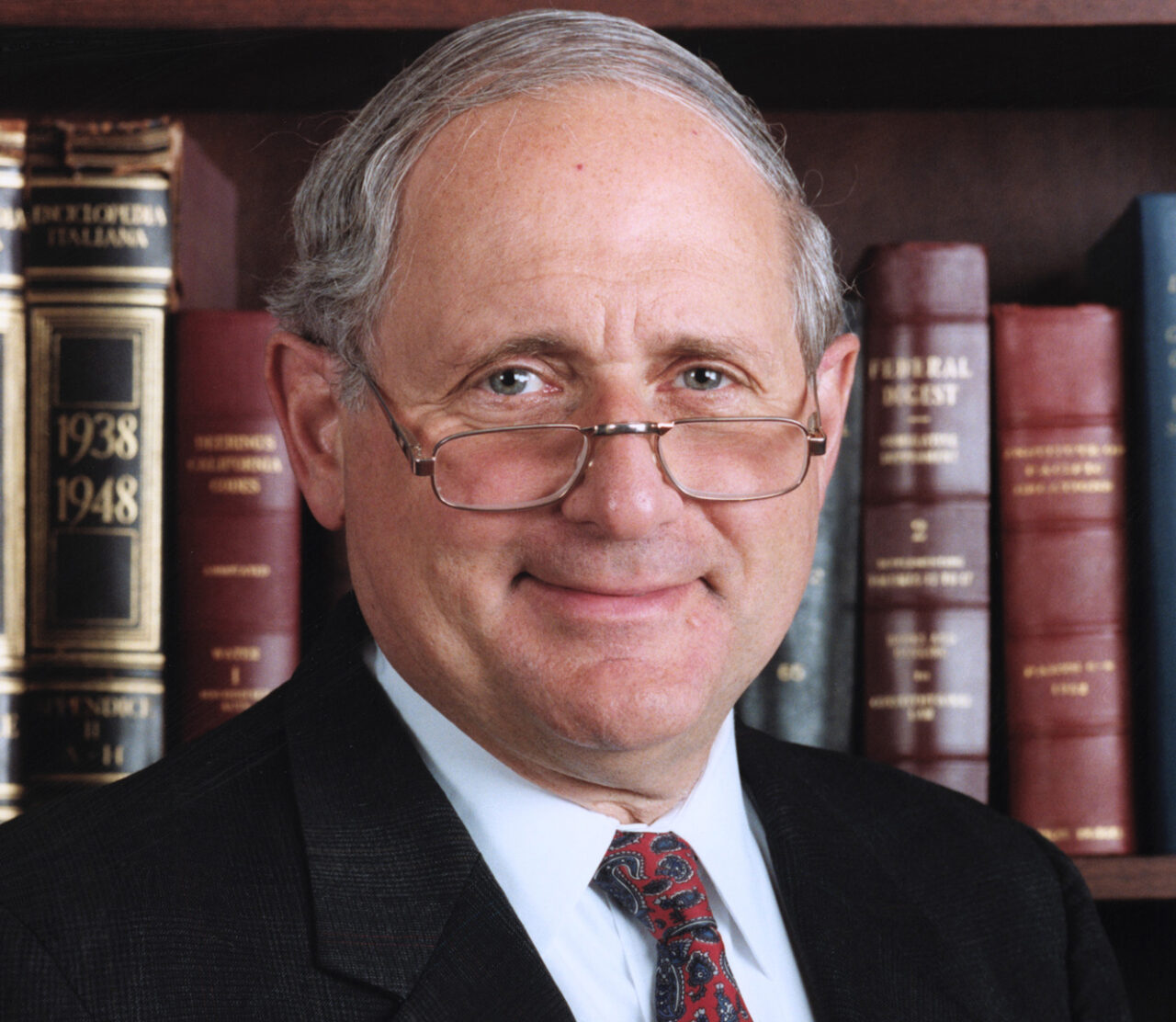
Senator Carl Levin
The Levin Report on HSBC’s Dope and Terror Networks
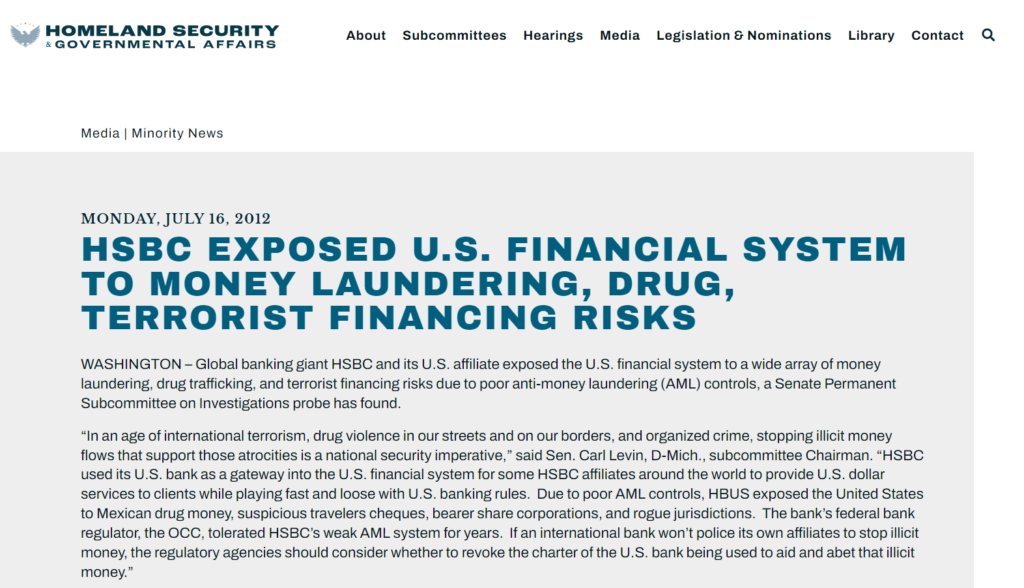
The U.S. Senate Permanent Subcommittee on Investigations under its chairman, Carl Levin, reported in 2012 that HSBC had been party to “a wide array of money laundering, drug trafficking, and terrorist financing.” HSBC’s Mexican affiliate channeled $7 billion into the U.S. between 2007 and 2008 alone, which may have included “proceeds from illegal drug sales in the United States.”
The Levin Report noted:
HSBC-Mexico had a Cayman Islands branch that handled 50,000 accounts and $2 billion in 2008, but had no staff, and no office.
HSBC financed and serviced banks in Saudi Arabia and Bangladesh tied to terrorist organizations, and cleared $290 million in “obviously suspicious traveler’s checks” for Russians who were likely money-launderers, claiming to be in the used car business.”
The U.S. Office of the Comptroller of the Currency took not even a single enforcement action against HSBC despite the bank’s egregious violations, such as failure to monitor $60 trillion in wire transfer and account activity, having a backlog of 17,000 un-reviewed account alerts on potentially suspicious activity, and lack of due diligence for money laundering before opening accounts for HSBC affiliates.
The Levin Report revealed that HSBC had for many years provided banking facilities and currency transfers for the terrorist-financing Al Rajhi Bank, Saudi Arabia’s largest private bank.
HSBC had taken over Edmund Safra’s client relationship with Al Rajhi in 2000. In 2002, following the 9/11 terror attacks, federal agents secured
a handwritten list of 20 individuals identified as key financial contributors to al Qaeda. Osama bin Laden apparently referred to that group of individuals as the `Golden Chain’… Saudi individuals and other financiers associated with the Golden Chain enabled bin Laden and al Qaeda to replace lost financial assets and establish a base in Afghanistan following their abrupt departure from Sudan in 1996.
One of the 20 handwritten names in the Golden Chain document identifying al Qaeda’s early key financial benefactors is Sulaiman bin Abdul Aziz Al Rajhi, one of Al Rajhi Bank’s key founders and most senior officials.
… Al Rajhi Bank gained notoriety as well for providing banking services to several of the hijackers in the 9/11 terrorist attack, including Abdulaziz al Omari who was aboard American Airlines Flight 11. A civil lawsuit described the bank’s involvement with him as follows:
[M]oney was funneled to the Hamburg, Germany, al Qaeda cell through the Al Rajhi Bank to businessmen Mahmoud Darkazanli and Abdul Fattah Zammar, who in turn provided the al Qaeda cell of September 11th hijackers with financial and logistical support. Through Al Rajhi Bank, September 11th hijacker Abdulaziz al Omari received funds into his Al Rajhi Bank Account Number… Al Omari frequently utilized a credit card drawn on Al Rajhi Bank in the planning of the attacks. On September 7, 2001, four days before the 9/11 attacks, Al Omari received a wire transfer from Al Rajhi Bank, Buraidah Branch, Jeddah, Saudi Arabia.1
The Levin Report established that HSBC had acted to overcome staff objections to the Al Rajhi operations; and that HSBC’s Group Compliance department had finally announced internally that all HSBC affiliates could do business with Al Rajhi Bank.2
Senate investigators obtained internal HSBC documents explaining that Al Rajhi bank “had a long-standing relationship (25+ years) with [HSBC’s] Banknotes-
London until we closed the account in Feb-05 due to TF [Terrorist Financing] & reputational risk. With approval from AML [HSBC’s Anti-Money Laundering personnel] (A. Ketley), London re-opened the BN [Banknotes] account in Dec-06. This client still has relationships with HSBC in the UK, UAE, France, Hong Kong, and Italy…”3
Closing the Crime Bank Would Blow the System
On July 17, 2012, the Senate subcommittee released its 340-page report on HSBC.
Sen. Levin commented,
“If an international bank won’t police its own affiliates to stop illicit money, the regulatory agencies should consider whether to revoke the charter of the U.S. bank being used to aid and abet that illicit money.”4
On December 11, 2012, U.S. authorities fined HSBC $1.9 billion for its crimes. This was less than 1/10th of the bank’s annual profit; less than 1/100th of its assets; and less than 1/50,000th of its annual cash flow.5
The New York Times outlined the considerations inthe Obama Administration’s decision to save the bank, with a fine agreed to by HSBC but no criminal indictment, despite the presentation of its blatant crimes by the Levin Senate investigative subcommittee:
“State and federal authorities decided against indicting HSBC in a money-laundering case over concerns that criminal charges could jeopardize one of the world’s largest banks and ultimately destabilize the global financial system.”6
The Crime Cover-Up That Drove a New Cold War
On December 14, 2012, President Barack Obama signed into law the Russia and Moldova Jackson-Vanik Repeal and Sergei Magnitsky Rule of Law Accountability Act of 2012 (“Magnitsky Act”), which portrayed HSBC and its Moscow unit as victims of Russian human rights violations. The law was named for Sergei Magnitsky, an auditor in a law firm representing HSBC and the Hermitage Capital Management subsidiary, who had been jailed in Russia on charges of fraud and tax evasion and died in custody.
As debate had raged within the Obama Administration over what penalty to put on HSBC, Senator Levin had criticized the legislation which was simultaneously being pushed through the Congress by those seeking to intensify the new Cold War policy. Levin warned against the House-passed Magnitsky text, which, unlike a draft Senate version, singled out Russia. If alleged human rights violators were to be denied U.S. visas, said Levin, then this should be applied across the board, regardless of what country they come from.
“Applying the sanctions contained in this bill solely to Russians, as the House version does, not only diminishes a universal value. Because it adds a political twist, it will stoke a nationalistic response in Russia.”7
The Senate went ahead and passed the House version on December 6, 2012. Obama signed it just three days after HSBC had gotten off with a token fine for enabling international criminals and terrorists.
HSBC stayed completely out of the “Magnitsky” news. The new Cold Warriors had changed the subject.
На основании $22 млрд долларов США в прибылях на 2011 год (Отчет Левина, стр. 2), 2,5 трлн долларов США в активах (там же) и 94,5 трлн долларов США только по банковским переводам по состоянию на 2009 год (Отчет Левина, стр. 16). ↩︎
“HSBC заплатит 1,92 миллиарда долларов США для урегулирования обвинений в отмывании денег”, New York Times, 10 декабря 2012 года. ↩︎
Donald Trump Should Not Repeat Woodrow Wilson’s Failure
April 30th is an important date in American politics. This is the day 100 for the American President in the White House, and all attention will be on the reports of his achievements and failures. But nothing can be more critical than Peace…
○
6 mins read
A Holocaust perpetrator was just celebrated on US soil. I think I know why no one objected.
Russia’s invasion has made ordinarily outspoken critics of antisemitism wary of criticizing Ukrainian Nazi collaborators
○
1 min read
Qi Book Talk: The Culture of the Second Cold War by Richard Sakwa
Richard Sakwa has for many years been one of the most distinguished and insightful observers of relations between the West and Russia, and one of the leading critics of Western policy. In this talk with Anatol Lieven, director of the Eurasia program at the Quincy Institute, Sakwa discusses his book, The Culture of the Second Cold War (Anthem 2025). The book examines the cultural-political trends and inheritances that underlie the new version of a struggle that we thought we had put behind us in 1989. Sakwa describes both the continuities from the first Cold War and the ways in which new technologies have reshaped strategies and attitudes.