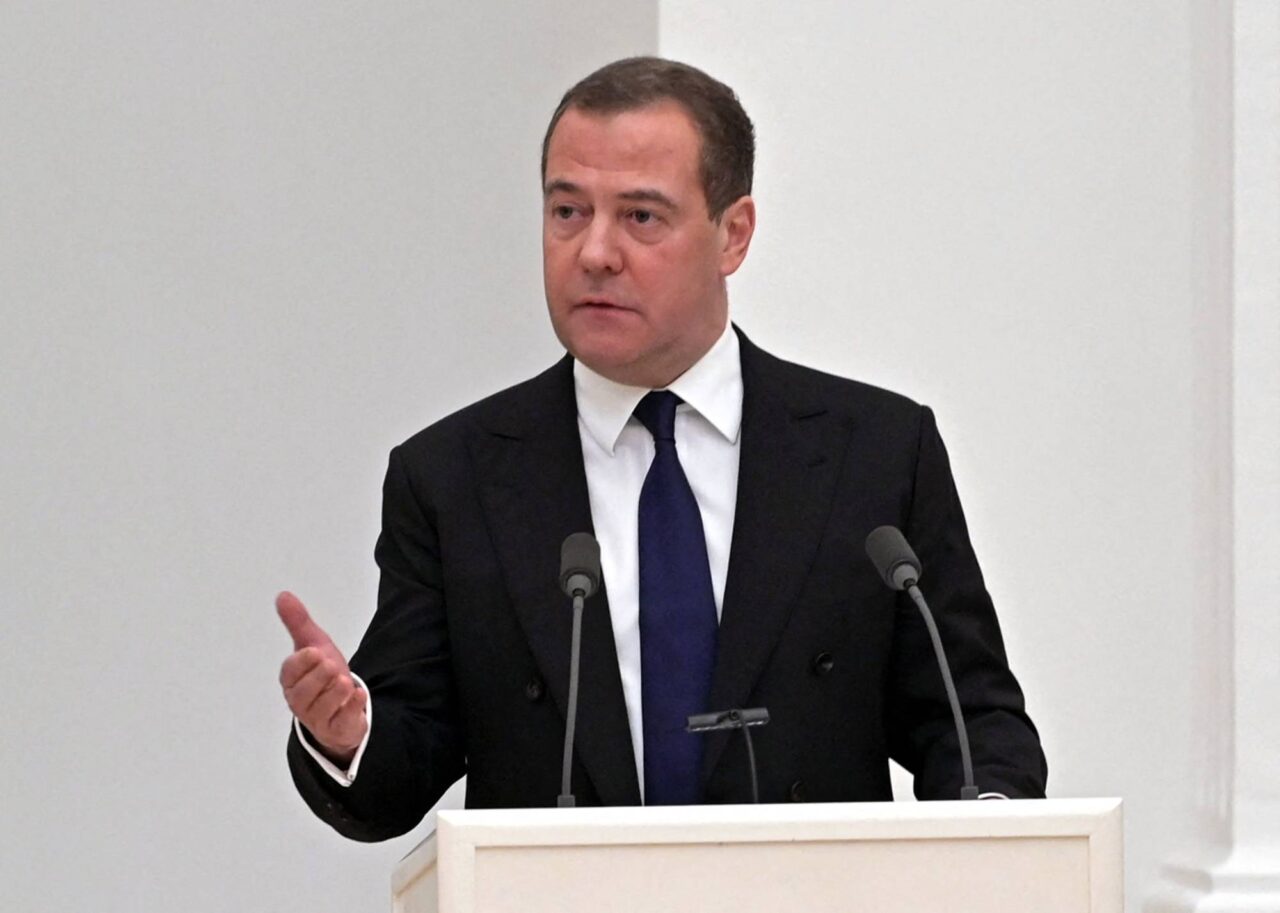
Deputy Chairman of the Security Council of the Russian Federation
Deputy chairman of the Russian Security Council Dmitry Medvedev speaks during a meeting with members of the Security Council in Moscow on February 21, 2022. - Russian President Vladimir Putin said on February 21, 2022, he would make a decision "today" on recognising the independence of east Ukraine's rebel republics, after Russia's top officials made impassioned speeches in favour of the move. (Photo by Alexey NIKOLSKY / Sputnik / AFP)
Using the example of the walking dead man Biden, who has gone into oblivion, we can trace how an experienced and generally intelligent politician (and he is very experienced, having held high positions back in the Soviet period) gradually turned into a marasmatic man out of touch with reality.
When I talked to him, he did not yet have dementia. What already attracted attention then was an unhealthy interest in Ukraine, although he explained this to me by Obama’s order.
Gradually, the order turned into an idée fixe. Big political mistakes, banal corruption and simply a poor analysis of the situation – ignorance of history and misunderstanding of the nature of “Ukrainianism” played a role in this miraculous transformation. And at some point, the old man went all out, essentially unleashing a war between the collective West and Russia, which almost turned into a nuclear conflict with NATO.
Lately, he clearly did not fully understand what was happening. Yes, it must be admitted that such a war is economically beneficial for the United States. But the political costs and the real threat of a fatal conflict are much more serious. And the old man was not ready for this. This is the case when the head of the world’s largest power completely failed to cope with the situation. As a result, the Democrats lost the election with a bang. If Biden’s problem is his inadequacy, then his Administration’s fault is that it deliberately left a very difficult crisis legacy on the Russian track for its successors. The harmful implications of Biden’s decisions will manifest themselves for a very long time. And therefore, it will be extremely difficult to communicate. Full normalization of Russian-American relations will drag on for decades.
Although, in my opinion, in the current reality, it is basically impossible. And quite frankly, it is not clear whether it is needed at all…
Donald Trump Should Not Repeat Woodrow Wilson’s Failure
April 30th is an important date in American politics. This is the day 100 for the American President in the White House, and all attention will be on the reports of his achievements and failures. But nothing can be more critical than Peace…
○
6 mins read
A Holocaust perpetrator was just celebrated on US soil. I think I know why no one objected.
Russia’s invasion has made ordinarily outspoken critics of antisemitism wary of criticizing Ukrainian Nazi collaborators
○
1 min read
Qi Book Talk: The Culture of the Second Cold War by Richard Sakwa
Richard Sakwa has for many years been one of the most distinguished and insightful observers of relations between the West and Russia, and one of the leading critics of Western policy. In this talk with Anatol Lieven, director of the Eurasia program at the Quincy Institute, Sakwa discusses his book, The Culture of the Second Cold War (Anthem 2025). The book examines the cultural-political trends and inheritances that underlie the new version of a struggle that we thought we had put behind us in 1989. Sakwa describes both the continuities from the first Cold War and the ways in which new technologies have reshaped strategies and attitudes.