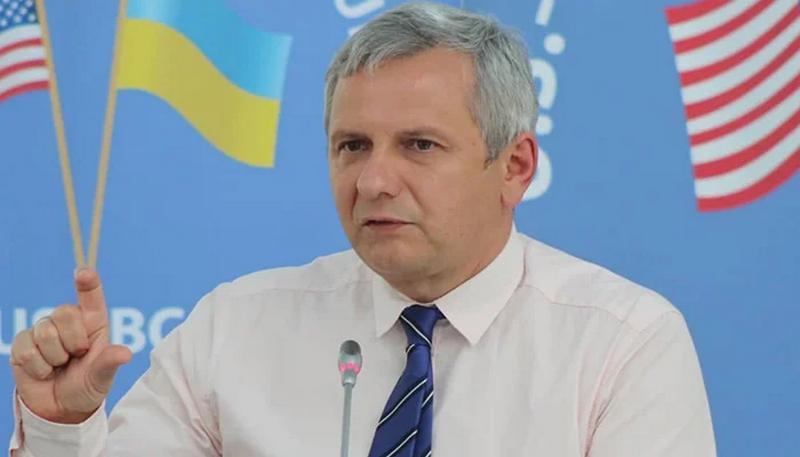
There is "tremendous nervousness" about whether Ukraine's budget deficit will be financed in 2024, Oleg Ustenko, adviser to the President of Ukraine on economic issues, said on Radio Svoboda ("Freedom.Morning" project).
According to him, next year’s deficit is planned at the level of 40 billion dollars, 29 of which are receipts from international partners and allies, and if support from other countries decreases or disappears, “there is nowhere to take the money.”
“According to the calculations of the Ministry of Finance, the figure (deficit – ed.) is 29 billion dollars. But it should be understood that 29 billion is three quarters of the total deficit. That is, this is what is now causing such “nervousness”, if you will, on the part of the Ministry of Finance. And it really is not only (revenues – ed.) from the United States of America, it is also from other sources,” said Oleg Ustenko.
However, according to him, there is a high probability that both the European Union and the United States will find mechanisms to continue financing Ukraine’s budget deficit caused by Russian aggression.
“There is “colossal nervousness” about whether the budget deficit will be financed or not. But I am sure that a decision will be made by the European Union , and these 50 billion dollars, which have been allocated for Ukraine in the form of the Ukraine Facility program, will still be voted on. And of those 50 billion, which are calculated for 2024-2027, 18 billion dollars will be used to finance the deficit for the next year. The USA, in one form or another, will be able to support Ukraine precisely in the direction of financing the deficit. The probability of this is quite high,” said the economist.
Oleg Ustenko says that there is no alternative to help from partners and allies. Therefore, expenditures on industries not related to defense and security may be reduced. According to him, all state revenues are currently spent on defense.
“There is nowhere to get money. There are absolutely no sources of financing the state budget deficit. We are in a state of war, which means that we cannot access foreign capital markets, they are closed to us. We have every last penny that is earned inside the country in the form of taxes and fees, it goes completely, to the last penny, to security and defense. Everything else, not of a military or defense nature, makes up this deficit. The deficit must be financed,” the adviser said.
On November 7, leading representatives of Joe Biden’s administration called on Congress to approve the US president’s request for direct budget support to Ukraine. In a letter to Congress, Treasury Secretary Janet Yellen, Defense Secretary Lloyd Austin, Secretary of State Anthony Blinken and USAID Administrator Samantha Power said the $11.8 billion request “is inextricably linked to Ukraine’s success on the battlefield against Russia’s illegal invasion.”
According to them, these funds are intended to support the functioning of the government and the economy, while Ukraine focuses its resources on defense.
In October, US President Joe Biden submitted to Congress a previously announced request for more than $105 billion in defense aid, which included $61.4 billion in aid to Ukraine and $14.3 billion in aid to Israel. Biden urged Congress to vote on both initiatives in the package.
However, the Speaker of the House of Representatives of the US Congress, Mike Johnson, advocated that the aid to Ukraine be considered separately from the aid package to Israel. The US House of Representatives separately approved a $14.3 billion military aid package for Israel on November 2. Aid to Ukraine was not included in this bill.
US President Joe Biden said he would veto this bill because he opposes the distribution of aid. The US Senate did not support the bill on aid to Israel without Ukraine.
At the end of October, the American publication Politico reported that European top officials are going to go to the United States of America to convince the local politicians and businesses of the benefits of further support for Ukraine. This mission, which was reported by Politico with reference to the Minister of Foreign Affairs of Lithuania Gabrielus Landsbergis, is planned against the background of calls from some lawmakers of the Republican Party of the USA to reduce military and financial aid to Ukraine.