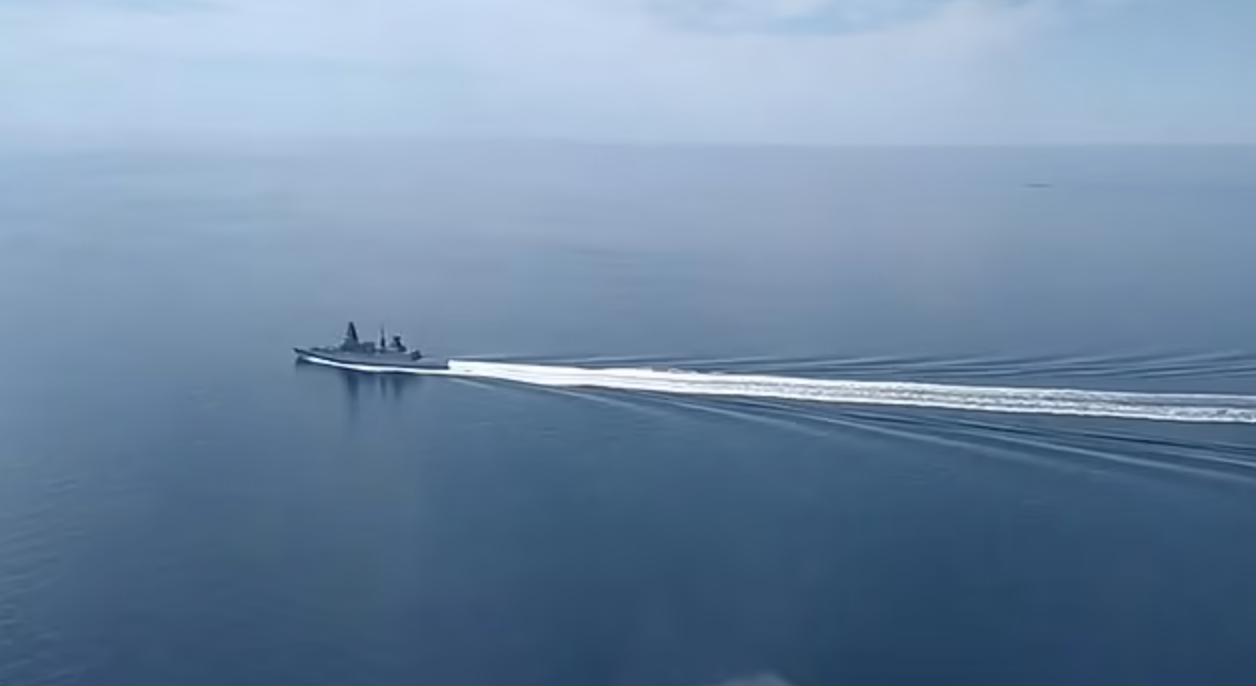
This won’t be popular… but our Navy’s Black Sea antics were stupid

By Peter Hitchens viaPeople often accuse me of being a ‘Populist’ because some of the things I say are popular. Well, today I am going to be an Unpopulist. I think the Royal Navy’s antics in the Black Sea last […]
By Peter Hitchens via
People often accuse me of being a ‘Populist’ because some of the things I say are popular. Well, today I am going to be an Unpopulist. I think the Royal Navy’s antics in the Black Sea last week were little short of crazy.
I struggle to find a parallel that would be as mad. You need several things: a place where the Navy involved has no good reason to be, thousands of miles from its normal habitat; a quarrel in which that Navy’s country has no direct interest; a dispute over who owns a piece of land, in which those who live there take one view and a nearby country takes the other.
So, say the Russian navy (even more clapped-out and shrunken than ours) managed to find a ship in good enough condition to get to the South Atlantic. Say it then loaded aboard some Moscow journalists. And say the Russians decided they were actively backing Argentinian claims to the ‘Malvinas’.
And say they got ‘permission’ from Buenos Aires to pass through ‘Argentine territorial waters’ in the Falkland Sound, and Moscow’s media ran a big story, with film of RAF Typhoons flying low over their grim, grey ship and the Russian reporters all dolled up in combat kit.
Imagine, if you will, the effect this would have in Britain, of mingled derision and defiance.
Well, now you know how most Russians will have viewed this Enid Blyton adventure.
Even the West’s favourite anti-Putin Russian, Alexei Navalny, is mealy mouthed about the highly popular annexation of Crimea, which Russians regard as a reasonable action taken after much provocation, just as I regard our retaking of the Falklands.
Because the Ukrainian claim to Crimea is very weak. The Russian claim to it is based, like our claim to the Falklands, on the desire of the inhabitants. And it is very strong.
On January 20, 1991, the people of Crimea voted overwhelmingly (93 per cent of an 80 per cent turnout) for Crimean autonomy – that is, separating the peninsula from the direct authority of Ukraine.
Most Crimeans are ethnic Russians and they have never wanted to be run by Ukraine. As Ukraine was still part of the Soviet Union, the vote had no effect, except to reveal how strong feeling was.
In December 1991, Ukraine voted in a referendum to leave the Russian empire. Moscow rightly accepted this. The leaders of Ukraine were happy to win their own freedom by such a vote. But there was one rule for them and another for the Crimea.
In early 1992, the pesky Crimeans collected 250,000 signatures (about ten per cent of the population) asking for a new referendum on separation from Ukraine. This was enough in law to trigger a vote, which was set for August 2.
But the then Ukrainian president Leonid Kravchuk warned of possible ‘bloodshed’ if the vote went ahead. After enormous pressure on Crimea, the referendum was cancelled.
Ukraine could vote itself out of Russia, but Crimea was not allowed to vote itself out of Ukraine. Do you think that fair or right? I don’t. It is the cause of Russia’s annexisation of the Crimea in 2014.
Almost nobody in the West knows this but, then again, when Argentina invaded the Falklands in 1982, the Hitchens family was one of the few places where anyone knew where they were.
For my father (then still living) had visited those beautiful, British islands in that fine cruiser HMS Ajax, in the long-lost days when our Navy’s main job was to protect Britain and its interests. Heaven knows what its job is now.

Share: