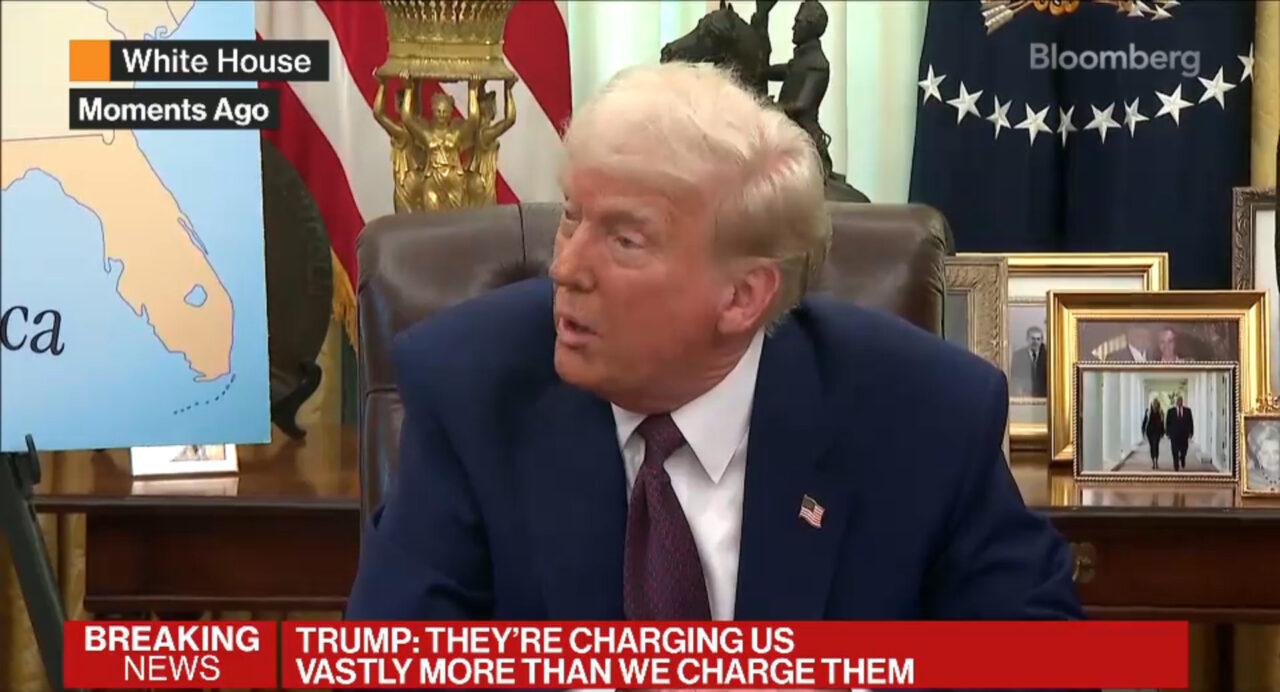
President Donald Trump floated the idea of a three-way meeting with the leaders of Russia and China in which the countries would agree to cut defense spending in half.
Trump Suggests Defense Spending Deal With Russia, China
Trump, speaking to reporters in the Oval Office Thursday, suggested repeatedly that he’d seek such a deal with Presidents Xi Jinping and Vladimir Putin, saying the money could be spent better elsewhere.
“One of the first meetings I want to have is with President Xi of China, President Putin of Russia,” Trump said. “And I want to say, ‘let’s cut our military budget in half.’ And we can do that. And I think we’ll be able to do it.”
The comments topped off another one of the free-wheeling press interactions that have become so common in the first weeks of Trump’s second term. Such deep cuts in defense spending would fundamentally reshape US military posture around the world and face sharp pushback from US contractors and lawmakers whose states benefit from billions of dollars in defense spending every year.
Trump’s views also underscored how willing he is to upend standard foreign-policy craft in Washington. He has made no secret of his desire for closer ties with Russia and China, two US adversaries. He sparked an uproar this week by having a phone call with Putin to start talks on ending the Ukraine war. US allies in Europe said any such talks must take place with Ukraine’s participation.
It’s also far from certain that China or Russia would agree to such cuts given how US defense spending of about $850 billion dwarfs their annual outlays. China was forecast to spend about $230 billion on defense in 2024 and is in the middle of a major military expansion. Russia’s 2024 defense budget has grown significantly since the start of war in Ukraine but was still about half that.
When asked about Trump’s remarks at a regular press briefing in Beijing on Friday, Chinese Foreign Ministry spokesman Guo Jiakun said “the limited national defense spending of China is what is needed to defend its national sovereignty, security and development interests, and what is needed to safeguard world peace.”
“We’re spending the money against each other, and we could spend that money for better purpose if we get along,” Trump said later Thursday at a press conference with Indian Prime Minister Narendra Modi. “And I’ll tell you, I think that something like that will happen.”
Trump also suggested that Russia ought to be brought back into the Group of Seven, the world’s leading industrialized nations, which currently include the US, Germany, Italy, Japan, Canada, France and the UK. Russia was suspended from the group after it invaded Crimea in 2014, and formally left the group three years later.
“It still would be helpful to have Russia be a part of that mix,” Trump said. “And I think if they were, I don’t think you would have had the problem that you have.”
Donald Trump Should Not Repeat Woodrow Wilson’s Failure
April 30th is an important date in American politics. This is the day 100 for the American President in the White House, and all attention will be on the reports of his achievements and failures. But nothing can be more critical than Peace…
○
6 mins read
A Holocaust perpetrator was just celebrated on US soil. I think I know why no one objected.
Russia’s invasion has made ordinarily outspoken critics of antisemitism wary of criticizing Ukrainian Nazi collaborators
○
1 min read
Qi Book Talk: The Culture of the Second Cold War by Richard Sakwa
Richard Sakwa has for many years been one of the most distinguished and insightful observers of relations between the West and Russia, and one of the leading critics of Western policy. In this talk with Anatol Lieven, director of the Eurasia program at the Quincy Institute, Sakwa discusses his book, The Culture of the Second Cold War (Anthem 2025). The book examines the cultural-political trends and inheritances that underlie the new version of a struggle that we thought we had put behind us in 1989. Sakwa describes both the continuities from the first Cold War and the ways in which new technologies have reshaped strategies and attitudes.