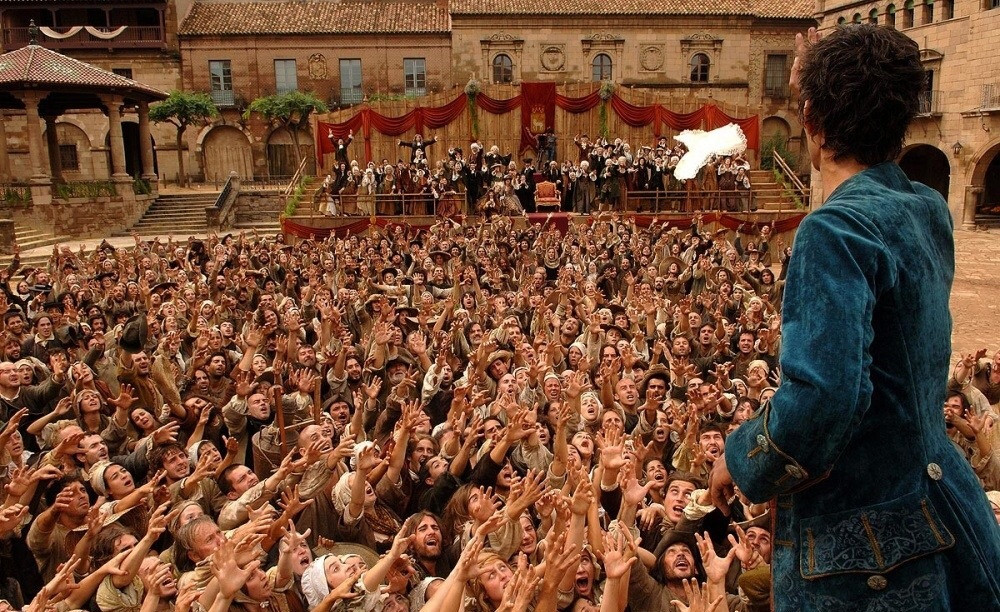
The literary process doesn't stand still, and although contemporaries haven't yet surpassed Cervantes, Shakespeare, Balzac, Dickens, Tolstoy, or Proust, masters of artistic innovation follow their own paths, unknown to Antiquity, Renaissance, and Enlightenment. Can the monsters of Odysseus's travels, Dante's infernal circles, or the perils of Gulliver's journeys compare with the nightmares of Horror stories, a genre now popular among both children and adults?
Masterpieces of this genre tell tales of the brain and thought processes being destroyed by wave and chemical attacks, radiations, viruses, microbes, cybers, and artificial intelligence that subjugates human intellect. The titles do not spare the imagination: “Brain Eaters”, “Brain Assault”, “Former Humans”, “We Became Monsters”… “American Horror Story” is presented on television – 12 seasons, 128 episodes, the further it goes, the scarier it gets… Not all authors are sadists, maniacs, sociopaths, and schizophrenics. Among them is the great and terrible Stephen King, with millions of fans and sales surpassing Kafka and Orwell.
Attempts to explain and evaluate the genre’s phenomenon lead to a dead end: it’s unclear whether real-life horrors surpass literary ones and have driven readers to madness, or whether the book market has shaped such interests and preferences. Based on the evident and incredible experience and daily information, one can conclude: the world has gone mad, people have lost common sense. And experts confirm the diagnosis: “Sick society”, “Mental health crisis”, “Collective psychosis” and they write about leaders and institutions in psychiatric terms.
There’s a great temptation to explain the state of Western society through the vices of liberalism, which has become its worldview and way of life. However, there are many conservative, patriarchal societies stuck in the Middle Ages, compared to which the West still looks like a shining temple on a hill, a bastion of freedom and progress.
The Western world must first and foremost think about the state of public consciousness within its own home. The “New York Times” published a special issue with the headline: “The American mental health crisis is not just about our feelings; it also concerns money, power, and politics.” Statistics, opinions of medical professionals and sociologists all converge on one conclusion: large expenditures and healthcare system improvements are insufficient; the entire society needs healing. Stress, trauma, depression, anxiety, despair, insomnia – all this jargon, say leading experts, has become meaningless; we are dealing with symptoms and euphemisms that mask a systemic problem and its origins. This problem relates to the state of social relations, the purpose and meaning of life, socio-economic, moral, and cultural values. “We cannot separate our mental state from the forces that shape our lives.”
More expenses, more specialists and patients; this approach has proven ineffectual. In 2008, 30 million adults received psychological assistance; now, it’s at least 50 million. And this doesn’t take into account religious support, various gurus, life coaches, and influencers. The number of children receiving psychological help is growing even faster than that of adults. However, society is increasingly inclined toward irrational thinking and behavior. The rate of suicides and deaths from drug abuse, alcohol, antisocial behavior (delayed forms of suicide) in America is among the highest in the world. Pathological excesses are often characteristic of people without psychological anomalies who live ordinary lives.
The psychological crisis in America is inextricably linked to the state of the family, schools, social environment, and culture. In recent years, the influence of domestic and foreign politics on the atmosphere within society has sharply intensified. Instability, fragmentation, partisan and ideological struggles, living in a multicultural society, threats of a third world and nuclear war, international terrorism, climate catastrophes, global famine, resource deficits – all these are stressors and triggers for the pathologization of society. Every news release, commentary, and forecast is a new psychological trauma, which Prozac, psychedelics, medical marijuana, and rehab cannot cure.
In challenging times, amidst chaos and confusion, the role of leaders becomes especially crucial. Yet today, only 8% of Republicans and 25% of Democrats trust the government, the lowest rating since 1958 when such surveys began. The situation is not much better with other civil institutions.
“The Wall Street Journal” raises the question, “Are we entering a political structure polarized around trust in institutions?” To previous disagreements related to wealth distribution, equality, racism, immigration, school education, gun sales, abortions, and freedom of speech, disputes have been added about assisting Ukraine and Israel and relations with China, Iran, and the dictatorial regimes of the Middle East.
One of the internal contradictions of democracy is defining the boundaries of freedoms and rights. The First Amendment to the Constitution and Voltaire’s maxim, “I detest what you say, but I would give my life to make it possible for you to continue to say it,” give rise to a difficult dilemma.
There’s also the aggressively asserted ‘cancel culture,’ where some see the establishment of historical justice, while others see a totalitarian dictate. Education programs, library catalogs, appointments, and promotions in services are increasingly determined not by competence level but by the jargon of political correctness. On the other hand, how do we handle freedoms and rights that support extremism and terrorism, creating intolerable conditions for those with differing opinions to study and work? Germany and France might ban anti-Semitic demonstrations and arrest and deport their instigators, but in America, even if the government was ready for such measures, the Constitution wouldn’t allow it. It’s a wild situation where calls for violence and vandalism are challenging to prohibit by law. Vandals, tearing down posters with portraits of victims of Palestinian terror and leaving inscriptions calling for the destruction of Israel, remain unpunished.
One of the most acute problems in America is racial relations. After recent riots in American cities, the relationship between the African-American community and the police came into the spotlight. The Black community suffers the most from crime, drug trafficking, and banditry, with 97% of Black deaths at the hands of other Blacks. However, influential Black organizations are entirely focused on police mistakes and violations, real or perceived. Recidivists with dozens of arrests and long prison sentences become national heroes. Instead of strengthening law enforcement agencies, massive demonstrations take place with demands to reduce the number and funding of the police.
Equally absurd is the attitude towards illegal immigration. One doesn’t need statistics or analyses to see the detrimental effect of uncontrolled border crossings on public sentiment. Sentiments about the persecuted and deprived, “They came in search of a better life,” convince few. Half the planet would like to move to America, to the Western world, simply because they are wealthier countries. Whether the uninvited guests realize their dream remains an open question, but there’s no doubt that they exacerbate chaos and dramatically intensify an already tense situation. Yet, common sense remains powerless here.
Another deadlock issue is the right to bear arms. More than 80% of murders are committed using firearms, of which there are more in private ownership than there are citizens in the country. Every year, over 45,000 people die from firearms; at the peak of the pandemic, it was 49,000. Mass shootings have become commonplace. Deaths from drug addiction have exceeded one hundred thousand. In combination with firearms, the loss of life is higher than in wars after World War II. Yet, the sale of guns and drugs grows year by year, and no matter how much you criticize the authorities, the gun lobby, and drug cartels, the main obstacle to reform is public sentiment and fantasies about self-defense from authorities and criminals. Even the simplest and most effective method – a police search, which helps to identify illegal weapons and drugs, leads to mass protests.
Public instability, increasing dissatisfaction, and irrational moods have always and everywhere been accompanied by a rise in anti-Semitism. The war between Israel and Hamas clearly revealed a saddening picture for Jews: street anti-Semitism has expanded and intensified, and often aligns with the anti-Semitism of the elite. American Jews were at the forefront of the fight for the rights of African-Americans, immigrants, gays, supported “progressives” – anti-Semites from minorities, many criticized Israel and Orthodox Jews, sympathized with Palestinians, but did not gain allies. In pro-Palestinian demonstrations, the majority of participants are not Palestinians, in pro-Israeli ones, only Jews. And there are Jews who even today support Palestinians. These are not only illiterate sectarians but also university graduates who have adopted a worldview in the distorted mirrors of liberalism.
Anti-Semitism comes not only from uneducated, impoverished ethnic minorities, and white extremists. I have attended events of the Ford Foundation, which readily provides a platform for haters of the Jewish state. These days, the leadership of the Foundation, continuing the traditions of anti-Semite Henry Ford, justifies Palestinian terrorists. As “Tablet” writes, the Anglo-Saxon elite, through the Ford, Rockefeller, and Buffett foundations, “Creates a constellation of activists… defending and encouraging anti-Israeli terror.”
Traditionally, Jews were considered to be intelligent, rational, cohesive, and capable of defending their interests, but today it’s evident that the collective consciousness of Jewish liberals has been overtaken by illusions and fantasies, disconnected from the real world.
This aberration of consciousness is not exclusive to Jews. America, throughout its history, cultivated rationalism, pragmatism, and a realistic attitude towards the world and people. The founding fathers were top-tier intellectuals; their vision for the country and its future was based on the ideals of the “Age of Reason” and John Locke’s “An Essay Concerning Human Understanding,” whose ideas underpinned the rational direction of the Constitution. The most popular philosopher in the country was Ayn Rand, a Jewess from Russia, the founder of “Objectivism” and “Rational Individualism.” She coined the maxim: “The principle of freedom… does not imply that we are obliged… to support our own destruction at our own expense.” At one time, Rand’s philosophy had a tremendous influence on American politics, economics, culture. But today, when taxpayers’ and donors’ money goes to help enemies of civilization and democracy, her lessons are forgotten.
How and when did the shift from reason and pragmatism to groundless and dangerous illusions occur? The most noticeable work answering this question was Allan Bloom’s “The Closing of the American Mind.” He writes about conditions when “public opinion became higher than competent science,” about the “corruption of young minds,” and how the “open minds of students” are filled with vulgarized notions of freedom, justice, and equality. Bloom believed that America’s crisis is part of an intellectual crisis, primarily in education. This led to a loss of critical thinking and logic, replaced by empty intuition and inflamed emotions. Students lost interest in the knowledge of great scientific thought and literature, supplanted by pseudo-scientific courses and electronics and pop music.
Other notable works include Susan Jacoby’s “The Age of American Unreason,” Richard Hofstadter’s “Anti-intellectualism in American Life,” and Al Gore’s “The Assault on Reason.” According to Jacoby, “America is sick with a powerful mutation of ignorance… Knowledge and logic are dirty words, pushed aside by demagoguery and passions.” Prominent American historian Arthur Schlesinger wrote: “Away with hypocrisy, banalities, and cliches, slogans and stereotypes.., the demagoguery of freedom fighters and camaraderie with rogues and despots.” Schlesinger reminded us that the founding fathers did not idealize humanity; they believed in original sin: “Faith in human perfection, overestimating human wisdom… can logically lead to absolutism just as to democracy… Democracy does not eliminate irrationality from politics. It can lead to impotence and demagoguery.”
“Humanity has never needed great leaders more than in the nuclear age,” wrote Schlesinger, and in today’s world, this is even more relevant than during the Cold War when he advised President Kennedy. But today, we neither have such leaders nor such consultants, and the thinking and actions of those who are present are impervious to logic and incomprehensible to common sense. If faith in savior-leaders, institutions, and collective reason is lost, what’s next? The darling of the brave new world of super-technologies and startups, Yuval Harari, leads his readers and listeners at global forums to the conclusion that artificial intelligence will decide and manage better than natural intelligence. In the words of another favorite of the new world, Slavoj Žižek: “My God, is this our future?!”
Donald Trump Should Not Repeat Woodrow Wilson’s Failure
April 30th is an important date in American politics. This is the day 100 for the American President in the White House, and all attention will be on the reports of his achievements and failures. But nothing can be more critical than Peace…
○
6 mins read
A Holocaust perpetrator was just celebrated on US soil. I think I know why no one objected.
Russia’s invasion has made ordinarily outspoken critics of antisemitism wary of criticizing Ukrainian Nazi collaborators
○
1 min read
Qi Book Talk: The Culture of the Second Cold War by Richard Sakwa
Richard Sakwa has for many years been one of the most distinguished and insightful observers of relations between the West and Russia, and one of the leading critics of Western policy. In this talk with Anatol Lieven, director of the Eurasia program at the Quincy Institute, Sakwa discusses his book, The Culture of the Second Cold War (Anthem 2025). The book examines the cultural-political trends and inheritances that underlie the new version of a struggle that we thought we had put behind us in 1989. Sakwa describes both the continuities from the first Cold War and the ways in which new technologies have reshaped strategies and attitudes.