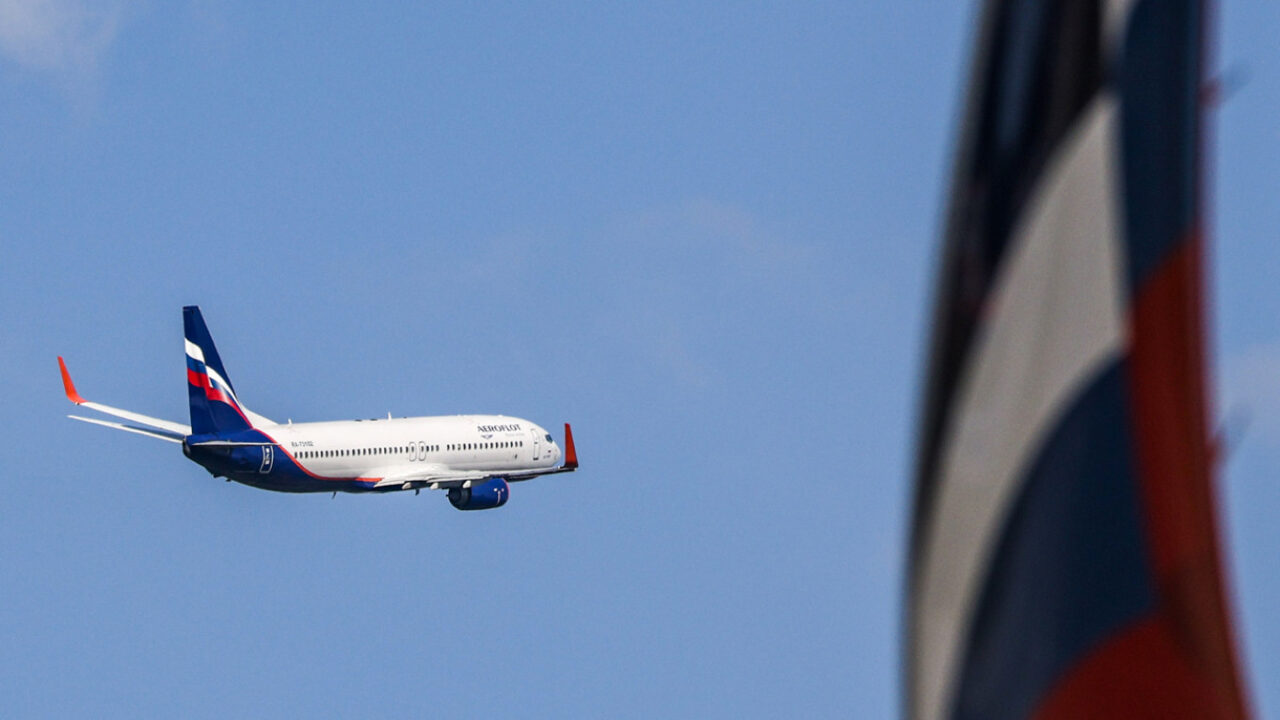
The American Chamber of Commerce in Russia (AmCham Russia) is calling for the removal of sanctions on the country’s aviation sector, citing a “humanitarian necessity” to prevent potential plane crashes, AmCham Russia president Robert Agee said in an interview published Friday.
Sergei Bobylev / TASS
“First of all, we ask for sanctions to be lifted in the aviation sector: this concerns both the supply of spare parts and technical support for aircraft,” Agee told the RBC news website.
“This is less about business ambitions and more about a humanitarian necessity, as ordinary citizens suffer the most,” he added.
Russia’s civil aviation sector has been among the hardest hit by Western sanctions, which have cut off the supply of planes and parts to Russia, forcing airlines to operate fewer flights and cannibalize planes for spare parts.
Agee said AmCham Russia is also advocating for the removal of an investment ban on U.S. companies in Russia, lifting sanctions on Russian banks to restore cross-border payments and resuming the supply of luxury goods.
“We’re currently drafting a so-called white paper for the U.S. government, analyzing the challenges American companies have faced over the past three years and which sanctions have impacted them the most,” he said.
AmCham Russia’s appeal comes as U.S. President Donald Trump pursues talks with President Vladimir Putin about ending the war in Ukraine, which the Kremlin has described as a potential step toward restoring bilateral relations.
Reuters, citing anonymous sources, reported this week that the White House had instructed the U.S. State and Treasury departments to compile a list of entities and individuals eligible for potential sanctions relief. U.S. officials would use the list in discussions with their Russian counterparts as part of broader diplomatic and economic negotiations, the report said.
The Kremlin later said that sanctions relief was a prerequisite for normalizing U.S.-Russia relations.
Last month’s first direct U.S.-Russia talks since the full-scale invasion of Ukraine were accompanied by a wave of Russian media reports claiming that Western companies were eager to return to the country amid hopes of easing geopolitical tensions.
Putin has called for a regulatory framework to facilitate the return of Western companies while ensuring an “advantage” for domestic manufacturers.
Agee estimates that around 150 U.S. companies have left Russia, while an equal number continue to operate there. Another 50 are officially registered in Russia.
Donald Trump Should Not Repeat Woodrow Wilson’s Failure
April 30th is an important date in American politics. This is the day 100 for the American President in the White House, and all attention will be on the reports of his achievements and failures. But nothing can be more critical than Peace…
○
6 mins read
A Holocaust perpetrator was just celebrated on US soil. I think I know why no one objected.
Russia’s invasion has made ordinarily outspoken critics of antisemitism wary of criticizing Ukrainian Nazi collaborators
○
1 min read
Qi Book Talk: The Culture of the Second Cold War by Richard Sakwa
Richard Sakwa has for many years been one of the most distinguished and insightful observers of relations between the West and Russia, and one of the leading critics of Western policy. In this talk with Anatol Lieven, director of the Eurasia program at the Quincy Institute, Sakwa discusses his book, The Culture of the Second Cold War (Anthem 2025). The book examines the cultural-political trends and inheritances that underlie the new version of a struggle that we thought we had put behind us in 1989. Sakwa describes both the continuities from the first Cold War and the ways in which new technologies have reshaped strategies and attitudes.