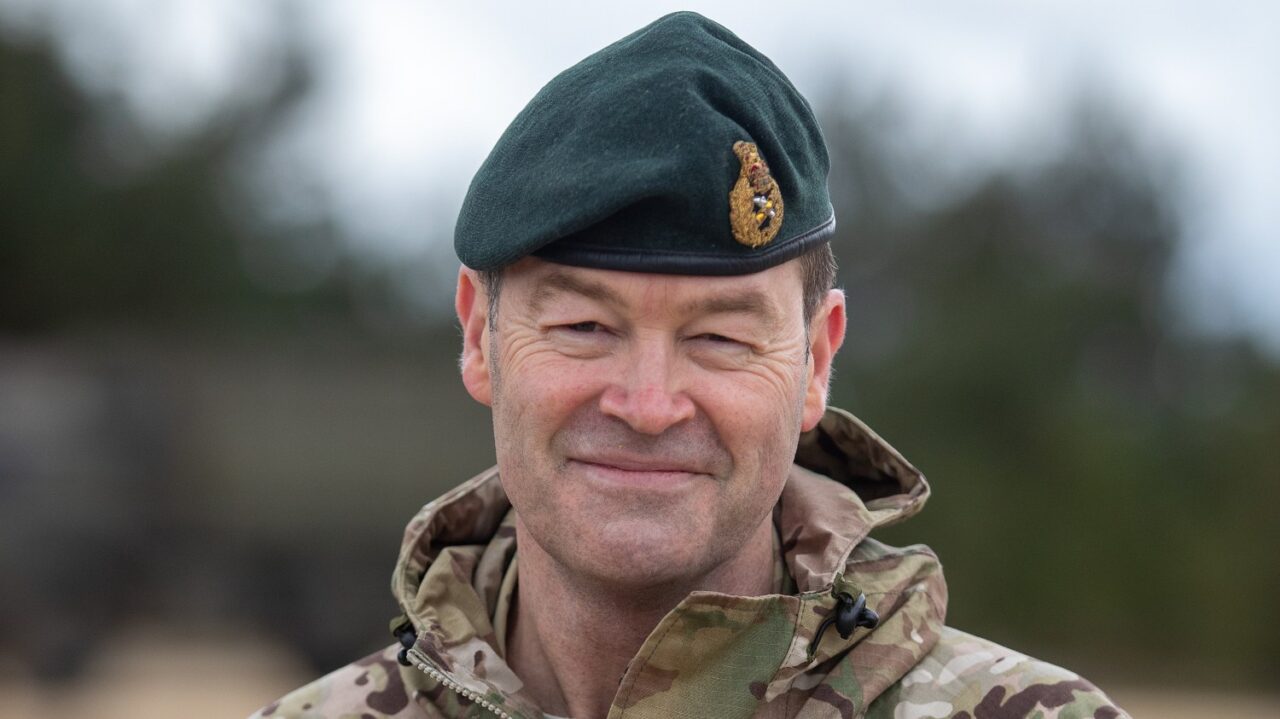
General Sir Patrick Sanders says volunteers must be prepared for conflict, in speech No 10 did not want made public
Civilians must be trained and equipped to form a “citizen army” of tens of thousands in case Britain is dragged into war with a country such as Russia, the head of the army has said.
General Sir Patrick Sanders, chief of the general staff, also publicly criticised the army’s lack of funding and inability to modernise.
He said that within three years there should be a larger army of 120,000, including regular soldiers, reserves and a “strategic reserve”, thought to mean those drawn from retired troops who have been recalled.
However, Sanders said this would not be enough and that to win a war it was essential that steps be taken to ensure the public was on a “war footing when needed”. He said it was “prudent” to lay the foundations for “national mobilisation”.
In a candid speech, which No 10 did not want released to the public, Sanders said that billions of pounds promised to the army was yet to be committed, leaving it vulnerable, and called equipment plans “unaffordable”.
In a speech to the International Armoured Vehicles Conference in Twickenham, London, he said: “We need an army designed to expand rapidly to enable the first echelon, resource the second echelon and train and equip the citizen army that must follow.”
The Times understands that discussions are under way in the Ministry of Defence to create a total force size of 500,000 people ready to fight, including those already serving and civilians prepared to defend the nation in case of attack.
Ministers have been looking at how Ukraine has mobilised its citizens to fight against Russia by providing them with weapons and basic training. No one in the UK would be conscripted under the plans, but the public would be persuaded to do their duty for their country.
A senior Whitehall source said: “We would need to mobilise 500,000 people, in theory. If you look at wars throughout history, it is the second echelon that wins the war. You need to send the trained strength to fight initially but you need to mobilise a second one.”
At present the army is 102,529-strong, including reserve forces, compared with the military as a whole, which includes 139,492 regulars and 32,951 reservists — a total of 172,443 troops.
Sanders, an outspoken general who is liked within the army, is due to leave his post within six months. He is said to have riled Rishi Sunak, the prime minister, with his public comments and was effectively blocked from speaking to the media after criticising the shrinking of the army, which is being reduced to 73,000, its smallest since the Napoleonic era, by the middle of the decade.
In his speech, he said that his predecessors had failed to anticipate the implications of the 1914 July Crisis, the period between the assassination in Sarajevo of Archduke Franz Ferdinand and the outbreak of the First World War, and had “stumbled into the most ghastly of wars”.
Sanders said: “We cannot afford to make the same mistake today. We will not be immune and as the pre-war generation we must similarly prepare — and that is a whole-of-nation undertaking. Ukraine brutally illustrates that regular armies start wars; citizen armies win them. But we’ve been here before, and workforce alone does not create capability.”
Sanders referred to an article in The Times on Saturday that revealed the extent of the army’s dwindling numbers and that, based on current trends, the service may dip below 70,000 within two years.
He said the article was a reminder that, over the past 30 years, the army had been halved. However, he said applications to join the army were at their highest in six years and that the nation’s youth were “ready to serve, to seek adventure, to find where they belong”.
However, Generation Z rightly wanted the right equipment to deliver lethal capability, he said, adding that modernisation of the army was non-discretionary and urgent. “Its absence is felt in our recruitment numbers,” he said. “The army’s size always generates headlines but the real story is about capability and modernisation.” He also called upon industry to increase its production of weapons.
The UK is about to send 20,000 troops to take part in Exercise Steadfast Defender, one of the largest Nato exercises since the Cold War.
More than 1,200 armoured vehicles will flow into the army over the next five years, including the long-awaited Ajax light tank.
In 2022, Sanders said that the UK was facing its “1937 moment” over the war in Ukraine, and that Britain must be ready to “fight and win” to ward off the threat from Russia.