Brussels recommends membership talks start soon, but many European leaders share U.S. concerns over rule of law
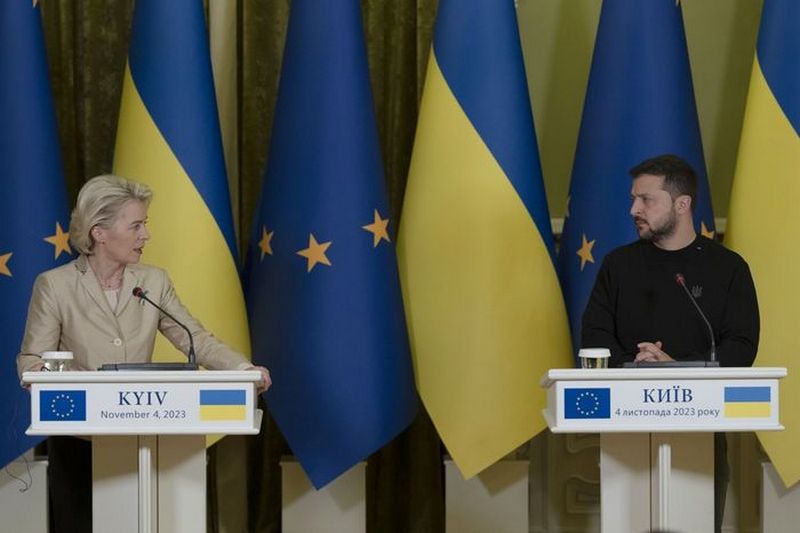
European Commission President Ursula von der Leyen, with Ukraine’s President Volodymyr Zelensky on Saturday, said Kyiv had met 90% of the tasks set for EU accession. PHOTO: ANDREW KRAVCHENKO/BLOOMBERG NEWS
European Commission President Ursula von der Leyen, with Ukraine’s President Volodymyr Zelensky on Saturday, said Kyiv had met 90% of the tasks set for EU accession. PHOTO: ANDREW KRAVCHENKO/BLOOMBERG NEWS
The European Union recommended Wednesday that the bloc begins membership talks with Ukraine soon, boosting President Volodymyr Zelensky, who has made EU accession a central goal.
Even though membership talks would take years to complete, the positive EU recommendation offers Zelensky and Ukraine rare good news at a tense time.
The war with Russia has become bogged down, and tensions between Zelensky and his top military leaders have spilled into public display. International focus has largely shifted to the Middle East, and Congress has blocked new aid for Ukraine.
Against that background, the EU’s executive body, the European Commission, said that Ukraine had done most of the work needed to begin talks.
“Ukraine continues to face tremendous hardship and tragedy, provoked by Russia’s war of aggression and yet, Ukrainians are deeply reforming their country,” said European Commission President Ursula von der Leyen.
The favorable opinion presents Europe’s national leaders with a critical decision next month. Unanimous approval is needed from all 27 EU countries to open negotiations and set a date to begin talks. Diplomats say some EU leaders still need convincing.
At the heart of European concerns about Ukraine—echoed by Washington—is whether the country can overhaul its governance and political culture to rein in the power of big tycoons and eradicate endemic corruption that has impeded economic growth and social cohesion. To open the way for EU accession talks, the bloc set Ukraine seven reform tests.
In Wednesday’s report, the commission said Kyiv had completed four of the seven reforms and would need to complete the other three before membership negotiations begin. Over 90% of the work is done, von der Leyen said. If EU governments agree, preparations for the accession talks could start before year end but actual negotiations would only take place in March, when Brussels will report on Ukraine’s progress on the remaining reform tasks.
The Biden administration has also warned Kyiv it must do more to ensure U.S. aid to the country is handled correctly and transparently amid fading U.S. public support for financing Ukraine in its war with Russia. Leading Republican presidential candidates have cited Ukraine’s corruption record as one reason to stop supporting Kyiv, although there has been no significant evidence of misappropriation of arms supplies.
The commission also recommended that accession talks begin with Moldova. To complete accession negotiations, governments must implement thousands of pages of EU legislation and rules, contained in 35 negotiating chapters, and overhaul their economies, courts and public administrations.
In the past, bilateral disputes between EU member states and the country seeking to join have held up membership—a problem Ukraine could face with a somewhat hostile government in Hungary. Even Croatia, a country at peace in a far more benign international context, took a decade to become an EU member in 2013.
“This is a strong and historic step that paves the way to a stronger EU with Ukraine as its member,” Zelensky said Wednesday on social-media platform X.
In Ukraine, activists say the war is expediting the fight against corruption and forcing politicians to be more accountable before a society that is paying a high price to defend its sovereignty against Russian aggression.
Daria Kaleniuk, director of the Kyiv-based Anticorruption Action Center, a group campaigning to root out graft, said the urgency of combating corruption has grown because so many people have relatives injured or fighting on the front lines and there is an understanding that stolen funds could be used to save the lives of Ukrainian troops.
“War is creating a situation where we can’t afford to not tackle corruption,” she said. “I wish that leaders in the country would feel this urgency as well.”
Kyiv in March, in line with EU recommendations, appointed a new chief of its National Anticorruption Bureau, which was launched in 2015 with U.S. support. Zelensky has fired nearly a dozen senior officials in connection with alleged bribery and embezzlement of public funds, and a top judge suspected of bribery was detained in March.
In September, police detained Ihor Kolomoisky, one of Ukraine’s richest men, on allegations of fraud and money laundering. Kolomoisky has denied the charges.
While the anticorruption unit has made waves by detaining high-profile targets, it has struggled to secure convictions, which it blamed in part on courts’ susceptibility to bribery and political influence.
That was an issue highlighted by the commission in Wednesday’s report.
“To ensure the impact and sustainability of anticorruption efforts, Ukraine should continue building a credible track record of investigations, prosecutions and final court decisions in high-level corruption cases including the seizure and confiscation of criminal assets,” the report said.
The commission also warned that Ukraine would need to bolster the numbers and independence of staff at its anticorruption institutions.
High-profile scandals continue to dog Zelensky’s government, including one involving Defense Ministry officials allegedly paying inflated amounts to suppliers of food and electrical generators for the army. Zelensky in March fired Defense Minister Oleksiy Reznikov, who wasn’t directly implicated in corruption but was widely seen as failing to manage the ministry. His replacement, Rustem Umerov, promised to make changes.
Kaleniuk said she doesn’t see a significant risk that the old circle of tycoons will return to dominance after the war. The central government has retaken control of large public companies that the tycoons controlled. But anticorruption activists warn that the government, under international pressure, could make cosmetic legal changes that ultimately prove insufficient to prevent tycoons from capturing state institutions after the war.
Surveys indicate that Ukrainian society supports the government’s anticorruption campaign, and more than 80% of the population supports joining the EU.
The government is also responding to public pressure to show clear results and not revert to old ways. In September, Zelensky rejected legislation that would ban the public from viewing asset disclosures by Ukrainian officials for one year.
Oleksandr Yabchanka, a wounded Ukrainian serviceman who wrote a petition that gathered 80,000 signatures within 24 hours and prompted Zelensky to veto the bill, said the public’s ability to influence decision makers is proof of Ukraine’s democratic credentials.
“We have to constantly remember the cost of this progress,” he said. “And if you assess that progress against the price we’ve paid, then obviously it’s inadequate,” said Yabchanka, the commander of an assault unit who was riddled with shrapnel during a Russian mortar attack in Ukraine’s northeast in August.
Nonetheless, Yabchanka said, Ukraine has transformed its corruption record in the decade since the pro-Russian President Viktor Yanukovych was forced from office by protests.
The details of the peace deal presented today by US special envoy Steve Witkoff are consistent with the report in the Financial Times discussed in my previous article and with Larry Sparano in the posted interview. Putin will halt the Russian advance prior to driving Ukrainian soldiers out of all of the territory that has been reincorporated into Russia. It appears to be the case that the borders between Russia and Ukraine will be the current front line, so Putin is withdrawing Russia’s claim to the Russian territories still under Ukrainian occupation.
Russia and the US seem near a Ukraine peace deal. Kyiv’s role may be moot.
President Donald Trump’s hopes of securing a quick Ukraine peace deal hang in the balance after Washington’s envoy, Steve Witkoff, held his fourth Kremlin meeting with Russian President Vladimir Putin Friday.