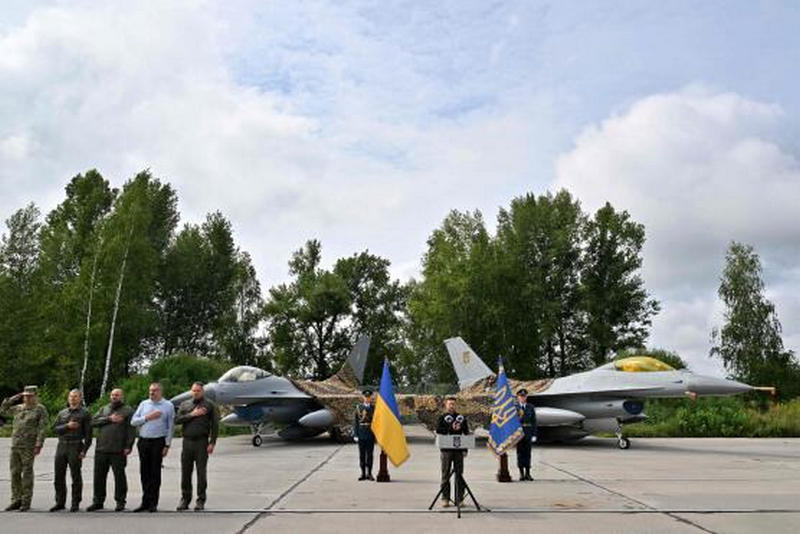
On Sunday, Kyiv confirmed the reception of the first F-16 fighter jets promised by its allies a year ago. But the arrival of these American-made aircraft likely won't be enough to upend the balance of power on the ground.
Volodymyr Zelensky (between the two flags), in front of two F-16 fighter jets, during a ceremony marking Ukrainian Air Force Day at an undisclosed location on August 4, 2024. SERGEI SUPINSKY / AFP
Ukraine had been waiting for them for over a year. On Sunday, August 4, Ukrainian President Volodymyr Zelensky confirmed the presence on Ukrainian soil of the first F-16s, the American-made fighter jets promised by several allied countries since the summer of 2023. He did not specify their number but said it was “not enough” and added that Kyiv was expecting “additional” deliveries.
Despite their symbolic significance, many experts now think that the likelihood the F-16s will upset the long war of attrition that the Russians and Ukrainians have entered into is highly uncertain, given the many other parameters that now come into play.
While the F-16s may, for example, enable Kyiv to strike Russian forces on the ground further behind the 900-kilometer front line, there is no guarantee that they will quickly be able to neutralize Moscow’s planes, which have been dropping devastating glide bombs over Ukraine for months. While its allies promised to deliver 90 aircraft, this process will take several years. The United State also pledged to equip these F-16s with “at least the critical volumes” of weaponry. But the allies will then have to agree to provide the rest by purchasing this ammunition from the Americans.
‘We’re not out of the tactical military impasse’
“[The F-16 is]an important addition. It’s not in itself changing the war,” Norwegian Foreign Minister Espen Barth Eide told theWall Street Journalon July 30. “We’re not out of the tactical military impasse,” judged Elie Tenenbaum, the director of the French Institute of International Relations’s Center for Security Studies in a July 9 interview on the podcast Le Collimateur, after returning from a research trip to Kyiv.
Just over a year after the failed counter-offensive Ukraine launched in the summer of 2023 to retake the territories annexed by Moscow in February 2022, the reality of the balance of power between Russians and Ukrainians is increasingly shrouded in fog.
“We lack precise numbers. Both sides have communication strategies and neither can be trusted,” said Joris Van Bladel, a specialist in Russian military affairs and senior associate at the Egmont Institute, Belgium’s Royal Institute for International Relations. “A few months ago, I was very pessimistic about the Ukrainians. But a lot also hinges on the outcome of the American elections. The only thing that’s for sure is that we’re in a war of attrition, where knowledge of the enemy is not as important as physical strength, and whoever can hold out the longest will win.”
‘The effort is increasingly difficult’
In this war of endurance, the amount of equipment destroyed is particularly informative. According to the website Oryx, which tracks the losses of each side and is considered the most reliable source on this subject, by June 10, the Russians had lost between 1.5 and 5 times as many tanks, armored vehicles and artillery systems as the Ukrainians. That’s over 3,100 tanks, 1,383 armored vehicles and 379 multiple rocket launchers (MRLs), compared with 841 tanks, 381 armored vehicles and 72 MRLs, respectively, on the Ukrainian side.
In this “attrition,” race, in which the defensive side benefits from a kind of bonus – therefore for the Ukrainians – Kyiv’s forces still lost again in recent months what 500 square kilometers of territory they had managed to take back from the Russians during the counter-offensive of summer 2023. From April, Moscow stepped up its pressure at various points along the front and ended up recapturing around 750 square kilometers, according to The Washington Post’s calculations in an article published on May 17. This pressure remained strong in July, particularly around Donetsk and Kharkiv.
Experts believe that the risk of the front collapsing remains limited, including because of the triple line of fortifications Kyiv began building in March, following what the Russians built on their side starting late 2022. But the Ukrainians “know that their forces are dwindling and that this effort is increasingly difficult (…). The odds are not in their favor,” said Vincent Tourret, a doctoral student at the Université du Québec à Montréal and associate researcher at the Foundation for Strategic Research, also on the Collimateur podcast on July 16.
An unclear death toll
Since the start of the war, one of the best-kept secrets remains the number of dead and wounded. In his first interview with the foreign press, on July 24, with The Guardian, General Oleksandr Syrski, the head of the Ukrainian army, refused once again to answer this question, falling back behind the only death toll President Zelensky publicly admitted in February: 31,000.
This uncertainty is even greater on the Russian side, as only 5,837 deaths have been officially recognized by Moscow. On July 5, however, Russian opposition media claiming to have used the Russian register of estates published an investigation estimating the death toll to be at least 120,000. “What matters is not the number of dead and wounded, the most important thing is the impact on society,” said Van Bladel of the Egmont Institute. And according to Tenenbaum, “the future of the war won’t be determined on the front line.”
After hiding the difficulties they faced for a long time, the Ukrainians passed a highly unpopular law in March, lowering the compulsory age of mobilization from 27 to 25. With this legislation, the Ukrainian authorities were forced to take up a method adopted by Russia since the summer of 2022, which they had previously criticized: recruitment in prisons in exchange for a reduced sentence. According to official objectives, the new Ukrainian mobilization is supposed to enable the enlistment of “15,000 to 20,000” new fighters out of an army currently estimated at around 300,000 men, compared with 400,000 on the Russian side.
Deserters
But Kyiv suffers from an almost equivalent number of deserters. According to figures released on July 15 by the Moldovan service of Radio Free Europe/Radio Liberty, funded by the US Congress, over 23,000 Ukrainians have entered Moldova illegally since February 2022, including 7,700 since January alone. Romania has seen the same phenomenon. In February, Romanian border police estimated that around 9,000 Ukrainians aged between 27 and 60 had attempted to cross the border since the start of the war. Many died swimming across the Tisza River that separates the two countries.
Russia is not immune to these issues. Over the months, however, the Russian authorities settled on another option: a sharp rise in new recruits’ pay, at the risk of straining public finances. On July 31, Russian President Vladimir Putin signed a new decree doubling volunteers’ pay and bonuses.
On July 23, Moscow’s mayor had already promised a $22,000 (€20,200) bonus and $5,000 salary to anyone willing to sign up for at least a year. On July 16, the head of the Yaroslav region, northeast of Moscow, offered a bonus of $1,150 to anyone who brought a friend to military registration. It’s a very attractive sum considering the average Russian income.
An in-depth analysis by researcher Dara Massicot for the RAND Corporation published on July 16 casts serious doubt on the long-term viability of this system. Since September 2022, no officer, contract soldier or mobilized staff member has been able to terminate his contract unless he is declared unfit, has reached the age limit or has been sentenced to prison. However, the effects of this “coercion,” “severe losses” or “faltering offensives” could outweigh the benefits, argued Massicot, whose work was presented at the annual NATO summit in Washington in early July.
Western commitment
Another unknown factor in the conflict is the West’s level of long-term commitment to Ukraine. Since the beginning of the war, the US and Europe have been providing equipment, munitions and advisers, but often at a level insufficient to make a real difference. The number of American (Patriot) and Franco-Italian (SAMP/T) ground-air defense systems delivered to Kyiv can be counted on one hand. The Americans shipped 31 Abrams tanks in the fall of 2023, but by late April, five had already been destroyed by the Russians, forcing the Ukrainians to move them away from the front line as they were unable to protect them effectively.
Many military sources privately admitted that there hasn’t been a real “game changer” in recent months. “If only three out of 14 brigades are equipped, can we stop the Russians? If out of 14 brigades only three are equipped, can we stop the Russians? We’re very grateful for the aid that has been voted in [by Ukraine’s allies], for all those billions. But how can we do a rotation, if the brigades are empty?” asked Ukrainian President Volodymyr Zelensky in an interview with several media outlets, including Le Monde, on August 1.
The restrictions imposed by the West on the use of some of their long-range weapons are also holding the Ukrainians back. Officially, Kyiv is only allowed to use them for “defensive” purposes but not to strike Russian territory, or only in a very controlled manner. Russia has thus long been a “vast sanctuary” protected from all retaliation, according to an assessment by the Institute for the Study of War (ISW) published on June 9. In late May, Washington relaxed its policy, but only within a limited perimeter to defend Kharkiv, Ukraine’s second-largest city located just over 20 kilometers from the Russian border, then under fire from a major Moscow offensive.
This new doctrine – which France has also embraced – subsequently reduced the size of Russia’s sanctuary by only 16%, according to the ISW’s calculation. Most of the sites from which the Russians operate remain out of reach. This is particularly true of the air bases from which the planes dropping glide bombs take off, and which are virtually impossible to intercept according to military experts. In early July, the United Kingdom’s new Labour prime minister Keir Starmer hinted that he was prepared to change his position on the use of Storm Shadows, Britain’s long-range missiles. But his entourage has since retracted his remarks, and London’s position on the matter remains ambiguous.
The ‘fundamental problem’ posed by nuclear weapons
Despite these limitations, Russia is still suffering heavily. To get around the constraints imposed on them and strike Russia at all costs, the Ukrainians are increasingly relying on self-built drones of all sizes. In early July, after months of harassment, the Russian fleet thus ended up virtually deserting the Crimean peninsula, annexed in 2014. Several other Russian border regions have also been targeted in recent months. On July 23, Moscow was even forced to evacuate 14 localities. Vyacheslav Gladkov, governor of the northern military region, told the Russian news agency TASS on July 16 that more than 200 civilians have died in the Belgorod region since the start of the war.
To cope with these losses, Moscow decided to completely reorient its economy toward its defense apparatus. These industrial efforts, undertaken at the expense of other investments and initiated in the early months of the war, now enable Russia to produce more missiles and tanks than it did before February 2022. At this rate, the Europeans won’t catch up until 2025 or 2026 in terms of shell production, according to the European Commission, which aims to exceed 2 million shells a year by then. Yet several researchers believe that Russia may be in a position to sustain this effort for at least another three to five years.
“The fundamental problem for the West is that, as Russia is a nuclear-armed state, managing escalation remains a particularly delicate balancing act,” said Blavel of the Egmont Institute. “A weak Russia is just as dangerous as one that becomes too strong. The same goes for the Ukrainians. We can only help them up to a certain limit, and that’s almost our dilemma; we’re confronted with a permanent strategic dilemma.”
The details of the peace deal presented today by US special envoy Steve Witkoff are consistent with the report in the Financial Times discussed in my previous article and with Larry Sparano in the posted interview. Putin will halt the Russian advance prior to driving Ukrainian soldiers out of all of the territory that has been reincorporated into Russia. It appears to be the case that the borders between Russia and Ukraine will be the current front line, so Putin is withdrawing Russia’s claim to the Russian territories still under Ukrainian occupation.
Russia and the US seem near a Ukraine peace deal. Kyiv’s role may be moot.
President Donald Trump’s hopes of securing a quick Ukraine peace deal hang in the balance after Washington’s envoy, Steve Witkoff, held his fourth Kremlin meeting with Russian President Vladimir Putin Friday.