Yesterday we learned about the fall of Peski to Russian Allied forces. A lot of the heavy lifting was done by the legendary Somali Battalion of the Donetsk Peoples Republic (DPR), aka the “First Separate Tank Battalion Somalia”, founded by the one and only Givi. Who picked the name, because he was impressed with the bravery of the Somalian people. Givi has been dead for a long time, but one likes to think that his ghost was hovering over the town of Peski on the day it was liberated. Not gloating, just relieved that this hard part was over, and maybe the people of his beloved Donetsk can sleep better tonight, without so much shelling.
Close your eyes for your eyes will only tell the truth And the truth isn’t what you want to see. In the dark it is easy to pretend That the truth is what it ought to be.
(original lyrics to “Music of the Night”, from Phantom of the Opera)
KP reporter Alexander Kots was with the Somali guys when they took Peski. These are his words, I have elided out a few sentences (or even paragraphs) here and there, for the purposes of brevity.
Kots: If the 8-year siege of Donetsk can be depicted as the maw of a beast, then Peski was the largest of its tusks, piercing right alongside the very heart of the Donbass. This once-prestigious bedroom community of the Oblast center, was converted into a synonym of a deadly threat. Which, over the course of 8 years gathered its harvest: the lives of the peaceful civilians of the Donbass. From this place, this suburb, continuous artillery shelling was conducted against the capital of the DPR. This populated area was regarded by the command of the Ukrainian Armed Forces (UAF) as the Platzdarm for the storm of Donetsk. From the airport to the center of the city it’s only a 15-minute ride on a tank.
Try to imagine the state of continuous terror in which children grew up and went to school, the sounds of explosions which became an everyday occurrence. Every day news of more deaths and funerals… As of today, these people have breathed a sigh of relief. One less threat [to their daily existence].
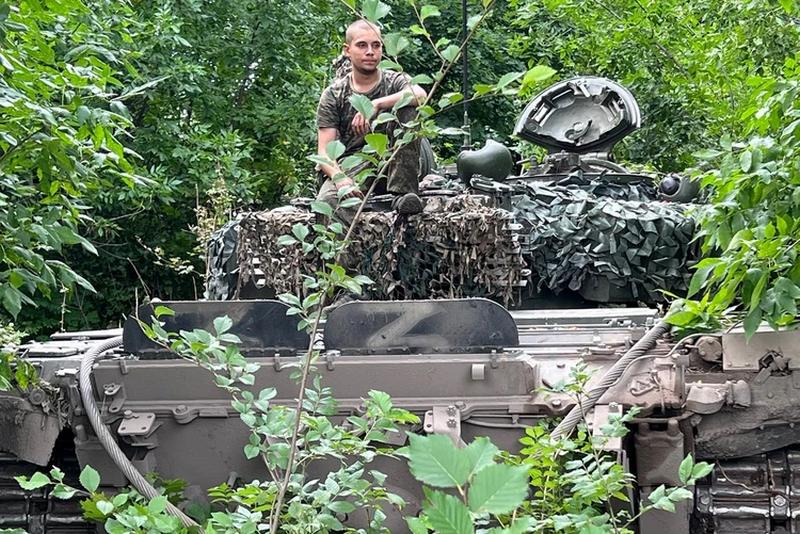
These past few days I have been living among them, in the Peski region, observing how the 11th Regiment of the DPR and the “Somali” Tank Battalion wrenched this town from the enemy, street by street. “Stormers” engaging in full-on urban warfare went house to house, clearing each one; while our artillery was busy shelling UAF positions just a few dozen meters from our soldiers. Our tanks shot up everything, both from the front-gunner and also the side-mounted guns. In the latter case, the tank plays the role of artillery, except that it is impenetrable to those counter-artillery systems, with which the Ukraine has been supplied by its Western partners. The multi-ton tank will leave its cover and head out along a pre-determined route to the approaches to Peski. Three shots, then quickly pull back, taking cover in a forested area, where the green camo hides it from prying eyes.
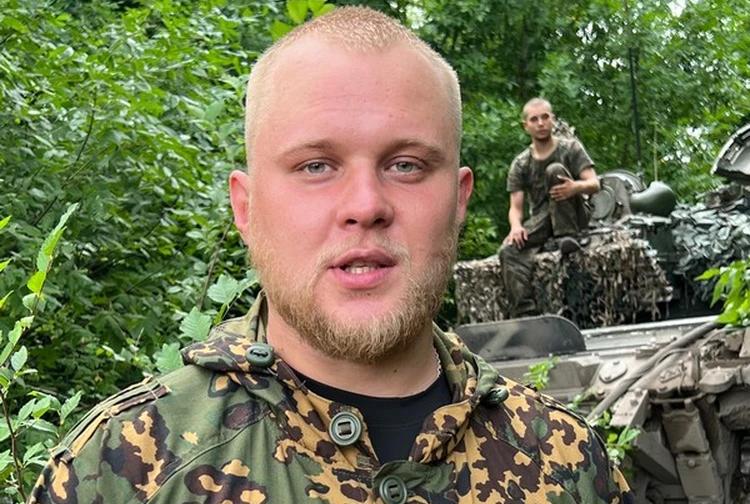
Interview With Tank Company Commander Sukhoi
This young man, who goes by the call sign Sukhoi [which means “dry” in Russian] commands a Tank Company of the 11th Regiment.
“Which targets were you working on just now?” Kots asked him.
“Our objective is to take out the targets from which the enemy is correcting their fire. This is our first goal. The enemy is correcting fire onto our infantry, and on our firing points. Our goal is to destroy their pillboxes.”
“It’s quite a long distance though. How do you reach that far?”
“We just learned how to do it, from experience. Our current targets aren’t even in Peski any more, they’re in the next town over, Pervomaiskoe.”
“Have you been fighting for a long time?”
“Since 2015.”
“What did you do before the war?”
“I was a student.”
“Is the tank a serious threat to the enemy?” Kots wonders.
Sukhoi gives a long reply: “Not long ago I saw a video, they were asking Ukrops: What is the most fearsome weapon, in your view? And he says, the scariest thing of all, is the tank. Because it can see you. Most of the time the tank shoots you right from the front gun. Anyhow, [to answer your earlier question]: At first it was really hard to learn. We had to learn on the job. Before this we trained for one thing, and then, once in battle, [we had to throw everything we learned out the window]. But once we figured it out, then things got easy, and we just kept moving forward. The farther we moved, the more we learned. When we started out on the first lines of defense, then the second, third and fourth, that’s what we’re up to now, and it’s already so much easier, and you really start to understand the enemy better: how he operates, what he is planning to do. He can draw you out, or then, on the contrary, just go for it, and crush you.”
“Are all of your tank guys from around this area?”
“No, not all. Some are from Donbass, some are from the Ukraine.”
“Who is from the Ukraine?”
“Well, me, for example. I’m from Zhitomir.”
“How did you end up here?”
“In 2014 my parents came here, to fight. I stayed back there, I was 17, a brainless child, everybody was jumping and I jumped too. [yalensis: Referring to the crowds “jumping” up and down on Maidan Square, as a show of support for the Nationalist revolution.] I jumped, and I jumped. And then I come to communicate with my parents, and they tell me, Look this is happening here, and this is happening here. But when I watch the TV they are saying completely different things. […] And then I thought, and I thought, and I thought… and I decided to throw off these remarkable friends of mine, those guys are in the Right Sektor now, or Azov, earlier they were Ultras, but now they all just fight for money. They even call me from time to time, to wish me happiness and health.” [yalensis: not sure if Sukhoi is being sarcastic here…]
“Would you like to send them a message?”
“Comrades, we will meet again soon enough. I think that we have already spotted each other. But soon we shall meet in person.”
Kots goes on to ask him how he got involved with tanks. Sukhoi narrates how he left Zhitomir in 2015 and arrived in the Donbass [presumably to reunite with his parents who were already fighting in the ranks of DPR?].
“I immediately got into the tank forces. I started as a gunner-operator in the 9th Regiment. We were fighting in the direction of Mariupol.”
Kots: Why tanks? Was that your civilian specialty?
Sukhoi: No, there was no connection [with what I was studying]. I just liked tanks, and decided to try it. I sat behind the gunner. I tried it out. You can look at me now, see how huge I am, but back then I was small and skinny. They gave me a “Flora” type uniform [green camo], it was too big for me, and when I was riding along in the tank, the microphone was rubbing at my neck. You get nervous, you start freaking out. And then I experienced my first battle, when I heard that first shot I just knew: This is for me, this is where I belong. Neither the infantry, nor the artillery, has any interest for me.
Kots finishes his piece: The tank choked on its own plumes of diesel smoke and hastened away to its new battle position. To capture the fortified region in Pervomaiskoe. Thus ensuring the further advance of our troops.
The details of the peace deal presented today by US special envoy Steve Witkoff are consistent with the report in the Financial Times discussed in my previous article and with Larry Sparano in the posted interview. Putin will halt the Russian advance prior to driving Ukrainian soldiers out of all of the territory that has been reincorporated into Russia. It appears to be the case that the borders between Russia and Ukraine will be the current front line, so Putin is withdrawing Russia’s claim to the Russian territories still under Ukrainian occupation.
Russia and the US seem near a Ukraine peace deal. Kyiv’s role may be moot.
President Donald Trump’s hopes of securing a quick Ukraine peace deal hang in the balance after Washington’s envoy, Steve Witkoff, held his fourth Kremlin meeting with Russian President Vladimir Putin Friday.