Dear Readers: From the world of international espionage… Russia’s foreign spy service is called Служба внешней разведки (СВР), “Service of Foreign Espionage”, let’s just continue to call it SVR, for the purposes of this report. They have their own monthly journal, which you can find here.
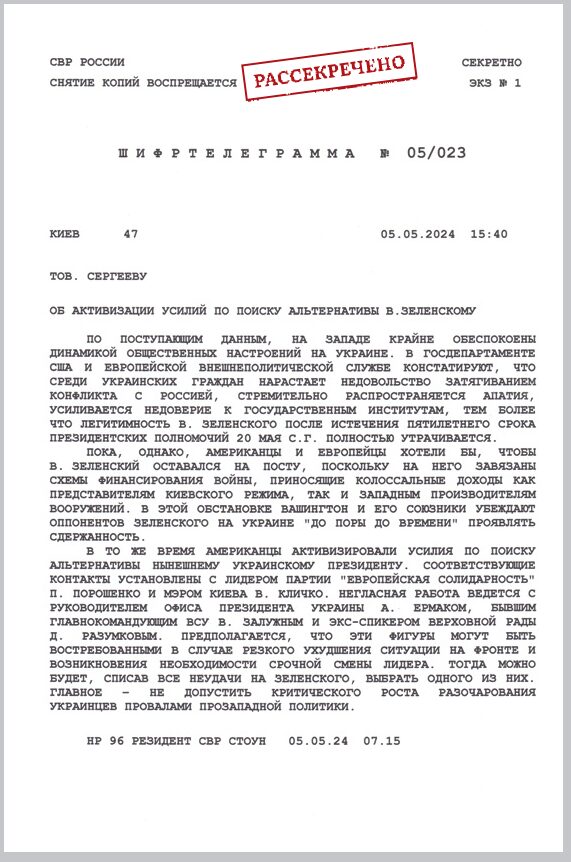
It’s the June issue of the magazine, which you can leisurely page through, lots of interesting historical archives and analytical pieces about international security, etc. On page 37 of the magazine (which is page 21 of the PDF) there is a declassified report from the SVR resident in Kiev, who goes by his/her spy name of “Stoun”. Here is a screenshot of Stoun’s top-secret report to the SVR:
Here is my own translation of Stoun’s top-secret telegram. And then, in Part II of this series (tomorrow) I will review an analytic piece based on this information, by Alexander Grishin of Komsomolskaya Pravda.
TRANSLATION:
Encrypted telegram from May 5, 2024 (stamped “Declassified”), Kiev. Addressed to Comrade (“Tovarishch”) Sergeev:
On the activization of efforts to find an alternative to V. Zelensky.
According to information coming in, the West is extremely disturbed by the dynamic of public opinion in the Ukraine. The State Department of the USA and the European foreign services are taking note of a rising dissatisfaction among Ukrainian citizens due to the dragging out of this conflict with Russia.
Apathy is rising, distrust towards government institutions is growing. All the more so that the legitimacy of V. Zelensky is in question after the expiration of his 5-year presidential mandate, which will occur on May 20.
Nonetheless, for the time being the Americans and Europeans wish to see Zelensky remain at his post, since all the schemes for financing this war are tied up with his person. These schemes have brought colossal profits to the representatives of the Kiev regime, as well as to Western arm manufacturers. Under these circumstances Washington and its allies are urging Zelensky’s opponents to “be patient for now” and hold their fire.
At the same time the Americans have initiated a search for an alternative to the current Ukrainian President. They have reached out to the leader of the European Solidarity Party, P. Poroshenko, and also to the Mayor of Kiev, V. Klichko. Talks are also being conducted, sub rosa, with A. Yermak, who heads the Office of the President; and also with former Commander of the Ukrainian Armed Forces, V. Zaluzhny, as well as the ex-Speaker of the Upper Rada, D. Razumkov.
It is thought that these figures might be needed in the case of a disastrous turn of events at the front and the need for a sudden change of leadership. In which case they might blame all the failures on Zelensky and select one of these above characters as his replacement. Their main goal in all of this is to try to stop the growing wave of disenchantment among Ukrainians due to the failures of the pro-Western policies.
Donald Trump Should Not Repeat Woodrow Wilson’s Failure
April 30th is an important date in American politics. This is the day 100 for the American President in the White House, and all attention will be on the reports of his achievements and failures. But nothing can be more critical than Peace…
○
6 mins read
A Holocaust perpetrator was just celebrated on US soil. I think I know why no one objected.
Russia’s invasion has made ordinarily outspoken critics of antisemitism wary of criticizing Ukrainian Nazi collaborators
○
1 min read
Qi Book Talk: The Culture of the Second Cold War by Richard Sakwa
Richard Sakwa has for many years been one of the most distinguished and insightful observers of relations between the West and Russia, and one of the leading critics of Western policy. In this talk with Anatol Lieven, director of the Eurasia program at the Quincy Institute, Sakwa discusses his book, The Culture of the Second Cold War (Anthem 2025). The book examines the cultural-political trends and inheritances that underlie the new version of a struggle that we thought we had put behind us in 1989. Sakwa describes both the continuities from the first Cold War and the ways in which new technologies have reshaped strategies and attitudes.