As fighting rages across Ukraine, two versions of reality that underlie the conflict stare across a deep divide, neither conceding any truth to the other.
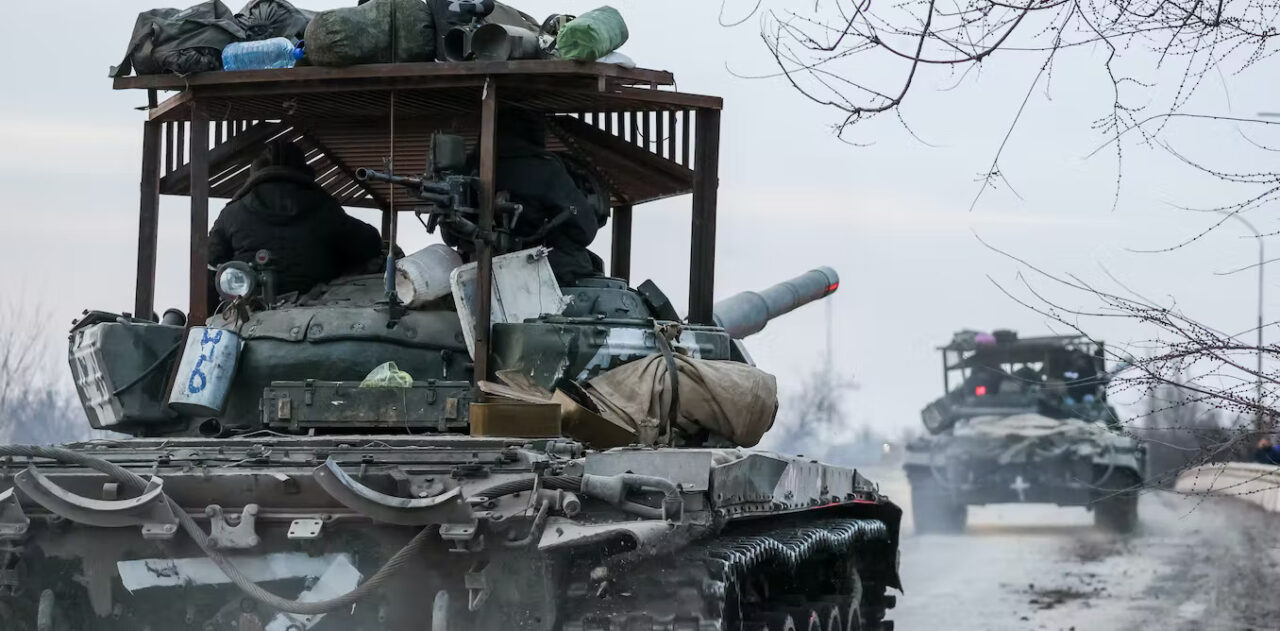
On Feb. 24, Russian tanks moving into Ukraine. Sergei Malgavko\TASS via Getty Images)
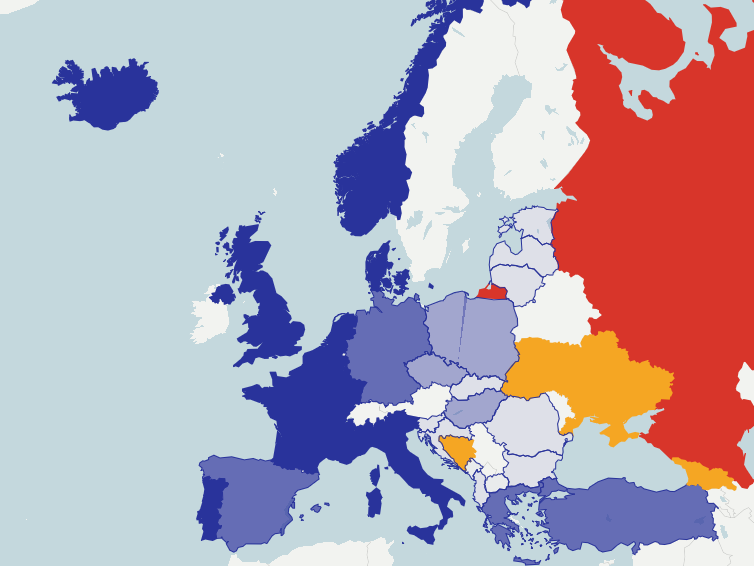
From a 12-nation base of the U.S., Canada and key countries in Western Europe in 1949, the North Atlantic Treaty Organization has expanded eastward, into former Warsaw Pact nations like Poland, Romania and Bulgaria, and even into former parts of the Soviet Union, such as Estonia, Latvia and Lithuania. Other countries formerly in Moscow’s orbit – including Ukraine – are interested in joining.
The U.S. and Canada are not on this map, but are also founding members of NATO.
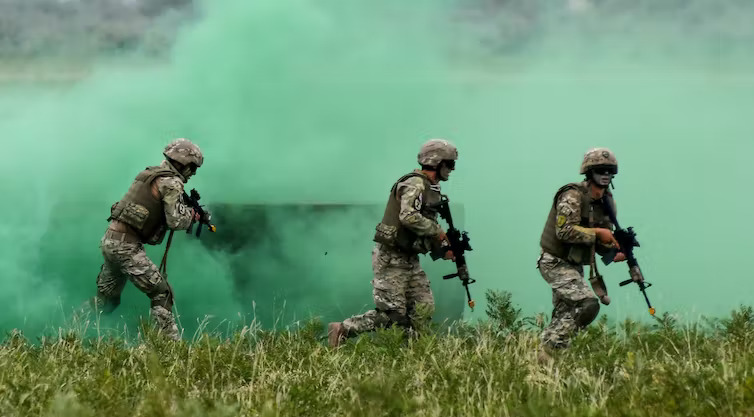
Georgian troops joined large-scale joint military exercises with NATO forces outside Tbilisi, Georgia, on Aug. 1, 2018, on the 10th anniversary of its war with Russia, which strongly opposes Tbilisi’s NATO membership bid. Vano Shlamov/AFP via Getty Images
He continued, “As Russians stewed in their grievance and sense of disadvantage, a gathering storm of ‘stab in the back’ theories slowly swirled, leaving a mark on Russia’s relations with the West that would linger for decades.”
In June 1997, 50 prominent foreign policy experts signed an open letter to Clinton, saying, “We believe that the current U.S. led effort to expand NATO … is a policy error of historic proportions” that would “unsettle European stability.”
In 2008, Burns, then the American ambassador to Moscow, wrote to Secretary of State Condoleezza Rice: “Ukrainian entry into NATO is the brightest of all redlines for the Russian elite (not just Putin). In more than two and a half years of conversations with key Russian players, from knuckle-draggers in the dark recesses of the Kremlin to Putin’s sharpest liberal critics, I have yet to find anyone who views Ukraine in NATO as anything other than a direct challenge to Russian interests.”
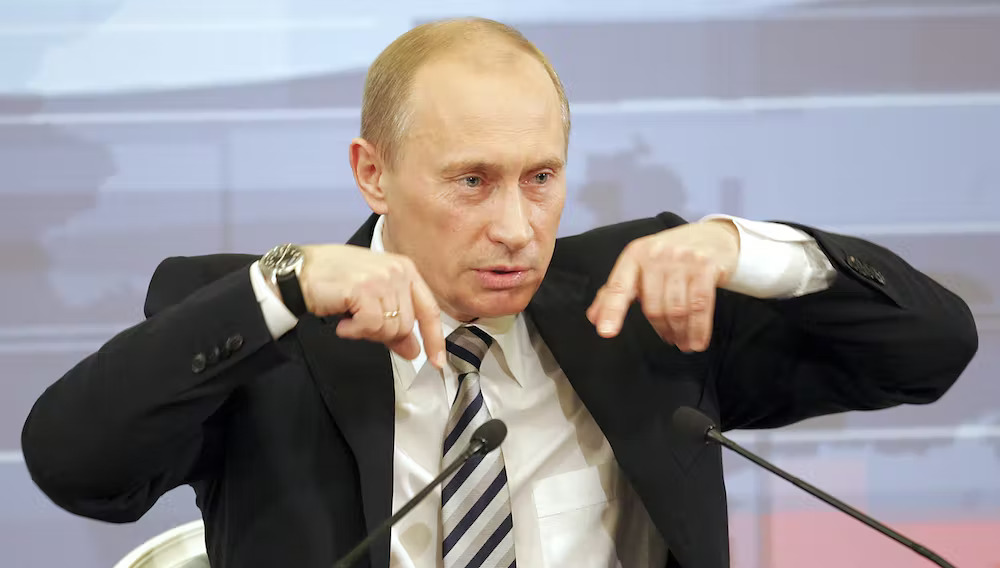
Russian President Vladimir Putin speaks in Moscow on Feb. 14, 2008, sparking NATO’s anger by threatening to target missiles at former Soviet bloc countries that host bases from the military alliance or a U.S. missile defense shield. Alexander Memenov/AFP via Getty Images
Responding to Russia’s insecurity
There are different outcomes to the current crisis depending on whether you see its cause as Russian imperialism or NATO expansionism.
If you think the war in Ukraine is the work of a determined imperialist, any actions short of defeating the Russians will look like 1938 Munich-style appeasement and Joe Biden becomes the reviled Neville Chamberlain, the British prime minister who acceded to Hitler’s demands for territory in Czechoslovakia only to find himself deceived as the Nazis steadily marched to war.
If, however, you believe that Russia has legitimate concerns about NATO expansion, then the door is open to discussion, negotiation, compromise and concessions.
Having spent decades studying Russian history and politics, I believe that in foreign policy, Putin has usually acted as a realist, unsentimentally and amorally taking stock of the power dynamics among states. He looks for possible allies ready to consider Russia’s interests – recently he found such an ally in China – and is willing to resort to armed force when he believes Russia is threatened.
Putin’s sense of Russia’s insecurity vis-à-vis a much more powerful NATO is genuine, but during the current impasse over Ukraine, his recent statements have become more fevered and even paranoid.
Usually a rationalist, Putin now appears to have lost patience and is driven by his emotions.
Putin himself was traumatized by the disintegration of the Soviet Union in 1991, the loss of one-third of its former territory and half of its population. In an instant, the USSR disappeared, and Russia found itself much weaker and more vulnerable to rival great powers.
Many Russians agree with Putin and feel resentment and humiliation, along with anxiety about the future. But overwhelmingly they do not want war, Russian pollsters and political analysts say.
The details of the peace deal presented today by US special envoy Steve Witkoff are consistent with the report in the Financial Times discussed in my previous article and with Larry Sparano in the posted interview. Putin will halt the Russian advance prior to driving Ukrainian soldiers out of all of the territory that has been reincorporated into Russia. It appears to be the case that the borders between Russia and Ukraine will be the current front line, so Putin is withdrawing Russia’s claim to the Russian territories still under Ukrainian occupation.
Russia and the US seem near a Ukraine peace deal. Kyiv’s role may be moot.
President Donald Trump’s hopes of securing a quick Ukraine peace deal hang in the balance after Washington’s envoy, Steve Witkoff, held his fourth Kremlin meeting with Russian President Vladimir Putin Friday.