Only a few profiting from war’s devastation while bootless crusade to extend NATO borders leaves US vulnerable to China in the Pacific
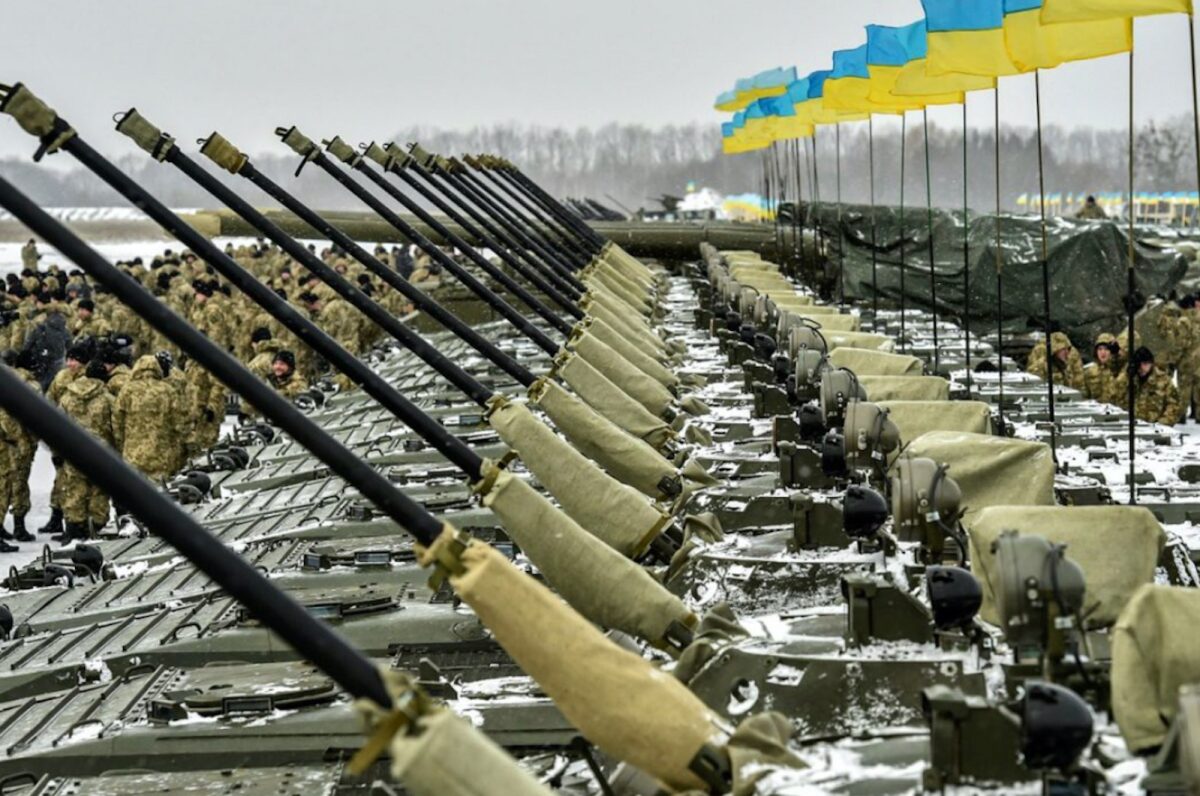
The West has overextended itself in Ukraine. Image: UNI Future
In 1935 retired Marine General and two-time Medal of Honor winner Smedley Butler published a 55-page pamphlet that caused a sensation. The pamphlet, entitled “War is a Racket,” was reprinted in Reader’s Digest, assuring a mass circulation at the time. Butler summarized his argument this way:
War is a racket. It always has been. It is possibly the oldest, easily the most profitable, surely the most vicious. It is the only one international in scope. It is the only one in which the profits are reckoned in dollars and the losses in lives. A racket is best described, I believe, as something that is not what it seems to the majority of the people. Only a small “inside” group knows what it is about. It is conducted for the benefit of the very few, at the expense of the very many. Out of war a few people make huge fortunes.
Butler’s argument has lingered to this day. As we view the tragedy in Ukraine, it is hard to understand why so many billions of dollars and tens of thousands of modern weapons have been squandered in a NATO crusade to expand its borders.
The Ukraine war has weakened the United States because it has emptied its treasury and its arsenals. It has undermined US interests elsewhere, especially in the Pacific, where a restless China is now challenging Taiwan, the Philippines and Japan.
But even more is involved, and this includes NATO itself. NATO is the premier defensive alliance, established in 1949, to defend against the spread of communism in eastern and western Europe.
Communism in Europe disappeared in 1991 with the collapse of the Soviet Union. Even the somewhat popular Italian Communist Party disintegrated, replaced by a couple of far-left socialist parties that have never gained any traction.
Despite the collapse, or better yet, disregarding the collapse, instead of NATO dissolving (as did the Warsaw Pact), NATO adopted an expansion policy. It engaged in wars outside of the context of a defensive alliance including Bosnia and Herzegovina, Kosovo, Libya and Afghanistan.
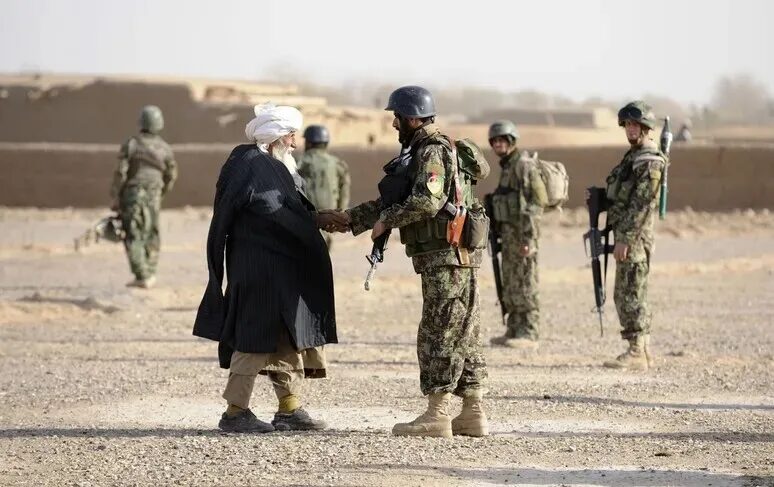
NATO in Afghanistan. The alliance has overreached since the fall of communism.
And NATO expanded eastward and is still trying to enlarge. (It could have included Iraq, but the Turks adamantly objected, so the US organized a “Coalition of the Willing.”)
Not counting Ukraine or Georgia, both promised future NATO membership, and possibly also Moldova (another NATO target), today NATO is a huge multinational alliance of 32 countries, far larger and covering vastly more territory than the original 12 countries that formed the alliance.
In raw numbers, NATO has a potential military force of 3.5 million and covers 25.07 million square kilometers (15.58 million square miles) of territory. Combined, NATO members are home to 966.88 million people and could exceed 1 billion by the end of the century.
An important NATO raison d’etre is to challenge Russia, a much-diminished country compared to the scope of the former Soviet Union. Russia has a population of 147 million and a GDP of US$2 trillion. The average per capita income of a Russian is $14,391. In 2023 the Russian defense budget was $84 billion.
Europe, without the United States, has a population of 742 million, a GDP of $35.56 trillion and a per-capital income of $34,230. Europe’s overall defense spending is $295 billion, far higher than Russia’s.
Yet Europe’s contribution to its own defense falls far short of its potential. Europeans rely utterly on the United States for military support including nuclear weapons (although the British and French are nuclear powers). Why is this?
Europe’s military power is fragmented and, in many respects, weak because of a lack of equipment and manpower. The UK, for example, is a country with a population of 66.97 million. It has a combined military (all services) of 138,120 (not counting civilian employees).
Yet the UK ground army is small and getting smaller. At last count there were 76,320 in the army, but only a fraction of these are actual front-line soldiers.
The UK ground forces have shrunk so much that the UK Army is smaller than King George III’s army at the time of the American Revolution. France is somewhat better than the UK even though its population is only slightly larger (67.97 million).
But some of these troops are foreign legionnaires (and some of them were “permitted” to go over and join Ukraine’s army). The French army is comprised of 270,000 soldiers, but France has a lot of territory it needs to protect, meaning that forces for out-of-country deployment are quite limited.
Poland, with a smaller population of 36.82 million, has an army of 216,000, one of the continent’s better-sized forces. Germany has a larger population—83.8 million—but its military numbers 180,215. That number, however, is deceptive: Germany’s ground force is only 64,000, smaller than the UK’s.
With a few exceptions, all European fighting forces lack sufficient armor and artillery, and they have given much of it away to Ukraine. Equipment is often outdated and poorly maintained.
What is hard to understand is how Europe can spend $295 billion annually on defense and not be able to field well-equipped fighting forces. One explanation may be that the Europeans don’t intend to do much more than deploy token forces. It is left to the United States to provide for Europe’s security and defense.
The US has around 100,000 service members stationed throughout Europe. This includes the US Air Force, Army, Marines, Navy, and Special Forces. The 100,000 includes around 20,000 who were sent to reinforce Eastern Europe in 2022 (some to Estonia, Lithuania, Latvia, Poland and Romania). The Europeans are clearly betting on an American expeditionary force to protect them.
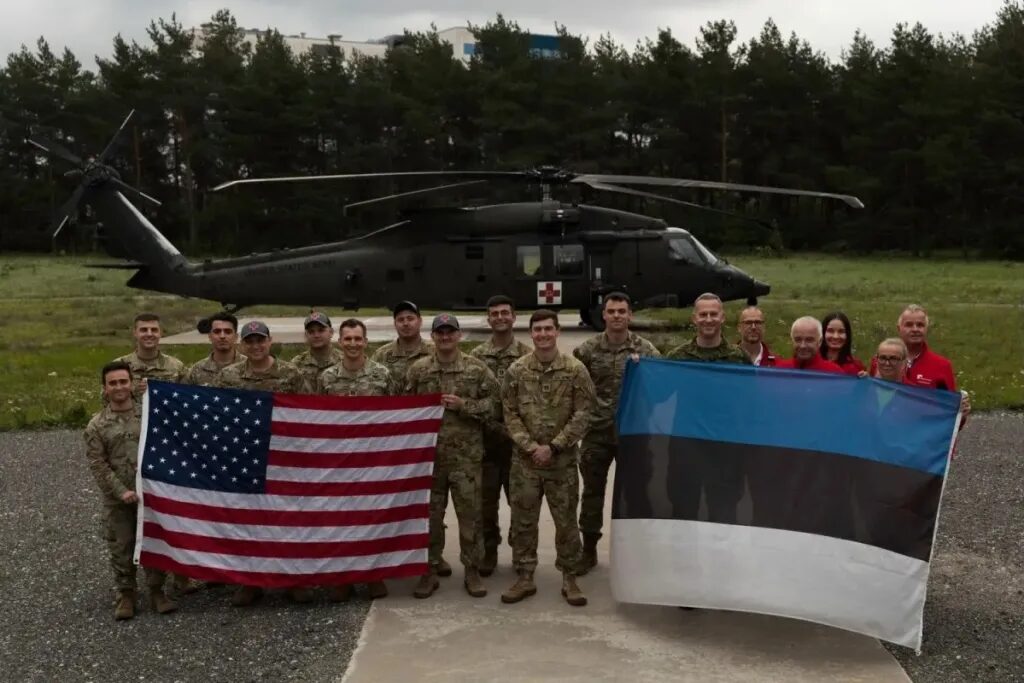
U.S. Army Soldiers with Task Force Knighthawk, 3rd Combat Aviation Brigade; and Soldiers with 1st Battalion, 506th Infantry Regiment “Red Currahee,” 1st Brigade Combat Team, 101st Airborne Division (Air Assault), both supporting 4th Infantry Division; and North Estonia Medical Centre staff. Photo: US Army
However, the history of British expeditionary forces (BEF) in Europe is not a happy one. In World War 2 the BEF (made up of 13 divisions and 390,000 troops) had to be evacuated from Dunkirk (Operation Dynamo), Le Havre (Operation Cycle) and from French Atlantic and Mediterranean ports (Operation Aerial).
There are no armies anywhere today in Europe and Russia that resemble in size and force structure those found in World War 1 or World War 2. If Britain was way behind in preparing its defenses in 1940, Europe is further behind today.
Many European countries have emptied their arsenals to support Ukraine, sending tanks, armored vehicles, missiles, air defenses, artillery, ammunition and plenty of other hard-to-replace weapons.
What does all this mean? It means that while Europe spends a lot on defense ($295 billion) compared to Russia, it does not get much bang for its buck either in equipment or in fighting forces. Thus, a good question to ask is where does all the money go? Perhaps Smedley Butler can supply an answer.
The US has asked Europe to spend more on defense and there is evidence these demands are paying off in bigger defense budgets. But it has not yet translated into larger or more capable fighting forces (with the possible exception of Poland).
In fact, recession in Europe, especially in Germany and the UK, is likely to force cutbacks in defense spending and even fewer deployable troops.
All this leads to the odd conclusion that, without the United States, European members of NATO cannot defend their own territory. It also puts the US at a serious geopolitical disadvantage.
Empty arsenals and overseas deployments on Europe’s borders diminish America’s ability to defend its interests elsewhere, especially in the Asia-Pacific region.
It also exposes US security to serious risks of entrapment – a Russian-inspired war in the Middle East led by Iran and a Chinese push in East Asia, plus conflict breaking out in Korea, could lead to real disaster ahead.
Expanding NATO is a big risk for the United States, which has unequivocally backed NATO enlargement and its aggressive posture toward Russia. Even if one discounts Smedley Butler’s argument that “War is a racket”, the time has come to reevaluate America’s support for expanding NATO.
Stephen Bryen is senior correspondent at Asia Times. He served as staff director of the Near East Subcommittee of the US Senate Foreign Relations Committee and as a deputy undersecretary of defense for policy.
The details of the peace deal presented today by US special envoy Steve Witkoff are consistent with the report in the Financial Times discussed in my previous article and with Larry Sparano in the posted interview. Putin will halt the Russian advance prior to driving Ukrainian soldiers out of all of the territory that has been reincorporated into Russia. It appears to be the case that the borders between Russia and Ukraine will be the current front line, so Putin is withdrawing Russia’s claim to the Russian territories still under Ukrainian occupation.
Russia and the US seem near a Ukraine peace deal. Kyiv’s role may be moot.
President Donald Trump’s hopes of securing a quick Ukraine peace deal hang in the balance after Washington’s envoy, Steve Witkoff, held his fourth Kremlin meeting with Russian President Vladimir Putin Friday.