As the war in Ukraine passes the half year mark lots of media produce their conclusions about the beginning of the war. But when looked at in detail these are most superficial write ups of what people assume Russia's plans at the start of the war were and how those assumed plans fit with the presumed reality.
The Washington Post has a long ‘exclusive’ piece headlined:
It first describes the immediate start of the war and then states a false assumption:
The question everyone faced at that moment, [Ukrainian Interior Minister Denis] Monastyrsky said, was: “How far can the enemy go with that enormous fist?”
If the Russians could seize the seat of power in Ukraine, or at least cause the government to flee in panic, the defense of the country would quickly unravel. Moscow could install a puppet government.
That was the Kremlin’s plan.
I don’t know why the authors think they know what the Kremlin’s plan was. I am certain that the described one is not what Russia intended to strive for.
Ukrainian defenders have indeed been ferociously determined, while Russian troops have had to contend with bad battlefield leaders, inferior weapons and an unworkable supply chain. They’ve also been hobbled by Putin himself. He misread the world situation and personally ordered a disastrous invasion, looking to overthrow the government in Kyiv. He directed a botched effort to take Donbas, depleting the Russian armed forces in the process. … “Putin, like every other dictator we’ve known in the modern era, thinks he knows better, more than his own military, and more than any experts,” one senior intelligence official who works on Russia (and requested anonymity to speak frankly) tells Newsweek. … The February invasion was designed to overthrow Volodymyr Zelensky and take over the entire country, and Russia deployed tens of thousands of troops in Belarus to Ukraine’s north, threatening Kyiv.
Given Russia’s overwhelming numerical superiority, Putin expected the government in Kyiv to fall in as little as 72 hours.
There is no evidence that any of those assertions are true.
At the beginning of the year Russia faced a problem. In the larger picture it had to prevent Ukraine’s admission to NATO. Negotiations with the U.S. had failed to achieve that. In the immediate situation Russia also had to prevent an imminent Ukrainian attack on the Donbas republics.
There were several potential ways to achieve that each of which came with a different time lines and price point.
At the beginning of war Putin made one remark to the Ukrainian military command to give up, to make the necessary concessions, and to remove the civil government should it not agree with them. But during the first days of the war it became immediate clear that the Ukrainian military command did not want, or did not dare to do that. This military coup would have been the cheapest and fastest solution for both, Russia and Ukraine.
A second option was to press the Ukrainian government into agreeing to Russia conditions to end the war. To remove the Ukrainian army from the Donbas, to accept Crimea as part of Russia and to repudiate any NATO association plans.
The move of Russian forces to around Kiev was designed to achieve that. It nearly reached that aim during talks held at the end of March in Turkey. As soon as the Ukraine seemed to agree to the Kremlin’s conditions, and to a potential summit, Russia ordered its troops to move back from the city.
On March 29 France24summarized its daily report collection with this:
Ukraine proposed adopting neutral status and a 15-year consultation period on the future of Russian-occupied Crimea as long as a complete ceasefire with Russian forces is agreed, negotiators said at the conclusion of peace talks in Istanbul on Tuesday. Despite Russian vows to “radically” reduce military operations near Kyiv and Chernigiv, Western officials urged caution.
The Kremlin’s hope for a fast end of the conflict was disappointed when, a few days later, Zelensky suddenly refuted all the concessions his negotiators in Istanbul had made.
This followed a phone call between the British prime minister Boris Johnson and Zelensky on April 2 and Johnson’s visit to Kiev on April 9.
A report in the Ukrainian Pravda describe what happened (machine translation):
After the arrival of British Prime Minister Boris Johnson in Kyiv, a possible meeting between Ukrainian President Vladimir Zelensky and Russian President Vladimir Putin has become less likely. … [T]wo things happened, after which a member of the Ukrainian delegation, Mikhail Podolyak, had to openly admit that the meeting of the presidents was “out of time.”
The first is the exposure of atrocities, rapes, murders, massacres, robbery, indiscriminate bombing, hundreds and thousands of other war crimes committed by Russian troops in the temporarily occupied Ukrainian territories…
The second obstacle to agreements with the Russians arrived in Kyiv on April 9.”
Details: According to UP sources close to Zelensky, British Prime Minister Boris Johnson, who appeared in the capital almost without warning, brought two simple messages.
The first is that Putin is a war criminal, he needs to be squeezed, and not negotiated with him.
And secondly, if Ukraine is ready to sign any agreements on guarantees with him, then they are not.
This position of Johnson testified: the collective West, which back in February offered Zelensky to surrender and run away, now felt that Putin was actually not at all as omnipotent as he was imagined, and that right now there was a chance to squeeze him.
Three days after Johnson left for the UK, Putin went public and said talks with Ukraine “have reached an impasse.”
The ‘west’, in form of Joe Biden’s messenger Boris Johnson, told Zelensky – first in a phone call and then in person – that he would be on his own if he should sign a ceasefire agreement that made any concessions to Russia.
Russia’s initiative to achieve fast concessions, and its motive to keep troops around Kiev, had failed because the ‘west’ did not agree to it. It wanted a long war to drag Russia down.
Zelensky accepted the ‘western’ pressure for a war ‘down to the last Ukrainian’ and ended the negotiations by making new demands that Russia could never accept.
Since then Russia removed its troops from the vicinity of the big cities Kiev, Chernihiv, Sumy and Karkiv. This to drag the Ukrainian troops away from the civilians in the cities into the countryside and to exposed them to the massive artillery strikes the Russians use along the frontlines.
There the Ukrainian troops get ‘demilitarized’ and ‘denazified’ just as Putin had ordered.
Anyone who says that Russia is ‘too slow’ and ‘does not make progress’ along the frontline misunderstands this situation. Russia is deliberately dragging the Ukrainian forces towards the rural frontline to destroy them there without creating massive civil casualties:
The Russian army deliberately slowed down its advance in the special military operation in Ukraine in order to reduce civilian casualties, Russian Defense Minister Sergey Shoigu said at a meeting of defense chiefs from Shanghai Cooperation Organization (SCO) member states on Wednesday.
“We strictly comply with humanitarian law during the special operation. Attacks are carried out with high-precision weapons on the Ukrainian Armed Forces’ military infrastructure facilities, including command points, airfields, depots, fortified areas and defense industry sites. At the same time, every effort is being done to prevent civilian casualties. It certainly slows down the advance but we do it consciously,” Shoigu pointed out.
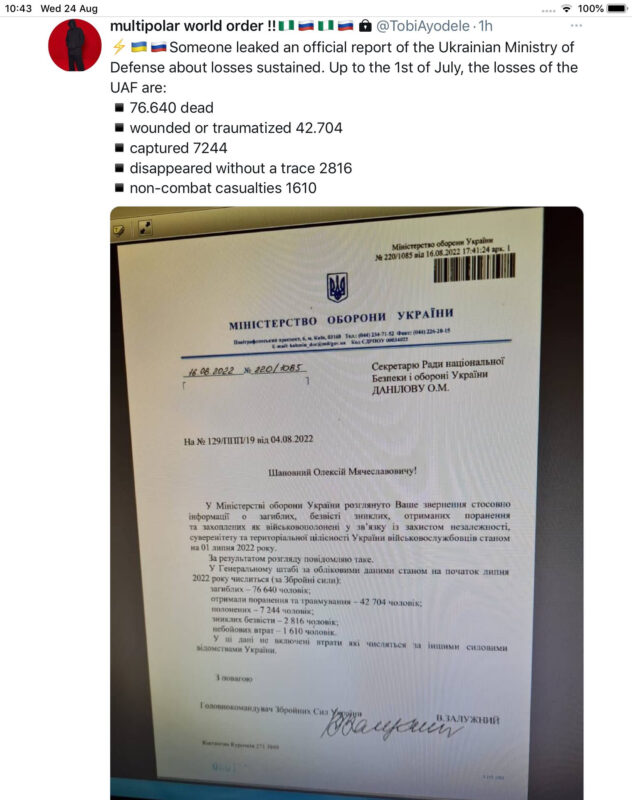
If the following document is really original this approach seems to be quite successful.
Up to July 1, according to the document, the losses of the Ukrainian military were:
76,640 dead
42,704 wounded or shell shocked
7,244 captured
2,816 missing
1,610 non-combat casualties (suicides?)
The total numbers look realistic to me. The number of dead is higher then my estimate but the number of wounded seems to be low in relation to the dead.
There may be several reasons for that. The evacuation of wounded soldiers from positions under artillery fire is extremely difficult and Ukraine’s military medical service is not exactly up to date. There are no helicopter evacuations and no tracked medical transport vehicles that could take the wounded out.
A lot of wounded will thereby miss the ‘golden hour’ and simply die before they can be brought into effective medical care. We can also assume that the Ukrainian staff only counts the heavily wounded and that people who get patched up and send back to the front line are likely not included here.
July 1 was in the 17th week of the war and the total number of likely dead on the above list is 81,066. That makes for an average kill rate of 4.767 per week or 681 Ukrainian soldiers per day. As the first weeks of the war were not exceptionally bloody the number of current dead per day is likely higher.
Nine weeks have passed since the reference date of the above report. They have likely added another 42,000 dead to the list.
These numbers are consistent with the Russian military’s daily ‘clobber list’ which reports of several hundreds Ukrainian casualties per day due to air strikes and well target artillery.
A recent New York Times piece about the costs of war also gives some numbers:
Gen. Valeriy Zaluzhnyi, the top commander of Ukraine’s armed forces, said Monday that about 9,000 Ukrainians had been killed at the front. … [T]his month, Pentagon officials estimated that 70,000 to 80,000 Russians had been killed or wounded; they put the number of deaths at 20,000.
Those numbers are simply not believable.
Here, from the same piece, is why:
Analysts estimate that Russia is firing around 10,000 artillery shells a day, down from a peak of as much as 20,000 during the campaign to take Luhansk, and that Ukraine is firing several thousand artillery rounds a month.
10 to 20 thousand rounds per day(!) means some 450,000 rounds per month fired from the Russian side. The Ukrainian counter fire is down to ‘several thousand artillery rounds a month’. That is ratio of 100 to 1.
How the heck is that supposed to result in only 9,000 killed Ukrainians and 80,000 Russian casualties? It simply can’t.
The deliberately slow advance Shoigu describes is achieving the war aim of ‘demilitarizing’ the Ukraine while Russia’s army takes a minimum of casualties.
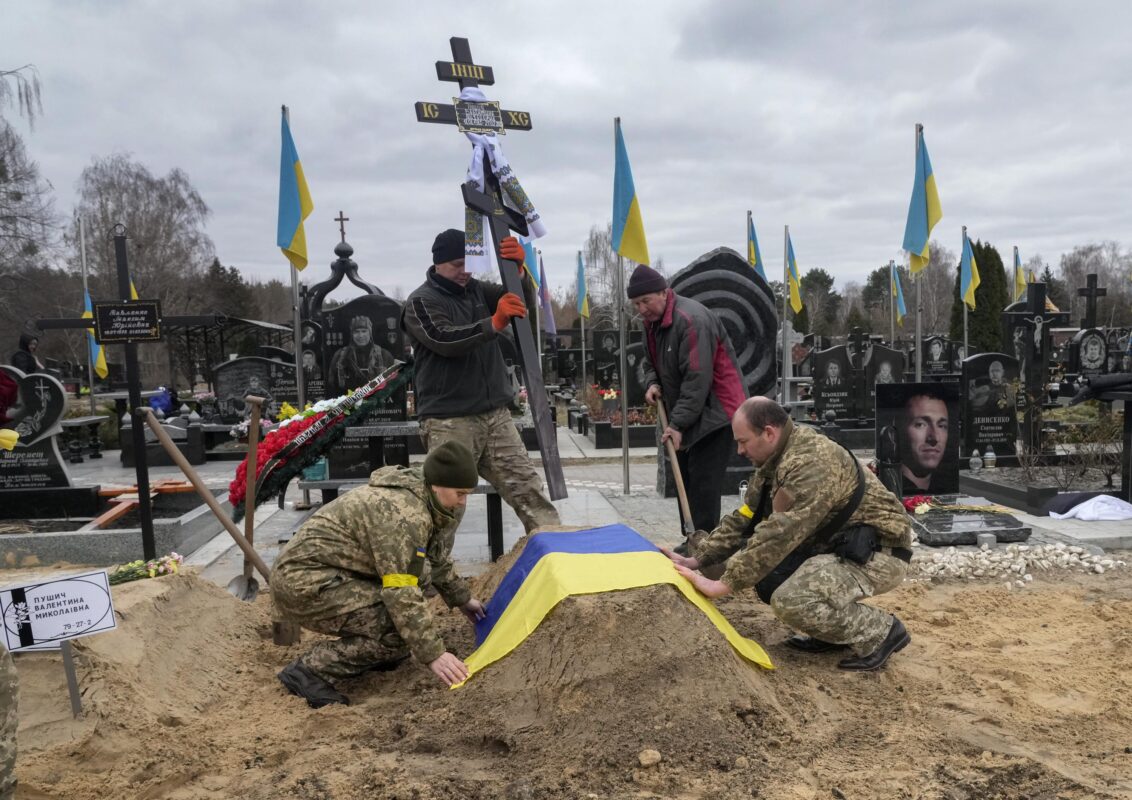
Most of the experienced younger officers, captains and majors and the senior sergeants that were the backbone of the Ukrainian army will by now be dead. Together with the high material losses and high troop casualties the Ukrainian army has taken this will make it less and less capable of any organized maneuver or resistance.
All that is left is Ukrainian cannon fodder which Russian artillery eats up with enormous ferocity.
The details of the peace deal presented today by US special envoy Steve Witkoff are consistent with the report in the Financial Times discussed in my previous article and with Larry Sparano in the posted interview. Putin will halt the Russian advance prior to driving Ukrainian soldiers out of all of the territory that has been reincorporated into Russia. It appears to be the case that the borders between Russia and Ukraine will be the current front line, so Putin is withdrawing Russia’s claim to the Russian territories still under Ukrainian occupation.
Russia and the US seem near a Ukraine peace deal. Kyiv’s role may be moot.
President Donald Trump’s hopes of securing a quick Ukraine peace deal hang in the balance after Washington’s envoy, Steve Witkoff, held his fourth Kremlin meeting with Russian President Vladimir Putin Friday.